The Jakarta Post
Please Update your browser
Your browser is out of date, and may not be compatible with our website. A list of the most popular web browsers can be found below.
Just click on the icons to get to the download page.


Popular Reads
Top Results
No results found. Please check your search term and try again
Can't find what you're looking for?
View all search results
Popular Reads
Top Results
No results found. Please check your search term and try again
Can't find what you're looking for?
View all search resultsTrump administration bans new Chinese humanoid robots
Change text size
Gift Premium Articles
to Anyone
Share the best of The Jakarta Post with friends, family, or colleagues. As a subscriber, you can gift 3 to 5 articles each month that anyone can read—no subscription needed!
 Set as preferred source
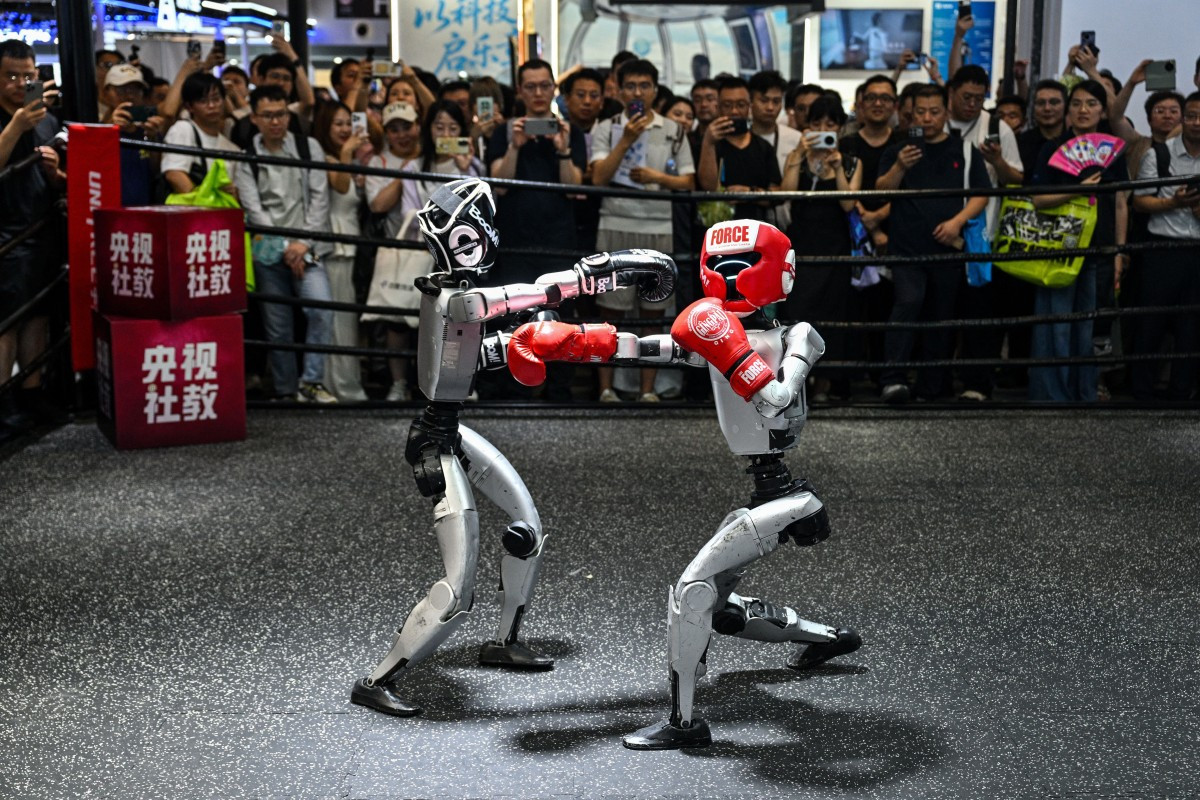 Humanoid robots controlled by a remote control by Unitree Robotics take part in a fight during the World Artificial Intelligence Conference (WAIC) in Shanghai on July 18, 2026. (AFP/Hector Retamal)
T
he Trump administration on Tuesday unveiled bans that target imports of new Chinese robots and power inverters, seeking to protect the US AI buildout from national security threats and reshore key industries slated for explosive growth.
The Federal Communications Commission on Tuesday afternoon released the measures, which bar Chinese imports of new humanoid and quadruped robots, in addition to connected power inverters, which enable renewable energy sources and batteries to connect to grids and data center equipment.
The restrictions, as first reported by Reuters, show the Trump administration is aiming to safeguard the US artificial intelligence supply chain from Chinese threats of disruption, data theft and cyberattacks, while also driving firms to shift manufacturing to the US.
"These devices could create supply chain vulnerabilities that could disrupt US economic and national security and could create a cybersecurity risk that threatened American critical infrastructure," the FCC said in a statement. "The FCC will continue to do our part to secure America’s critical supply chains," FCC Chairman Brendan Carr added in the press release.
The Chinese embassy in Washington said Beijing "urges the United States to heed the objective and rational voices of the business communities in both countries" and "stop smearing Chinese companies and threatening them with sanctions."
China's government will "take all necessary measures in response to any action that causes material harm to its interests," the embassy said.
Some analysts forecast broad adoption of humanoid robots, topped with AI-enabled "brains," in consumer and industrial arenas, while explosive data-center construction in the US will depend on reliable sources of inverters.
Treasury Secretary Scott Bessent has warned that Chinese AI firms could face US sanctions for stealing US intellectual property.
US officials are also keen to avoid another scenario as happened with rare earth minerals – critical inputs for tech manufacturing so dominated by China that Beijing has been able to leverage access to them to secure big wins on the international stage.
FCC likely to exempt non-Chinese suppliers
Following Tuesday's actions, the FCC is expected to exempt many non-Chinese suppliers from the restrictions, as it has done with recent bans on foreign drones and routers, four additional sources said.
The measures, which went into effect upon publication, apply only to robot and inverter models that have not yet been released. However, the FCC has the authority to revoke authorizations for sales of models that have already been authorized for purchase in the United States.
President Donald Trump is credited with bringing international attention to the tech threat posed by China during his first term, giving voice to concerns about intellectual property theft by Chinese firms, and the threat of state-sponsored spying by Chinese telecom juggernauts like Huawei.
But he has so far taken a much more dovish approach during his second term, faced with Beijing's aggressive use of export controls on rare earth minerals last year.
Chinese robot maker in crosshairs
The robot ban is expected to hit Unitree, a world leader in humanoid robots with just under a fifth of global market share, according to Counterpoint Research.
The firm, which is one of three Chinese companies dominating the nascent but buzzy industry, was recently added to the Pentagon's list of alleged Chinese military-backed companies, which can be a harbinger of tougher US action.
Unitree recently formed a partnership with Nvidia to use the AI chip company's cutting-edge Blackwell chip to power the brain of a Unitree robot. Nvidia has said data from the robots will remain in the US and that Unitree's biggest customers are US academic and research institutions.
China hawks fear the robots could spy on key US industries, extracting data and sending it to Beijing or disrupting critical functions.
Robots "collect data that could be leveraged by malign actors to surveil Americans, enhance the capabilities of foreign intelligence services, or to remotely commandeer the robots," the FCC said on Tuesday.
US Representative John Moolenaar, a Michigan Republican who chairs the House Select Committee on China and has proposed legislation targeting Chinese robots for national security reviews and potential bans, said the FCC move "protects our country and strengthens our nation’s robotics industry."
China is the world’s largest maker of inverters, led by Sungrow Power Supply and Huawei, already heavily sanctioned by the US Beijing has been expanding its share in the Western inverter market by driving down prices.
Reuters previously reported that the FCC was working on a Chinese inverter ban prompted by recent action by Europe and concerns around disruption and installation of malware.
Authorities want to avoid another Chinese government-linked hacking campaign like the one dubbed Volt Typhoon, revealed in 2023. By taking control of privately owned routers, the attackers sought to hide subsequent attacks on American critical infrastructure.
The US Department of Defense is already barred from procuring solar photovoltaic cells, modules or inverters manufactured by a foreign entity of concern, which would include Chinese companies.
Unitree, Sungrow and Huawei did not immediately respond to requests for comment.