The Jakarta Post
Please Update your browser
Your browser is out of date, and may not be compatible with our website. A list of the most popular web browsers can be found below.
Just click on the icons to get to the download page.


Popular Reads
Top Results
No results found. Please check your search term and try again
Can't find what you're looking for?
View all search results
Popular Reads
Top Results
No results found. Please check your search term and try again
Can't find what you're looking for?
View all search resultsRhine water level falls to new lows, halting sailings at chokepoint
German companies report growing disruption from Rhine water levels that have hit a series of record lows.
Change text size
Gift Premium Articles
to Anyone
Share the best of The Jakarta Post with friends, family, or colleagues. As a subscriber, you can gift 3 to 5 articles each month that anyone can read—no subscription needed!
 Set as preferred source
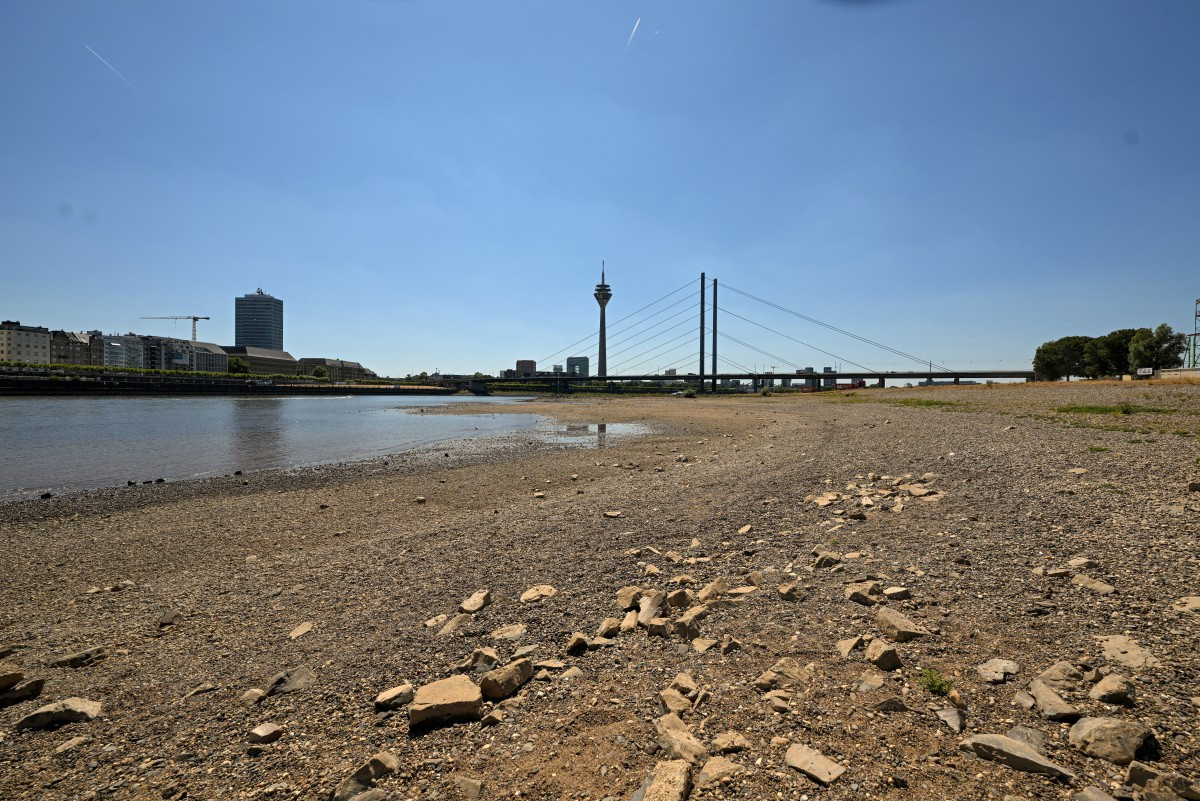 The partially dried-up river bed of the Rhine is pictured in Duesseldorf, western Germany, on July 28, 2026, following exceptionally hot weather. (AFP/Ina Fassbender)
The river Rhine in Germany has fallen to new lows, stranding cargo vessels, the country’s inland navigation agency said on Wednesday, as Europe has entered another heatwave.
German companies report growing disruption from Rhine water levels that have hit a series of record lows.
Chemical producers, utilities, steelmakers and agricultural traders have warned of higher costs, transport bottlenecks and curbed production.
Inland navigation agency WSV said the navigable water depth at the chokepoint of Kaub near Koblenz was 12 centimetres (4.72 inches) on Wednesday, below the previous lowest recorded level of 25 cm in 2018. The river is about 1 metre deeper than the navigable depth.
Most vessels cannot sail either north or south through Kaub so north/south river navigation is effectively stopping at this point, one commodity trader said.
The trader said some vessels were returning north to seek work and others were trapped south of Kaub.
Loads have to be spread among vessels to prevent them running aground in shallow water, and sailings on northern sections of the river continue often only 20 percent full, traders said.
River shipping and logistics operator RheinCargo said it was organising additional rail freight transport of raw material supplies to the Duisburg steel producer Huettenwerke Krupp Mannesmann GmbH, or HGK, part of the Salzgitter group.
“Under normal circumstances, HGK Dry Shipping transports around 24,000 (metric) tons of coal and ore per day from Rotterdam to Duisburg,” HGK said. “However, because of the current low water levels, only about 14,500 tons per day can presently be moved by inland waterways.”
HGK associate RheinCargo will initially operate three weekly freight train round trips between Rotterdam and Duisburg, western Germany, until the end of September with each train transporting around 2,000 tons of coal for the steelworks.
On Monday, an industry group warned that parts of the Rhine river in Germany could soon become unnavigable as water levels drop further due to soaring summer temperatures and low rainfall.
Cargo ships have managed to continue transporting goods along the waterway, which flows through the industrial heartland of Europe's top economy, albeit with reduced loads and at higher costs.
But the BDB association of inland shipping warned the water level at the town of Kaub -- used as a reference point for vessels plying the waterway -- is expected to fall even further this week.
"With water levels this low, commercial shipping will no longer be able to transport goods in the region," the group's managing director Jens Schwanen told the Rheinische Post newspaper.
"In principle, this means the Rhine is no longer continuously navigable and thus divided in two."
There would still be shipping on the river in the Netherlands and in Germany up to around Cologne, and further south on several tributaries, he said.
But water levels along much of the Rhine in Germany would be too low for vessels to pass.
A spokeswoman for the WSV agency responsible for managing German waterways told AFP that "water levels are expected to continue to fall slightly over the coming days".
There are no bans on shipping, however, she added, and it was up to the individual captains to decide how to adjust their cargoes to adapt to the lower waters.
Asked about the BDB's warning, a transport ministry spokesman said that the government was "monitoring very closely whether the situation will turn out as described in that scenario".
The Rhine originates in the Swiss Alps, flows through and along the borders of several countries, and empties into the North Sea in the Netherlands.
Problems on the Rhine have already prompted some German companies, including steelmaker Thyssenkrupp and chemical giant BASF, to use shallow-draft ships to continue transporting raw materials and finished products.
A halt to shipping on parts of the key economic artery would deal yet another blow to Germany's economy, already battling problems ranging from the Iran war energy surge and US tariffs.
Chancellor Friedrich Merz's government is weighing help for companies who transport goods via the river, including the chemical and oil sectors, and has agreed with some states to temporarily lift a ban on trucks driving on Sundays and public holidays.