The Jakarta Post
Please Update your browser
Your browser is out of date, and may not be compatible with our website. A list of the most popular web browsers can be found below.
Just click on the icons to get to the download page.


Popular Reads
Top Results
No results found. Please check your search term and try again
Can't find what you're looking for?
View all search results
Popular Reads
Top Results
No results found. Please check your search term and try again
Can't find what you're looking for?
View all search resultsAfrica bigger, US smaller: UN adopts new map
The new map, known as the Equal Earth cartographic projection, improves "the accuracy of the cartographic representation of the world," the resolution said.
Change text size
Gift Premium Articles
to Anyone
Share the best of The Jakarta Post with friends, family, or colleagues. As a subscriber, you can gift 3 to 5 articles each month that anyone can read—no subscription needed!
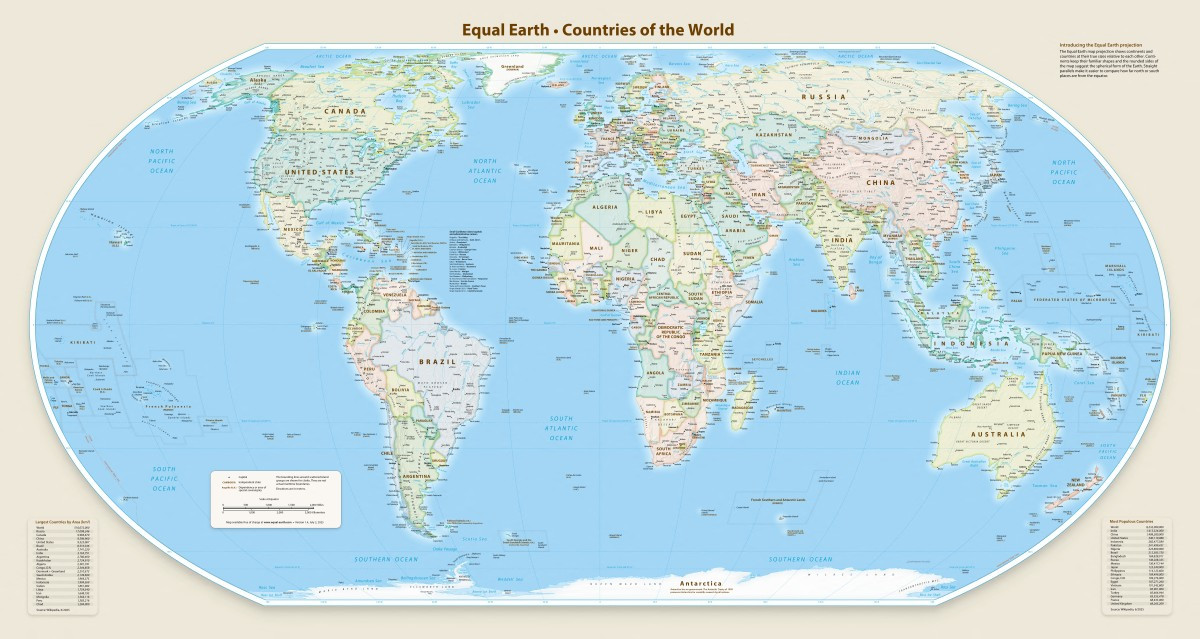 This handout graphic provided by Equal Earth shows the Equal Earth cartographic projection. The United Nations General Assembly voted on Sept. 4, 2026, to back a resolution spearheaded by several African countries to adopt a map that makes their continent bigger while shrinking North America and Europe, which aimed at “a more accurate representation“ of continental landmasses. (AFP/Handout/Equal Earth)
T
he United Nations General Assembly voted Friday to adopt a new world map that makes the African continent bigger while shrinking North America and Europe, drawing ire from Washington.
Aimed at "a more accurate representation" of continental landmasses, the resolution was supported by 164 countries while the United States voted against it and six other states abstained.
The new map, known as the Equal Earth cartographic projection, improves "the accuracy of the cartographic representation of the world," the resolution said.
It urges member states to use the new map in place of the traditional Mercator projection, which was designed for maritime navigation by Flemish cartographer Gerardus Mercator in 1569.
Foreign Minister Robert Dussey of Togo, which sponsored the resolution, said maps "guide education, nourish the imagination, and influence collective perceptions."
"They are therefore never neutral; when they present a distorted image of our planet, they risk perpetuating inaccurate representation that is passed down through generations."
The US however slammed the resolution, saying such moves are "the reason this institution is losing its credibility."
"Instead of focusing on genuine problems [...] this body is debating map projects from the 16th century and their role in promoting reparations and cognitive justice," US representative Yaryna Ferencevych said ahead of the vote.
The Mercator projection focused on accurate depictions of the shapes and angles of land masses, but their relative sizes were often inaccurate, largely due to the challenge of rendering a three-dimensional globe onto a two-dimensional map.
It inflated northern regions and compressed equatorial ones, making Europe and North America appear much larger, while shrinking Africa and South America.
A group of cartographers launched the Equal Earth projection in 2018. It makes Africa, Latin America, South Asia and Oceania appear much larger.
"Equal Earth preserves the relative surface areas of continents and, as much as possible, shows their shapes as they appear on a globe," one of the cartographers, Bojan Savric, told AFP in 2025.
France, which co-sponsored the resolution in support of the new map, announced Friday that it would abandon the Mercator projection.
In that map, "the [US], Russia and China take on a disproportionate visual prominence compared to Africa, Latin America or southeast Asia," while "Greenland appears almost as big as Africa," Foreign Minister Jean-Noel Barrot said.
"Changing maps obviously doesn't change the world," he said. "But correcting a distorted representation is already an act of truth."
The initiative comes as France is seeking to improve relations with Africa, particularly in former colonies with which it has prickly ties.