The Jakarta Post
Please Update your browser
Your browser is out of date, and may not be compatible with our website. A list of the most popular web browsers can be found below.
Just click on the icons to get to the download page.


Popular Reads
Top Results
No results found. Please check your search term and try again
Can't find what you're looking for?
View all search results
Popular Reads
Top Results
No results found. Please check your search term and try again
Can't find what you're looking for?
View all search resultsPoll shows rising trust in global institutions, less comfort with US as global leader
The survey, commissioned by the Rockefeller Foundation and conducted in 34 countries from July 21 to August 5, reflected a grim view of economic developments and security challenges, with nearly 70% saying the world had gotten worse over the past year.
Change text size
Gift Premium Articles
to Anyone
Share the best of The Jakarta Post with friends, family, or colleagues. As a subscriber, you can gift 3 to 5 articles each month that anyone can read—no subscription needed!
 Set as preferred source
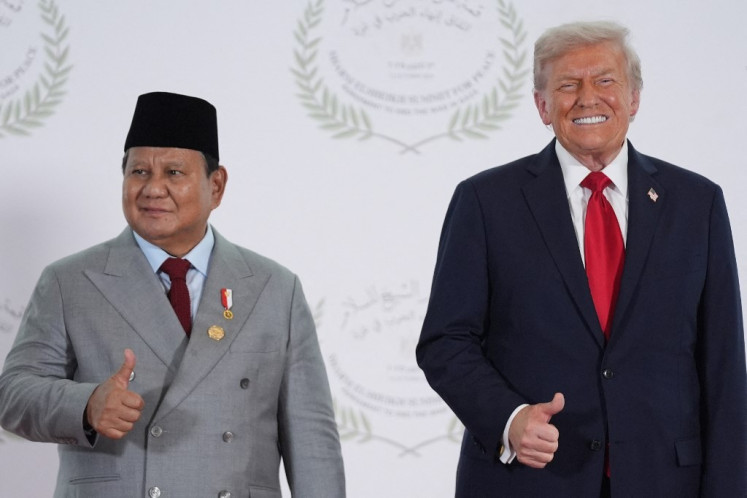
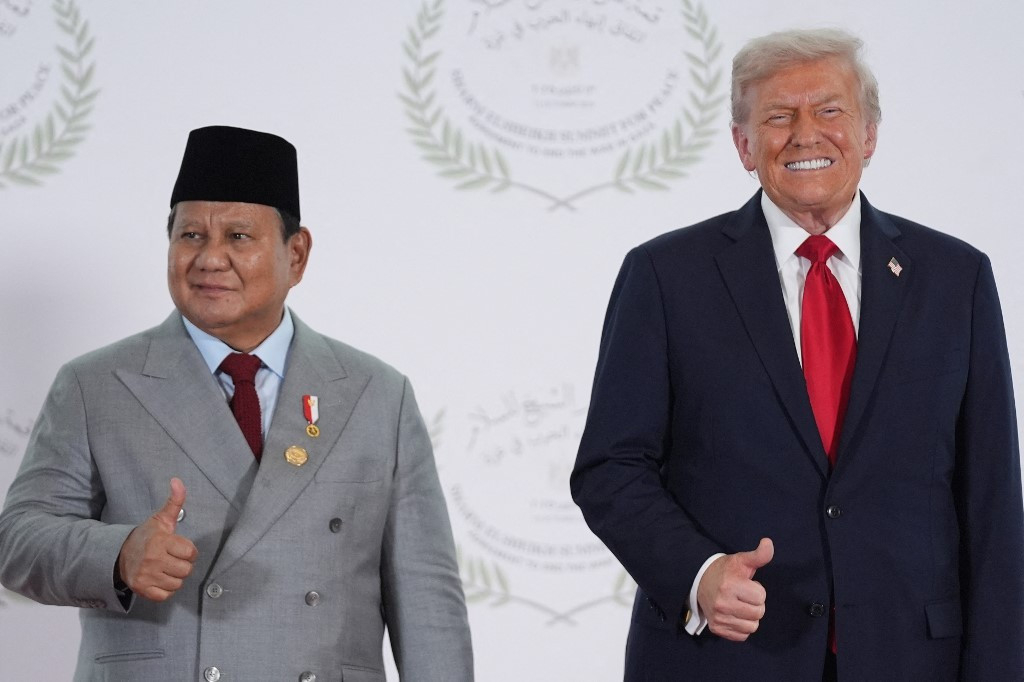 US President Donald Trump greets President Prabowo Subianto during a summit on Gaza in Sharm el-Sheikh on October 13, 2025. Trump landed in Egypt on October 13 for a summit on Gaza, following a lightning visit to Israel after a ceasefire he brokered entered into force. (AFP/Evan Vucci)
A
new poll of over 35,000 people worldwide shows continued support for global cooperation and rising trust in international institutions, but less comfort with the United States or China taking leadership roles. In fact, many view both as a threat.
The survey, commissioned by the Rockefeller Foundation and conducted in 34 countries from July 21 to August 5, reflected a grim view of economic developments and security challenges, with nearly 70% saying the world had gotten worse over the past year.
Only 38% of those surveyed felt their national economies would improve over the next five years, with optimism down sharply in two of the largest economies. Optimism fell 26 percentage points in India to 50% and 16 points in China to 56%.
Despite widespread pessimism, 57% of those surveyed said countries should cooperate to solve global challenges such as security even if it means compromising on some national interests. That's up from 55% in last year's survey.
The poll, released ahead of next week's United Nations General Assembly in New York, comes after nearly seven months of war in the Middle East that has upended global energy markets, lowered economic growth and fueled inflation. That followed a year of turmoil sparked by sweeping tariffs imposed by U.S. President Donald Trump on imports from nearly every country.
The United States and Israel launched their war against Iran on February 28, followed by Tehran's subsequent closure of the Strait of Hormuz, which had carried 20% of the world's oil. The conflict has spread to other countries, including Lebanon, Yemen and Saudi Arabia, adding more upward pressure on oil prices.
The poll showed that the people surveyed were not comfortable with the United States or China as a global leader, and 61% supported countries working together without the participation of either of the world's two largest economies.
Canada received the highest level of comfort for taking a leading role in world affairs at 60%, followed by Japan (58%) and Australia (55%). The European Union and Britain were closely behind, with 55% and 54%, while the United Nations stood at 52%.
By contrast, just 39% were comfortable with the United States taking a leading role and 37% with China. Russia was viewed even more negatively, with just 26% comfortable.
Eric Pelofsky, vice president of the Rockefeller Foundation, said the poll results showed the "middle powers" approach championed by Canadian Prime Minister Mark Carney had real credibility globally. Carney has also called the war in the Middle East a failure of the global order.
"It reflects a deep erosion in global leadership" for the United States, he said. "People are discussing solutions to global problems and are no longer asking what do the Americans think. That's a gut punch."
Views differed sharply in developing and advanced economies, with 53% of developing countries comfortable with China, against 23% in wealthier nations. Russia had a 27-point gap and the United States 17 points. The question was not asked in 2025.
International institutions saw their results rise over the past year. Trust in the World Health Organization rose to 69% from 61%, while the U.N.'s score rose to 62% from 58%.
The World Bank, International Monetary Fund and International Criminal Court, which all got failing grades in last year's survey, saw the biggest gains.
Trust in the World Bank rose to 55% from 46%, the International Monetary Fund edged to 51% from 43% and the ICC scored 54%, up from 48% last year. The World Trade Organization scored 57%, up from 50%.
Excluding assessment of respondents' own country, 42% viewed Russia as a major threat, compared with 34% for the U.S. and 30% for China. Russia was the most widely named country of concern in 14 countries, with the highest rates recorded in Europe.
The United States was seen as the greatest threat in 15 countries, with the highest percentages seen in Indonesia (73%), Brazil (59%), Mexico (58%) and Turkey (57%).