The Jakarta Post
Please Update your browser
Your browser is out of date, and may not be compatible with our website. A list of the most popular web browsers can be found below.
Just click on the icons to get to the download page.


Popular Reads
Top Results
No results found. Please check your search term and try again
Can't find what you're looking for?
View all search results
Popular Reads
Top Results
No results found. Please check your search term and try again
Can't find what you're looking for?
View all search resultsAs Americans vote, Trump says US will stop $4 billion in aid to Israel
US President Donald Trump said he had made a deal with Israeli Prime Minister Benjamin Netanyahu that Washington would stop US$4 billion in annual funding to Israel after this year, but will still sell weapons to its close Middle East ally.
Change text size
Gift Premium Articles
to Anyone
Share the best of The Jakarta Post with friends, family, or colleagues. As a subscriber, you can gift 3 to 5 articles each month that anyone can read—no subscription needed!
 Jim Watson/ AFP
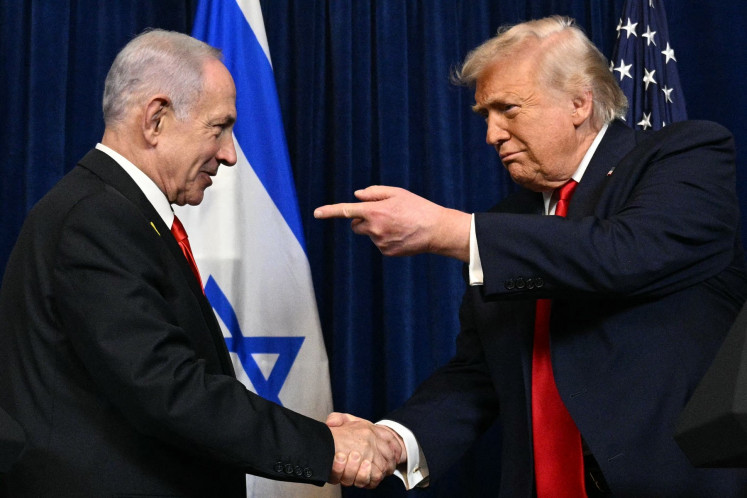
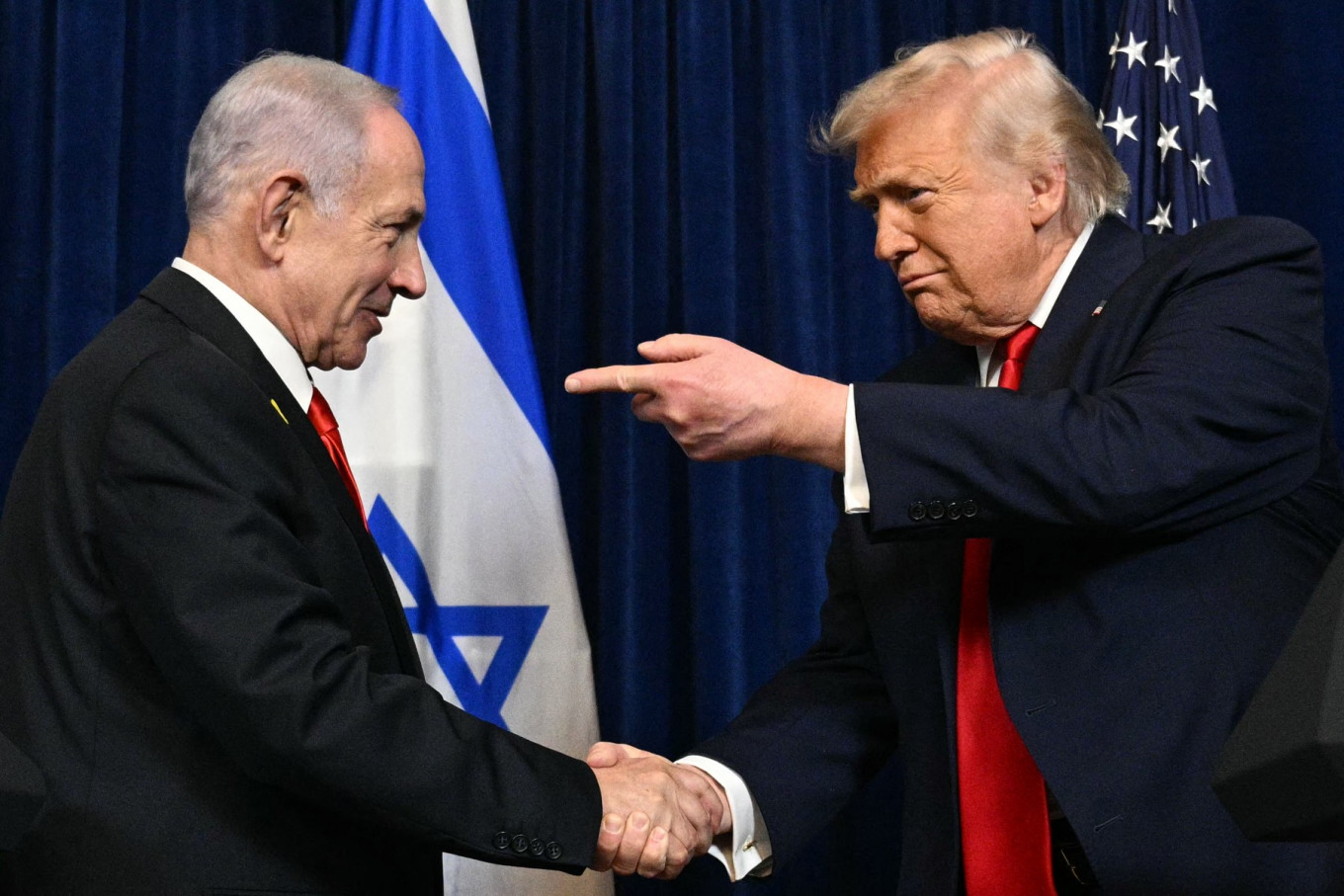
In this file photo, US President Donald Trump (right) and Israeli Prime Minister Benjamin Netanyahu shake hands as they arrive to speak to journalists during a joint press conference at Trump’s Mar-a-Lago residence in Palm Beach, Florida, on December 29, 2025. Trump hosted Netanyahu in Florida on December 29 for crucial talks on moving to the next stage of the fragile Gaza truce plan.
(AFP/Jim Watson)
U
S President Donald Trump on Tuesday said he had made a deal with Israeli Prime Minister Benjamin Netanyahu that Washington would stop US$4 billion in annual funding to Israel after this year, but will still sell weapons to its close Middle East ally.
In a surprise announcement as US voters headed to the polls for midterm elections that will decide whether Trump's Republicans will lose control of Congress, he cast the move as partly meant to take away a "bad talking point" he said left-wing Democrats had used against Republicans over support for military assistance to Israel.
Trump did not provide details or explain how the funding would be halted at the end of the year, given that the Memorandum of Understanding that provides $3.8 billion in US military aid to Israel each year does not expire until September 2028.
But he seemed to acknowledge that aid to Israel, no longer the solid source of bipartisan consensus it had been for decades, had become a political liability for him among some voters. Analysts suggested his declaration was timed as an Election Day ploy.
Discussions have been under way on how Washington's assistance to Israel would evolve beyond 2028, and Netanyahu had already said he expects US aid to wind down over time.
Trump, however, appeared to signal that his mind was made up about what would mark a significant shift in US-Israel relations, even as the two countries remain in conflict with Iran more than eight months after jointly attacking the Islamic Republic.
Trump told Fox News' "Fox & Friends" program that Israel no longer needed the funding and that some Democrats and left-wing politicians were using the US financial support to Israel to criticize Republicans. Opinion polls show that the US public's overall support for Israel has declined mostly due to the Gaza war.
"Now, as far as paying Israel, Bibi Netanyahu and I have made a deal that we give Israel $4 billion a year, and we made a deal months ago that we're stopping," Trump said. "We've already agreed that by the end of this year we won't be paying Israel. Now we'll help Israel if they need it," he added.
Israel's future leadership is uncertain after an Oct. 27 election in which Netanyahu – who has allied himself closely to US Republicans – lost his governing majority but denied his opponents a clear path to unseat him. The results paved the way for what are expected to be protracted negotiations over a new government.
Neither the White House nor Netanyahu's office responded to Reuters' requests for comment.
But Gadi Eisenkot, the leader of the rival bloc seeking to oust Netanyahu, wrote on X: "The fact that the security establishment, along with Israeli citizens, is learning about a change in the strategic relationship framework through the media highlights just how much Benjamin Netanyahu's conduct poses a genuine danger. We can no longer rely on him and must replace him."
Criticism of Israel
US public support for Israel has fallen, particularly among Democrats, since Israel's harsh response in Gaza to a deadly Hamas-led cross-border attack in October 2023.
A Quinnipiac University poll in June found 48 percent of voters and 66 percent of Democrats believe the US is too supportive of Israel, up from 16 percent and 20 percent, respectively, when the question was first asked in 2017.
Polls and analysts say Democrats are likely to wrest control of the House of Representatives from Trump's Republicans in Tuesday's elections. Control of the Senate remains uncertain.
A number of candidates critical of Israel won Democratic primaries over the past year, and even moderate lawmakers have been increasingly willing to challenge longtime US support.
In a key battleground race, Democratic candidate Abdul El-Sayed is vying to represent Michigan in the Senate. El-Sayed, who would become the first Muslim to serve as a US senator, has opposed unconditional military aid to Israel.
Trump said the left used the US funding as a "signal of unfairness" and that he wanted to take away what he called an easy target. He specifically mentioned El-Sayed when explaining why he said Washington was stopping the money.
"Because they [Israel] don't need it, and because why should we suffer the slings from lunatics like an El-Sayed when they don't need it?" Trump said. "It's a bad talking point."
Some members of Trump's Make America Great Again movement have also become increasingly critical of Israel, accusing it of having misled the president – who campaigned on a promise to avoid foreign interventions – into believing Iran could easily be defeated. Polls show most Americans oppose the war, which has driven up US gasoline prices and pushed down Trump's approval ratings.
"The curious issue is timing," said Jon Alterman of the Center for Strategic and International Studies think tank in Washington. "Why did President Trump announce it on Election Day? And why did he announce it amid speculation that a major joint US-Israeli military strike against Iran may be days away?"
While some US supporters of Israel urged Trump to reconsider and instead phase out the funding gradually, US Representative Ro Khanna, a progressive Democrat from California, said on X that "Zero aid Israel" would be part of his party's agenda if it wins congressional control.
Republican US Representative Don Bacon told CNN, "What I really had heartburn about is the Israelis didn't know about it."
Congress passed a law in 2020 authorizing the funding for Israel, but the Senate and House must still pass appropriations bills every year to distribute and release the funds.
Netanyahu said in an interview with an Israeli television channel in October: "If you think we're going to continue receiving what I secured twice, and that's tens of billions of dollars in American aid for the defense budget, prepare yourselves and get used to the fact that it won't happen because America has changed."
In anticipation of the possible reduction of US financial support in the coming years, the US House this past summer passed a defense bill provision that would deepen US-Israeli military technology ties. The provision of the 2027 National Defense Authorization Act, known as Section 219, envisions a much deeper defense cooperation between the two countries. Dozens of NGOs have called the idea "exceptionally dangerous" and urged US lawmakers to scrap it.