The Jakarta Post
Please Update your browser
Your browser is out of date, and may not be compatible with our website. A list of the most popular web browsers can be found below.
Just click on the icons to get to the download page.


Popular Reads
Top Results
No results found. Please check your search term and try again
Can't find what you're looking for?
View all search results
Popular Reads
Top Results
No results found. Please check your search term and try again
Can't find what you're looking for?
View all search resultsExpert: Fostering a culture of disaster preparedness key for a resilient society
Change text size
Gift Premium Articles
to Anyone
Share the best of The Jakarta Post with friends, family, or colleagues. As a subscriber, you can gift 3 to 5 articles each month that anyone can read—no subscription needed!
 Set as preferred source
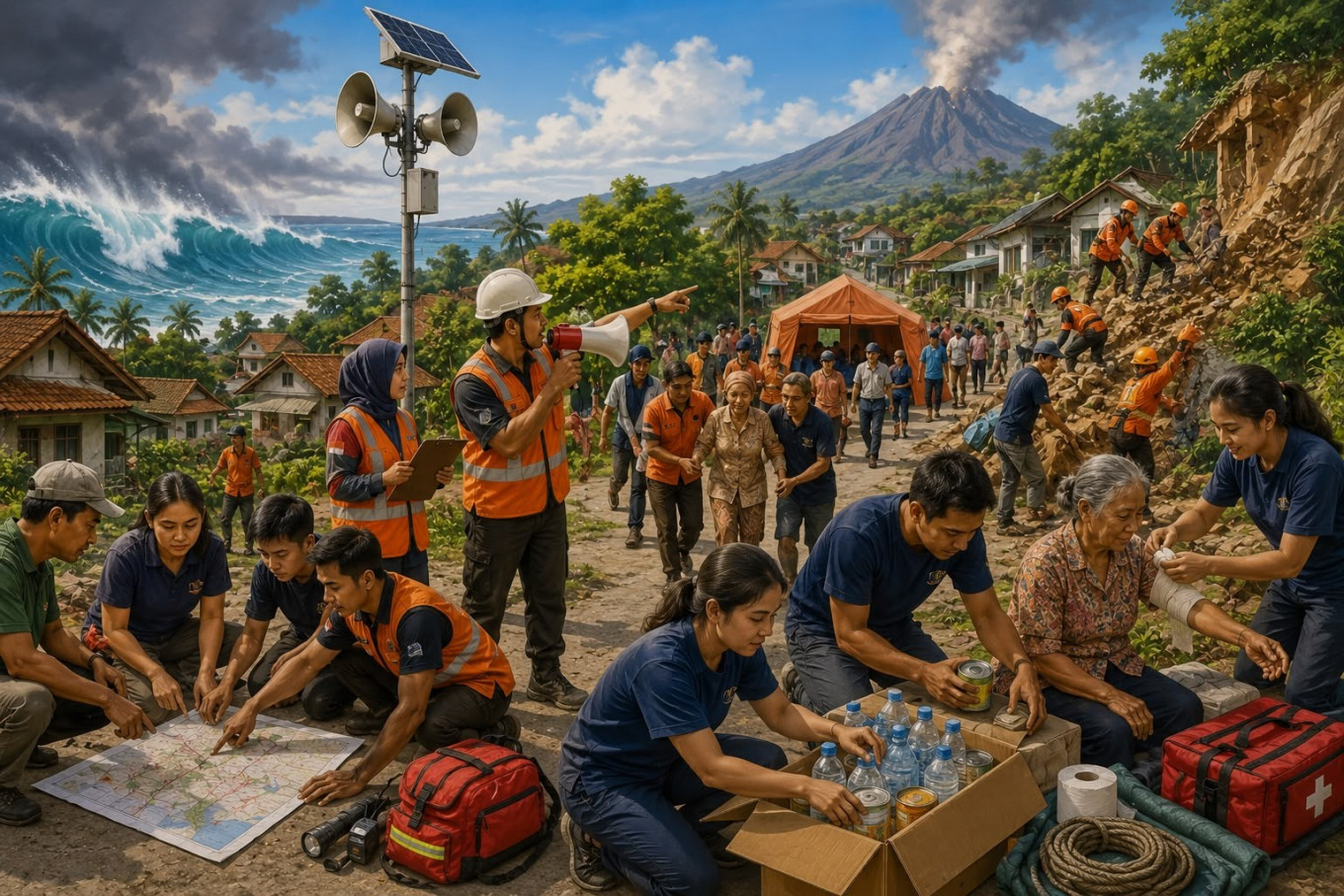 (Illustration generated by AI)
E
xperts have called for Indonesia to foster a culture of disaster preparedness in the wake of natural disasters that have occurred throughout the archipelago.
Ir. I Wayan Ariyana Basoka, S.T., M.Eng., Ph.D., a lecturer at Warmadewa University’s Faculty of Engineering and Planning, noted that Indonesia is located within the Pacific Ring of Fire and subject to equatorial monsoon patterns. In this sense, he continues, the archipelago's unique geology and climate require continuous public awareness, careful planning and proactive local engagement.
“While national institutions like the National Disaster Mitigation Agency (BNPB) steadily work to enhance early warning infrastructure, expand seismic monitoring systems, and strengthen regional coordination, the primary foundation of long-term safety lies within local neighborhoods,” he said, adding that community-level collaboration plays a crucial, indispensable role in ensuring that families remain safe, well informed and thoroughly prepared for any natural event.
Wayan pointed to the development of local volunteer first-responder teams as one of the most practical and effective forms of civic engagement, as residents, youth networks, and local civic leaders regularly work together to build practical, highly organized networks that champion public safety, education and mutual aid in rural villages and bustling urban neighborhoods alike.
During periods of intense weather or localized seismic activity, when immediate transport or municipal communication systems may experience temporary delays, he highlighted how localized teams can provide prompt, organized and practical assistance on the ground.
By drawing on their day-to-day knowledge of the neighborhood layout, trained volunteers help direct residents toward safe, well-lit gathering points, assist elderly neighbors who need extra mobility support and coordinate temporary shelter and essential food distribution.
“This deep-seated spirit of gotong royong, or traditional mutual cooperation, ensures that immediate care, practical assistance and steady reassurance are readily available right at the community's doorstep.”
Beyond immediate support during active weather, Wayan also explained how neighborhood groups lead valuable, everyday mitigation and safety initiatives throughout the year.
During fair weather periods, volunteers organize routine workshops to help households review family emergency plans, map clear evacuation paths and host regular safety walks through high-priority areas. In addition, they also spearhead vital environmental stewardship projects that protect local ecosystems such as planting deep rooted native trees along hillsides to strengthen soil stability, organizing neighborhood cleanup drives to maintain clear, unblocked drainage channels and keeping local digital channels updated with reliable, real-time weather and geological updates.
By taking proactive measures, local volunteer teams can bridge the gap between national government policy and individual household readiness, where hands-on involvement turns potential vulnerability into shared confidence, practical knowledge and widespread self-reliance.
Ultimately, Wayan emphasized that strengthening Indonesia’s national resilience is not merely managing environmental risk, but actively empowering people in their own backyards.
“By supporting grassroots volunteer networks, fostering clear and accessible communication, and continually nurturing community solidarity, Indonesia can strengthen its approach to building safer, stronger, and far more resilient neighborhoods for everyone,” he concluded.