The Jakarta Post
Please Update your browser
Your browser is out of date, and may not be compatible with our website. A list of the most popular web browsers can be found below.
Just click on the icons to get to the download page.


Popular Reads
Top Results
No results found. Please check your search term and try again
Can't find what you're looking for?
View all search results
Popular Reads
Top Results
No results found. Please check your search term and try again
Can't find what you're looking for?
View all search resultsAsian markets down as data shows China trade weak
Change text size
Gift Premium Articles
to Anyone
Share the best of The Jakarta Post with friends, family, or colleagues. As a subscriber, you can gift 3 to 5 articles each month that anyone can read—no subscription needed!
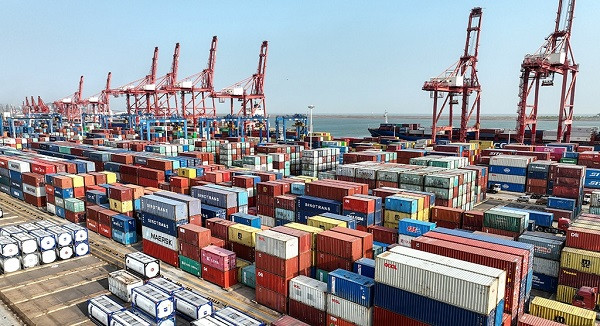 Cranes and shipping containers are seen at Lianyungang port in China's eastern Jiangsu province on April 13, 2023. (AFP/Getty Images)
A
sian share markets were mostly weaker on Tuesday as investors digested weaker Chinese trade data ahead of key inflation readings from China and the United States to deliver an updated outlook on the health of the global economy.
MSCI's broadest index of Asia-Pacific shares outside Japan was down 0.7 percent on Tuesday, after US stocks ended the previous session with mild gains. The index is down 2.9 percent so far this month.
The yield on benchmark 10-year Treasury notes rose to 4.0885 percent compared with its US close of 4.078 percent on Monday. The two-year yield, which rises with traders' expectations of higher Federal Reserve fund rates, touched 4.7682 percent compared with a US close of 4.758 percent.
Data showed China's imports contracted at 12.4 percent in July, missing forecasts for a drop of 5 percent, while exports fell 14.5 percent, compared with a fall of 12.5 percent tipped by economists.
Hong Kong's Hang Seng Index started to recover some ground lost earlier in the day, but was still down 1.26 percent after opening 1.73 percent in the red.
Sentiment rebounded in China as the blue chip CSI300 index turned positive to be up 0.07 percent after initially losing 0.54 percent.

Australian shares were up 0.15 percent, while Japan's Nikkei stock index rose 0.29 percent after early trading up by nearly 0.8 percent.
The mixed day in Asia follows a stronger night in US markets.
On Wall Street, the Dow Jones Industrial Average rose 1.16 percent, the S&P 500 gained 0.90 percent and the Nasdaq Composite added 0.61 percent.
Global investors are keenly awaiting inflation readings from China on Wednesday and the US on Thursday, expecting them to show stark differences in price movement in the world's two biggest economies.
US inflation likely accelerated slightly in July to an annual 3.3 percent, while the core rate was likely unchanged at 4.8 percent, according to a Reuters poll of economists. ANZ predicts China's July consumer price index to come in at minus 0.4 percent year-on-year.
"The Fed is wary of upside risks to elevated inflation given demand for labor remains excessive, and most policy makers think the policy rate will need to be kept restrictive," ANZ economists wrote on Tuesday.
"Weak inflation in China should be a global disinflationary force in goods markets going forward."
The prospect of economic stimulus from China's central government to reinvigorate a soft economy is still being contemplated by investors. Minor measures to help property markets have been delivered in the past fortnight, but no broad stimulus has been outlined.
"While awaiting ominous signs of deflation, markets are torn between economic gloom and hopes of resounding stimulus that is set to re-ignite China's growth," Mizuho economists said.
"We are however unconvinced that Beijing's stimulus efforts will achieve intended 'lift-off' for the still struggling economy."
The dollar rose 0.54 percent against the yen at 143.26. It is still some distance from its high this year of 145.07 hit on June 30.
The European single currency was down 0.2 percent on the day at $1.1002 while the dollar index, which tracks the greenback against a basket of currencies of major trading partners, was up at 102.29.
US crude ticked up 0.21 percent to $82.11 a barrel. Brent crude rose to $85.46 per barrel.
Gold was slightly lower with the spot price at $1934.1667 per ounce.