The Jakarta Post
Please Update your browser
Your browser is out of date, and may not be compatible with our website. A list of the most popular web browsers can be found below.
Just click on the icons to get to the download page.


Popular Reads
Top Results
No results found. Please check your search term and try again
Can't find what you're looking for?
View all search results
Popular Reads
Top Results
No results found. Please check your search term and try again
Can't find what you're looking for?
View all search resultsChina, Hong Kong stocks hit two-month lows but investors see buying opportunity
Change text size
Gift Premium Articles
to Anyone
Share the best of The Jakarta Post with friends, family, or colleagues. As a subscriber, you can gift 3 to 5 articles each month that anyone can read—no subscription needed!
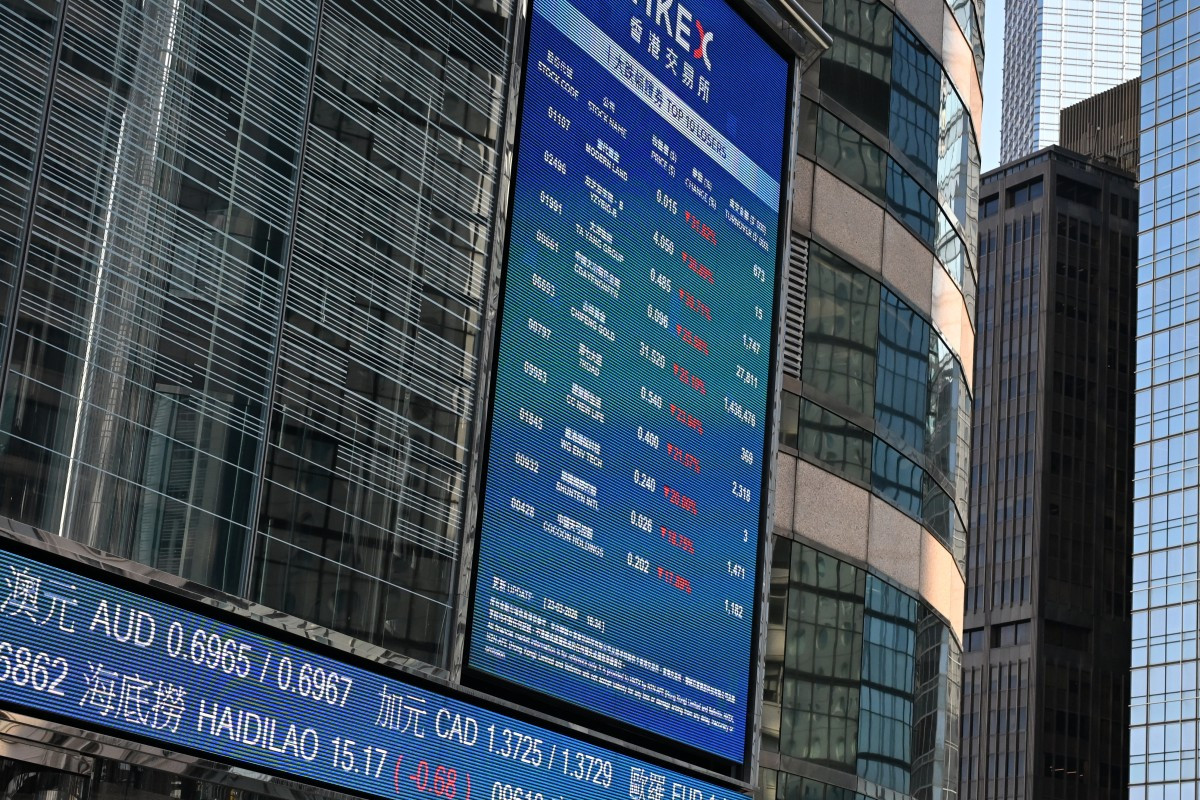 An electronic signboard shows the closing prices of stocks at the end of the day's trade outside the Hong Kong Exchanges and Clearing (HKEX) building in Hong Kong on March 23, 2026. (AFP/Peter Parks)
C
hina and Hong Kong stocks slid to their lowest levels in two months on Monday, tracking a global tech selloff, but pared losses by midday with some investors using the correction as a buying opportunity.
China's blue-chip CSI300 Index fell to its lowest level since April 16 at the open but trimmed losses to 1.7 percent by midday. The Shanghai Composite Index touched its lowest since April 8 before paring declines to 1.3 percent. In Hong Kong, the benchmark Hang Seng Index dropped 1.2 percent to its lowest level since late March.
Having experienced the March sell-off when the Iran war triggered a global market rout not long ago, market participants are more confident they will be able to ride out short-term volatility this time.
"The market opened lower as expected, and then performed much better than expectations," said Wu Zhou, fund manager at Shenzhen Deyuan Investment Co. "There's ample liquidity in the domestic market, and investors today are shifting money away from expensive stocks to relatively cheap ones, such as robotics."
Li Qiusuo, chief domestic strategy analyst at CICC, said in an investor call that the market remained in a short-term correction phase but noted the Shanghai Composite had now retraced most of its year-to-date gains, having risen more than 7 percent at its peak.
"The pace of the pullback should slow notably from here. At this point, there is no need to be overly concerned," Li said, adding that March 23 had presented a buying opportunity after the index broke below a key technical level.

Li forecast onshore A-share earnings growth of 6 percent this year, which would be the strongest in five years.
The CSI Robot Index rose 1.4 percent, bucking broader market declines, as a wave of domestic robotics firms, including Unitree, await public listings. Leader Harmonious Drive Systems surged more than 10 percent.
This year's tech rally in China has been driven largely by the chip supply chain, closely mirroring performances in global stocks such as Micron and Nvidia.
Shares of Zhongji Innolight, an Nvidia supplier of optical components and a bellwether for China's AI rally, fell 2 percent. The company has recently overtaken CATL as the biggest weight in China's CSI300 benchmark.
The tech-focused STAR50 Index fell 3.6 percent, while onshore semiconductor shares dropped 3.7 percent.
"The fundamentals of AI infrastructure remain solid. Both Jensen Huang and TSMC's C.C. Wei have indicated that future demand remains strong," said Zeng Wenkai, chief investment officer at Shengqi Asset Management. "This global selloff is simply a normal correction after substantial profit-taking. I believe this presents an excellent buying opportunity."
Wall Street's nine-week winning streak ended with a thud on Friday, as red-hot technology stocks suffered their largest one-day decline since April 2025 after a hot jobs report fueled fears of a hawkish policy pivot from the US central bank.
In Asia, South Korea's chip-heavy KOSPI and Japan's Nikkei fell roughly 5 percent and 4 percent by midday, respectively.