TheJakartaPost
Please Update your browser
Your browser is out of date, and may not be compatible with our website. A list of the most popular web browsers can be found below.
Just click on the icons to get to the download page.


Popular Reads
Top Results
No results found. Please check your search term and try again
Can't find what you're looking for?
View all search results
Popular Reads
Top Results
No results found. Please check your search term and try again
Can't find what you're looking for?
View all search resultsBeaten-down Indonesian stocks feel the love as AI rally cools
The reprieve comes at a fragile moment for Southeast Asia's biggest economy as the still-looming threat of a downgrade from index provider MSCI has made Jakarta stocks, Asia's worst-performing major stock market this year, down 28 percent.
Change text size
Gift Premium Articles
to Anyone
Share the best of The Jakarta Post with friends, family, or colleagues. As a subscriber, you can gift 3 to 5 articles each month that anyone can read—no subscription needed!
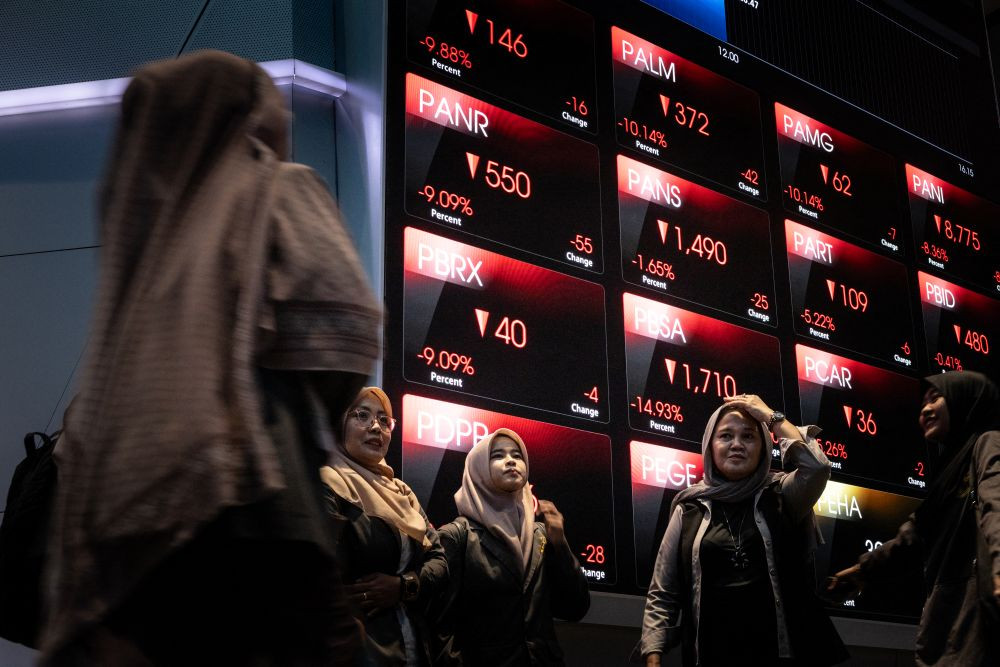 Momentous shot: A group of visitors takes a picture on Jan. 29, 2026 in front of a stock ticker display at the Indonesia Stock Exchange (IDX) in South Jakarta. (AFP/Yasuyoshi Chiba)
A
s the rally in AI stocks starts showing signs of fatigue and big investors turn sellers, some are buying back laggards and even warming to Indonesia's battered and unloved stock market.
The reprieve comes at a fragile moment for Southeast Asia's biggest economy as the still-looming threat of a downgrade from index provider MSCI has made Jakarta stocks, Asia's worst-performing major stock market this year, down 28 percent.
In contrast, shares in South Korea and Taiwan have surged due to a red-hot AI rally but recent worries about valuations and rebalancing needs have led investors to look at markets that are not as heavily tied to AI plays.

"We've been taking some profit in South Korea and buying Indonesia," said David Chao, Asia-Pacific global market strategist at Invesco in Singapore. "Indonesia is still probably the most under-looked macro growth story play."
Sentiment shifts
While still tentative, sentiment is growing that the worst may be over for Indonesian markets after more than US$4 billion in foreign outflows this year amid MSCI transparency concerns and fiscal worries.

"I would say a lot of the negativity is in the price already on the equity side," said Aninda Mitra, head of Asia macro and investment strategy at BNY Investments.
Mitra said that if price multiples cheapen even more and the rupiah stabilizes, despite concerns around the pending MSCI decision, "then I think there is a case to be made to start adding selectively."
Asset manager Allan Gray made its first investment in Indonesia last month, finding opportunity in Indofood Sukses Makmur, the holding company behind the country's dominant instant-noodle maker.
"On our estimates, INDF trades on just over five times earnings, which we believe is a good price to pay for a dominant, cash-generative, consumer-facing business," said Rory Kutisker-Jacobson, a portfolio manager at Allan Gray.
Banking and commodity firms are also once again popular among investors, with Citi preferring Bank Central Asia, Vale Indonesia, Alamtri Minerals and Amman Mineral International.
Investors looked for moves toward de-escalation in the Middle East while they waited for earnings reports due from major technology companies later in the week.

The Jakarta benchmark index is up more than 10 percent so far in July while tech-heavy indexes in the region have dropped sharply, suggesting some investors are starting to rotate into lagging markets.
The rebound has come despite little improvement in the concerns that triggered this year's selloff, including questions over Indonesia's fiscal discipline and uncertainty surrounding MSCI's review.
MSCI deadline
Indonesia has retained its emerging-markets status, with most analysts expecting MSCI to reaffirm that classification in November after extending its review to assess the impact of reforms that Jakarta regulators rolled out earlier this year.
S&P also helped calm investor nerves last week by reaffirming Indonesia's sovereign rating with a stable outlook.
Citi said Indonesia dominated client meetings in Hong Kong and Thailand earlier this month, with several investors sharing the bank's view that the stock market may have bottomed.
To be sure, not everyone is convinced that a cooling AI-driven rally will provide lasting support for Indonesian assets. Indonesia is also not the only market back in favor, with global investors revisiting Indian and Chinese equities.
The $1.4 trillion economy has been grappling with eroding investor confidence in President Prabowo Subianto's welfare policies as fears of worsening fiscal health leave the rupiah down nearly 8 percent this year, pinned at record lows.
As a net oil importer, higher oil prices during an Iran-related supply shock have added to concerns.
"Indonesia has become a structural downgrade for many global investors," said Arthur Budaghyan, chief emerging markets and China strategist at BCA Research. "The bar for these portfolios to upgrade Indonesia and allocate more capital to it has become very high."
Even so, the retreat by foreign investors has been gradual rather than a wholesale exit.
Copley Fund Research data shows more than half of active fund managers it tracks remain overweight on Indonesia although the percentage of funds invested in the country has dropped to 80.45 percent, a 15-year low.
"The structural case for Indonesia has not disappeared," the research firm said. "Indonesia is not a crowded trade in either direction [...] The cost of being wrong on a recovery is now arguably greater than the cost of further patience."