The Jakarta Post
Please Update your browser
Your browser is out of date, and may not be compatible with our website. A list of the most popular web browsers can be found below.
Just click on the icons to get to the download page.


Popular Reads
Top Results
No results found. Please check your search term and try again
Can't find what you're looking for?
View all search results
Popular Reads
Top Results
No results found. Please check your search term and try again
Can't find what you're looking for?
View all search resultsStability versus growth: Indonesia’s test in H2 2026
The real challenge facing policymakers in the second half of the year is not simply between stability and growth, but whether they can maintain the former toward the latter so as to nurture confidence in Indonesia's economy.
Change text size
Gift Premium Articles
to Anyone
Share the best of The Jakarta Post with friends, family, or colleagues. As a subscriber, you can gift 3 to 5 articles each month that anyone can read—no subscription needed!
 Set as preferred source
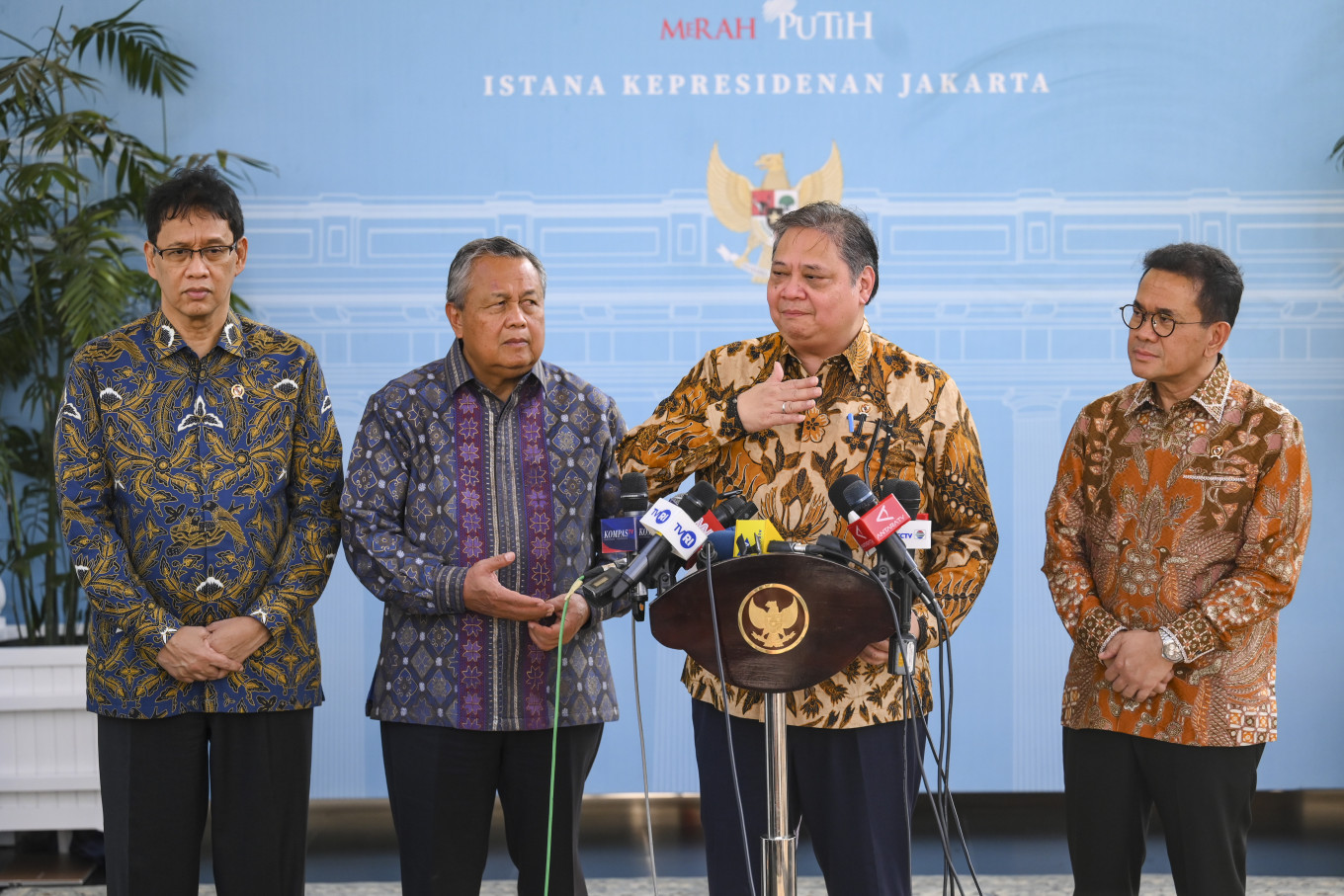 Coordinating Economy Minister Airlangga Hartarto (second right) addresses a press briefing on May 21, 2026, after attending a meeting chaired by President Prabowo Subianto at the Presidential Palace Complex in Central Jakarta. Accompanying him are (from left) Finance Minister Purbaya Yudhi Sadewa, former Bank Indonesia governor Perry Warjiyo and Trade Minister Budi Santoso. (Antara/Hafidz Mubarak A)
T
he early-August release of Indonesia’s second-quarter GDP growth will be an important checkpoint for the economy. The result will show whether the strong momentum recorded at the beginning of the year was sustained, or whether rising global and domestic pressures have started to weigh more visibly on economic activities.
Indonesia entered 2026 on relatively solid footing. Economic growth in the first quarter accelerated to 5.6 percent, above the post-pandemic average.
However, the external backdrop deteriorated rapidly. The United States-Iran war increased volatility in global financial and commodity markets. Higher oil prices raised concerns over imported inflation, production costs and fiscal pressures, while uncertainty over the direction of US monetary policy pushed global bond yields higher.
These developments strengthened the US dollar and encouraged investors to reduce exposure to emerging market assets. At the same time, several domestic developments put weight on investors’ confidence and added to capital outflow pressures. Concerns over fiscal policy, regulatory changes and policy coordination led investors to adopt a more cautious stance toward Indonesian assets.
These pressures were increasingly visible in Indonesia’s balance of payments. The current account deficit widened in the first quarter of 2026 to US$4 billion, equivalent to 1.1 percent of GDP. Meanwhile, the capital and financial accounts recorded a $4.9 billion deficit, reflecting capital outflow and an increase in the placement of financial assets abroad.
This combination of factors was reflected in the rupiah’s depreciation and the declining stock and bond markets. It also created a difficult policy environment ahead of the second half of the year.

The trade-off between stability and growth becomes more difficult when market volatility intensifies. Higher interest rates and tighter fiscal policy will have an impact on short-term activity, but allowing exchange rate instability and inflation expectations to become entrenched could impose much larger economic costs.
Former Federal Reserve chairman Alan Greenspan once stated that monetary policy should provide “a stable macroeconomic environment” to support sustainable long-term growth and allow financial markets to operate without excessive uncertainty.
For Indonesia, this means that in periods of heightened volatility, stability must remain the immediate priority. Protecting the rupiah, containing inflation and maintaining confidence in fiscal and monetary institutions are not objectives that stand in opposition to growth. Rather, they are necessary conditions for preserving growth over a longer horizon.
Against this backdrop, the monetary and fiscal responses have been broadly appropriate. Bank Indonesia has raised the BI-Rate by a cumulative 100 basis points, from 4.75 percent in April to 5.75 percent in June, to strengthen rupiah stability and contain the risk of imported inflation.
Fiscal policy has also become more selective, with several government programs reduced or reprioritized. Such adjustments can help preserve fiscal space and contain government bond supply risks.
However, they also potentially reduce the contribution of public spending to economic activities. Together with higher borrowing costs, tighter liquidity and weaker business confidence, this is likely to result in more moderate growth during the second half of 2026.
Stability-oriented policy does not always have to rely on conventional tightening. When the economic cost of another interest rate increase becomes substantial, policymakers can use more targeted instruments to achieve similar objectives with less negative spillovers to domestic growth.
Bank Indonesia’s July policy meeting provides an important example: The central bank maintained the policy rate at 5.75 percent.
Rather than implementing another rate hike, BI opted to expand hedging incentives aimed at attracting foreign portfolio inflows and strengthening the rupiah. The measures included raising the premium reduction incentive for foreign investors’ swap hedging transactions from 10 percent to 12.5 percent and extending a 15 percent incentive to domestic non-deliverable forward (DNDF) hedging transactions.
Reducing hedging costs improves the net risk-adjusted return available to foreign investors. In investors’ calculations, a lower hedging expense can partly replicate the attraction of a higher domestic yield.
Unlike another policy rate increase, however, the measure does not directly raise borrowing costs across the entire economy and is therefore more targeted. It provides an incentive for foreign investors to enter or maintain exposure to Indonesian assets while allowing the policy rate unchanged.
Ultimately, the effectiveness of monetary and fiscal policies will depend on confidence. High interest rates, foreign exchange intervention, hedging incentives and fiscal adjustments can stabilize markets temporarily. But sustainable stability requires investors, businesses and households to carry a perception that Indonesia’s economic fundamentals remain sound and that policy responses are proportionate, consistent and well-coordinated.
The country continues to have several underlying strengths: resilient domestic demand, a manageable current account deficit, a well-capitalized banking system and fiscal discipline anchored by the deficit ceiling. Nevertheless, these fundamentals must be supported by credible communication and consistent implementation.
Restoring investor confidence requires clear policy direction and stronger coordination among Bank Indonesia, the Finance Ministry, financial sector authorities and other government institutions.
Public confidence is equally important. Households and businesses need assurance that inflation will remain manageable, liquidity will be sufficient and policy changes will not create abrupt disruptions to income, employment or investment decisions.
Indonesia’s economic test in the second half of 2026 is therefore not simply whether policymakers choose stability or growth. The real challenge is whether they can protect stability in the near term while preserving the foundations for future growth that will also foster confidence in the economy.
*****
The writer is a senior economist at Bank Mandiri.