The Jakarta Post
Please Update your browser
Your browser is out of date, and may not be compatible with our website. A list of the most popular web browsers can be found below.
Just click on the icons to get to the download page.


Popular Reads
Top Results
No results found. Please check your search term and try again
Can't find what you're looking for?
View all search results
Popular Reads
Top Results
No results found. Please check your search term and try again
Can't find what you're looking for?
View all search resultsThe economics of running: When a free sport becomes big business
More than 500 running events are taking place in Indonesia and more than 200 cities in 2026, roughly five times the number recorded in 2022.
Change text size
Gift Premium Articles
to Anyone
Share the best of The Jakarta Post with friends, family, or colleagues. As a subscriber, you can gift 3 to 5 articles each month that anyone can read—no subscription needed!
 Set as preferred source
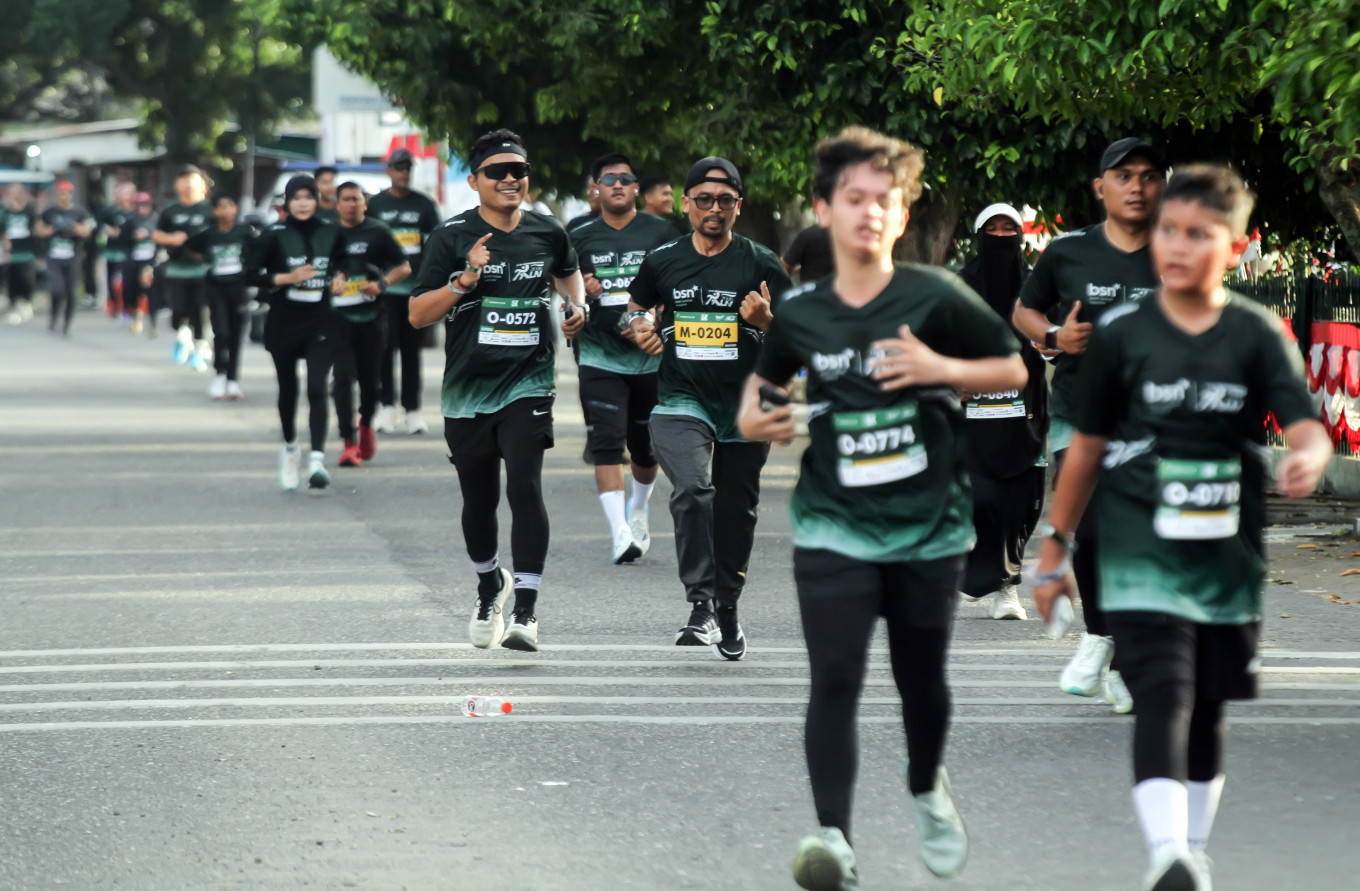 Participants run toward the finish line during the Lila Wangsa Run 2026 in Lhokseumawe, Aceh, Indonesia, Sunday, Aug. 9, 2026. (Antara/Rahmad)
T
here is something almost absurd about the economics of running. It is one of the few sports that costs almost nothing to start. You do not need a court, a membership, a ticket or even another person as a partner. All you really need is a pair of shoes and a road.
Yet running has become a surprisingly sophisticated consumer industry. People do not necessarily spend money on running itself. They spend money on everything that comes with it, from race registrations, running shoes, apparel, smartwatches and health and wellness products to hotels, transportation, restaurants and even weekend trips built around a race.
The sport may be free, but the experience is not. And that experience is becoming big business.
The global running events market was estimated at around US$2.8 billion in 2025 and is expected to nearly double over the next decade, according to a Marathon Events Market report by consulting firm DataIntelo. Marathon tourism, in which people travel across cities or countries specifically to run, is estimated at around $5.8 billion. The global running shoe market, meanwhile, was already worth roughly $19.5 billion to $26 billion last year.
Demand is becoming increasingly difficult to satisfy. More than 1.3 million people entered the ballot for the 2027 London Marathon, setting a world record. In New York, races organized by New York Road Runners generated an estimated $934 million in additional spending for the city last year.
The reason is straightforward: running moves people and people move money. A gym member can spend most of their money inside a single facility. A runner traveling to another city takes their spending with them. They need a hotel, transportation, meals and, increasingly, a few tourist activities before heading home. The race entry fee is therefore only the beginning. The real economic value lies in the spending that follows.

Indonesia is beginning to see the same phenomenon. More than 500 running events are taking place across 34 provinces and more than 200 cities in 2026, roughly five times the number recorded in 2022.
The community behind the sport is expanding just as quickly. According to fitness-tracking app Strava, the number of running clubs in Indonesia was nearly six times higher in 2025 than in 2024.
Running is also becoming less of an individual activity. Around one-third of runners now prefer to run with a community, particularly among Gen Z. The average Indonesian runner covers around 16 kilometers a week, while older runners tend to run even farther.
But the most interesting part of the story is not how quickly running is growing, but how consistently it has grown. Search interest in running has climbed steadily over the past seven years, rather than following the boom-and-bust pattern seen in some other sports. That distinction matters. A trend driven by hype can disappear as quickly as it arrives. A trend that becomes a habit is much harder to reverse.
Running is increasingly a habit. People train every week. They join clubs. They enter races. They replace their shoes. They buy new apparel. They travel to the next city for another event. What begins as exercise can therefore become a recurring consumption cycle.
A running event can move an economy
The economic impact becomes even more compelling when it can be seen in actual transactions. During the Mandiri Jogja Marathon (MJM) 2026, 10,200 runners came to Yogyakarta, compared with around 6,000 in the inaugural 2017 edition. During race week, the Mandiri Spending Index (MSI) in Yogyakarta and surrounding areas rose 7.4 percent, 1.6 times the increase recorded during MJM 2025.
It was also the strongest increase among major cities in Java, at 1.2 to 4.1 times the increase seen elsewhere. The timing makes the result even more interesting. Before the marathon, weekly spending growth in Yogyakarta was only around 0.5 percent. During race week, it jumped to 7.3 percent, the strongest acceleration in four years. The event was therefore doing more than filling a starting line. It was creating a temporary surge in local consumption at a time when spending momentum was otherwise weak.
And the money did not stay within the sporting event itself. Transportation spending increased 21.9 percent, restaurants 10.1 percent and hotels 6.4 percent. This is the economic logic of sports tourism in its simplest form. People come to a city for one reason, to run, but their spending spreads across an entire local economy. When most participants come from outside the city, that spending represents something even more valuable: new money entering the local economy rather than existing spending simply changing hands.
The runner is becoming a consumer segment
The opportunity does not end when the race does. Behind the growing number of runners is an expanding consumer ecosystem. Indonesia's sportswear market is estimated at around Rp 38.5 trillion ($2.16 billion) in 2025, growing 8 percent annually, and is projected to reach Rp 58.6 trillion by 2030. Running shoes alone accounted for around 42 percent of sports footwear sales on Indonesia's largest marketplace in 2025.
Local brands are also gaining ground. One Indonesian running-shoe brand accounted for 36 percent of sales among the 10 best-selling running shoes on the marketplace, the highest share among the brands in the group.
But perhaps the most valuable asset is not the product. It is the community. Communities make consumption repeatable. A runner who joins one race is more likely to join another. A runner who trains every week eventually needs another pair of shoes.
A running club creates opportunities for apparel, food, travel, wellness and sponsorship. That gives running an unusual economic combination: it grows, it repeats, and it travels. It grows as more people adopt the lifestyle. It generates recurring spending because the activity becomes habitual. And it moves spending beyond the runner's home city when races become destinations. Few consumer trends offer all three.
The next opportunity, therefore, is not simply to organize more races. It is to build the ecosystem around them. For local administrations, that means using sporting events as part of a broader tourism strategy. Secondary cities with attractive destinations can build calendars around running, cycling, triathlon or other community-based sports, bringing visitors and their spending outside the traditional tourism centers.
For businesses, the opportunity extends far beyond shoes and apparel. Hotels, restaurants, transportation, tourism, digital payments, health and wellness, insurance and consumer finance can all benefit from a growing population of active consumers.
And for policymakers, the focus should increasingly shift from how many people attend an event to how much economic activity it actually generates. Where do participants come from? How long do they stay? What do they spend? Which local businesses benefit? Those are the numbers that tell us whether an event is creating a lasting economic impact or simply generating a large headline.
Perhaps, then, the question we should be asking is no longer: Why are people willing to pay to run? The better question is: What happens to the economy when thousands of people decide to run together? The answer is surprisingly broad. A few hours of running can fill hotel rooms, restaurants, vehicles, shops and tourist attractions, creating demand for everything from shoes and apparel to healthcare and financial services.
*****
The writer is an analyst at Mandiri Institute.