The Jakarta Post
Please Update your browser
Your browser is out of date, and may not be compatible with our website. A list of the most popular web browsers can be found below.
Just click on the icons to get to the download page.


Popular Reads
Top Results
No results found. Please check your search term and try again
Can't find what you're looking for?
View all search results
Popular Reads
Top Results
No results found. Please check your search term and try again
Can't find what you're looking for?
View all search resultsKartu Kredit Indonesia: A New payment landscape
Eight banks joined the initial rollout of KKI, while payments are made through QRIS, either by scanning a code or using QRIS Tap.
Change text size
Gift Premium Articles
to Anyone
Share the best of The Jakarta Post with friends, family, or colleagues. As a subscriber, you can gift 3 to 5 articles each month that anyone can read—no subscription needed!
 Set as preferred source
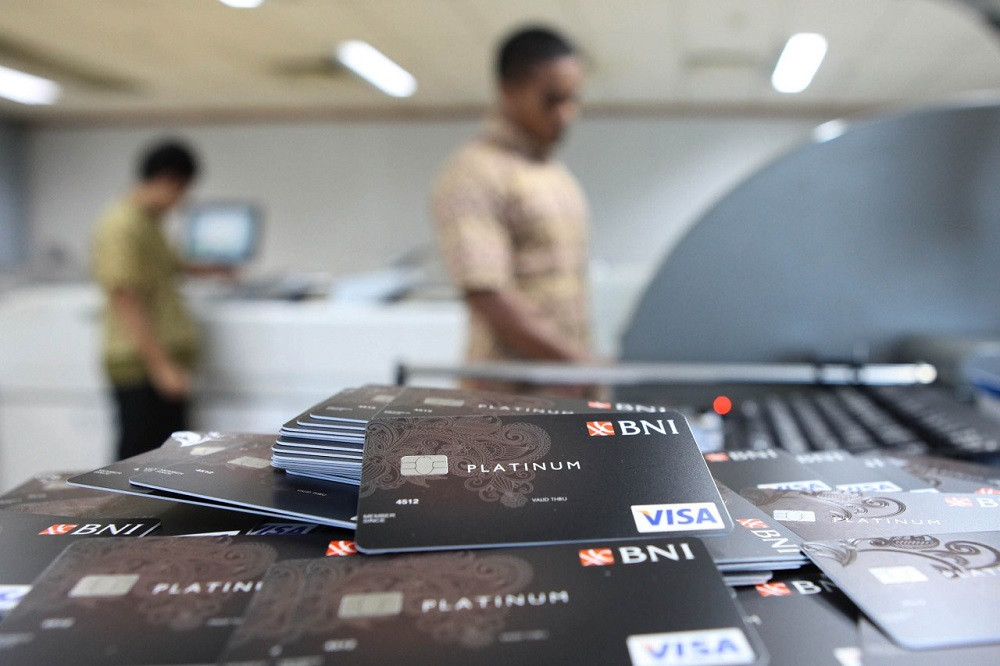 Cashless economy: State bank BNI employees print credit cards at the lender’s Card Business Division in Jakarta on Aug. 10, 2012. (JP/Nurhayati)
I
ndonesia’s credit card market is moving in an unusual direction. As of June, Bank Indonesia (BI) recorded 18.09 million credit cards in circulation, around 700,000 fewer than a year earlier. At the same time, transaction volume rose 15.7 percent year-on-year and transaction value increased 13.3 percent.
The number of cards is shrinking, but the cards that remain are being used more actively. This is the market that Kartu Kredit Indonesia (KKI), launched by BI together with the Indonesian Payment System Association (ASPI) on Aug. 17, is entering.
KKI is part of a longer effort by BI to build more of Indonesia’s payment system at home. The direction started with the National Payment Gateway (GPN) in 2017, which connected domestic payment networks and allowed more retail transactions to be processed within the country. QRIS later gave consumers and merchants one common standard for digital payments. KKI extends that same direction into credit.
Eight banks joined the initial rollout, including Bank Mandiri, BCA, BNI, BRI, CIMB Niaga, PermataBank, Bank Mega and BSI. These banks issue the credit facility, while payments are made through QRIS, either by scanning a code or using QRIS Tap. BI describes KKI as a deferred-payment instrument that is processed domestically.
For consumers, paying QRIS by credit is actually not new. Bank Mandiri, one of the banks now issuing KKI, had already allowed customers to use conventional credit cards as a source of funds for QRIS payments through Livin’ by Mandiri since 2022. Several banks later introduced similar features.
So the new part is not the act of scanning QRIS using credit. KKI brings a domestically processed credit product into a payment habit that already exists.

The relevance becomes clearer when looking at how large, and how everyday, QRIS has become.
By June, QRIS had reached 65.7 million users and 44.9 million merchants, 96.7 percent of them micro, small and medium enterprises (MSMEs). During the first half of this year, it processed 12.5 billion transactions worth Rp 1.1 quadrillion (US$62 billion), with transaction value growing 93.9 percent from the same period last year.
The transaction size tells a similar story. Based on total value and volume in the first half of 2026, the average QRIS transaction was only around Rp 89,000. That puts the typical QRIS payment much closer to a meal, groceries or everyday services than to the larger purchases traditionally associated with credit cards. The small-ticket nature of QRIS is therefore visible not only at the cashier, but also in the aggregate data.
BI is also making these smaller QRIS payments cheaper for merchants. Starting Oct. 1, transactions of up to Rp 100,000 will carry a zero percent merchant discount rate across all merchant categories. Previously, the zero rate applied only to micro merchants for transactions up to Rp 500,000, while larger merchants generally paid 0.7 percent. The policy was announced alongside KKI and points in the same direction: making small, everyday transactions an increasingly important part of the QRIS ecosystem.
This is what QRIS looks like in practice: a Rp 25,000 coffee, a Rp 30,000 lunch, a haircut or a purchase at a neighborhood store. These are transactions that happen regularly, often several times within a week, rather than the occasional large purchase more commonly associated with credit cards.
KKI brings credit into that environment.
Think of a typical cashier today. A QRIS code is already sitting on the counter, whether at a coffee shop, restaurant or neighborhood store. KKI adds another way to pay through the same QR code, this time using a domestically processed credit facility.
That creates an interesting possibility for the credit card market. Growth may no longer depend only on issuing more cards or increasing spending on larger purchases. Credit can also become relevant in more frequent, lower-value transactions that already take place through QRIS.
India offers a useful comparison. In 2022, RuPay credit cards were allowed to be linked to the Unified Payments Interface (UPI), and usage grew rapidly. By February 2025, RuPay accounted for around 16 percent of total credit-card spending in India, with roughly half of RuPay credit-card spending already taking place through UPI, according to the National Payments Corporation of India.
Indonesia starts from a different market structure, but the Indian experience shows how credit use can change once it enters a payment network people already use every day. Consumers still need to qualify for a credit facility, but QRIS gives that facility a much wider place to be used.
That matters because QRIS already reaches almost 45 million merchants, nearly 97 percent of them MSMEs. A neighborhood coffee shop that accepts QRIS can now sit in the same credit-enabled payment environment as a department store.
The effect on consumption may be less visible in total spending and more visible in how people use credit. Some KKI transactions will simply replace payments that would otherwise have been made through debit, e-money or cash. But a Rp 30,000 lunch is very different from a Rp 3 million appliance, even when both eventually appear on the same monthly statement.
This also fits what the credit-card data already show. Cards in circulation are falling, while transaction volume continues to grow faster than transaction value. Fewer cards are being used more often, while the average value per transaction has edged down by around 2 percent.
KKI extends that direction into the QRIS ecosystem. As adoption grows, transaction frequency, average ticket size and the types of merchants receiving KKI payments will show how far credit is moving into Indonesia’s everyday spending.
*****
The writer is an analyst at Mandiri Institute