The Jakarta Post
Please Update your browser
Your browser is out of date, and may not be compatible with our website. A list of the most popular web browsers can be found below.
Just click on the icons to get to the download page.


Popular Reads
Top Results
No results found. Please check your search term and try again
Can't find what you're looking for?
View all search results
Popular Reads
Top Results
No results found. Please check your search term and try again
Can't find what you're looking for?
View all search resultsBonds set for bruising September but stocks little fazed
The rise in borrowing costs has been front-and-center for investors, given that sovereign yields are an anchor for global markets, a reference price for investing in riskier stocks and a benchmark for mortgages and corporate borrowing.
Change text size
Gift Premium Articles
to Anyone
Share the best of The Jakarta Post with friends, family, or colleagues. As a subscriber, you can gift 3 to 5 articles each month that anyone can read—no subscription needed!
 Set as preferred source
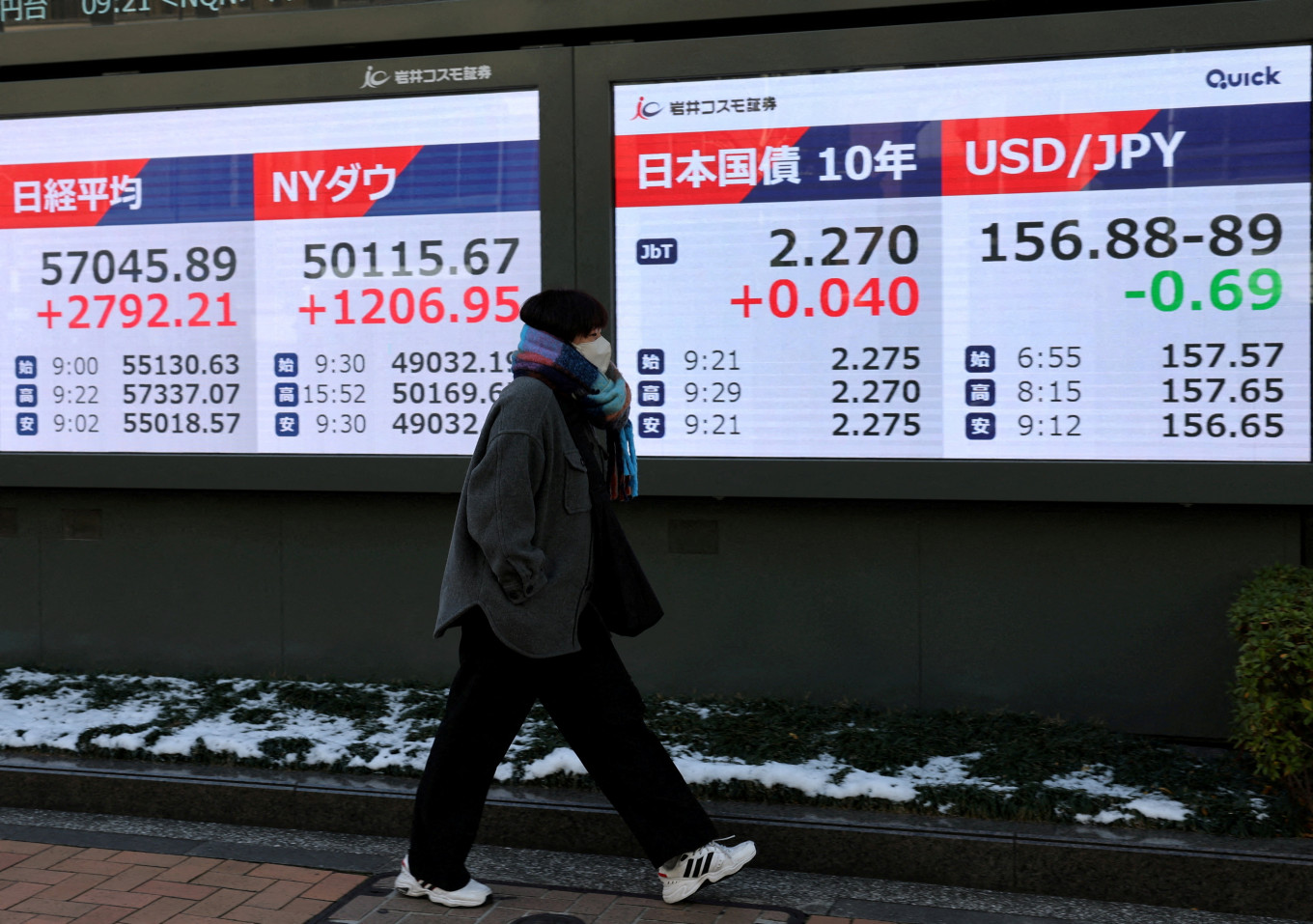 A woman walks past an electronic board displaying the Nikkei share average, the Dow Jones Industrial Average, the level of Japan's 10-year government bonds and the exchange rate between the US dollar and Japanese yen, outside a brokerage in Tokyo on Feb. 9, 2026. (Reuters/Kim Kyung-Hoon)
G
lobal bonds wobbled on Wednesday and were set for their worst month in years, hit by a toxic mix of deteriorating government finances, a glut of issuances and rising inflation as the seven-month-old US-Israeli war on Iran keeps energy costs elevated.
Stocks fared better, however, largely unfazed by the surge in bond yields and were upbeat in Asia.
The rise in borrowing costs has been front-and-center for investors, given that sovereign yields are an anchor for global markets, a reference price for investing in riskier stocks and a benchmark for mortgages and corporate borrowing.

Benchmark 10-year US Treasury yields held near their highest point since 2007 at 5.23% in Asia and were set for a rise of nearly 50 basis points (bps) this month, the largest in about two years. Bond yields move inversely to prices. In Japan, the 10-year government bond was poised for a 42 bps surge this quarter.
The 2-year Treasury yield was flat at 4.889% after New York Federal Reserve President John Williams pushed back against expectations for earlier policy tightening, though yields remain more than 50 bps higher for the month.
"This is becoming much bigger than another repricing of the next few central bank meetings," said Charu Chanana, chief investment strategist at Saxo.

"I do think we are moving towards a structurally higher-yield regime ... The hurdle for yields to return sustainably to the ultra-low levels investors became accustomed to after the (Global Financial Crisis) looks much higher."
Read also: New York offers Jakarta assistance on municipal bond plan
Yields in Japan are hovering near multi-decade highs, while 10-year government bond yields in Germany and France hit 17-year and 18-year peaks this week.
While a persistently higher risk-free rate increases the cost of refinancing for companies and weighs on growth, its impact on stocks has thus far been relatively limited.
MSCI's broadest index of Asia-Pacific shares excluding Japan rose 0.4% and was on track for a monthly fall of nearly 1%.
Japan's Nikkei jumped 2.1% and was set to end the month up 0.8% and the quarter down 4.7%, while South Korea's Kospi was headed for a monthly gain of 0.7% and a quarterly plunge of 19%.

Nasdaq futures edged 0.13% higher and S&P 500 futures added 0.24%. Euro Stoxx 50 futures rose 0.77% at 6,384, German DAX futures were up 0.76% at 25,729, and FTSE futures added 0.71% at 10,753.
Much of the resilience in equity markets can be attributed to upbeat corporate earnings, strength in the global economy and continued hype around artificial intelligence.
"What was surprising to us was the sanguine reaction of the equity market where the growth in nominal GDP was driving earnings optimism," Mohammed Apabhai, Citi's head of Asia-Pacific trading strategy, said in a note, referring to the recent rise in bond yields.
"US equity markets are reacting to the rise in bond yields but only outside of the tech space."
He added that, in meetings with macro funds and institutional investors in New York, many asked how high bond yields could go, at what level hyperscalers might scale back capital spending and when equity markets would react.
Read also: Danantara launches dollar bond, eyes $1 billion
In Chinese shares, the blue chip CSI 300 index rose 0.2% in morning trade and is struggling to lift off a one-year low made earlier in the week. The gauge is on course for a 13% slump this quarter, the largest since the height of COVID-19 lockdowns.
The Shanghai Composite index was up 0.3% by the lunch break and set for a 6.2% quarterly fall, also the biggest in four years.
In currency markets, the dollar was on track for a monthly gain of 2%, aided by the rise in US yields.
That left the euro trading near a 16-month low at $1.1336. It was headed for a monthly loss of 2.4% as the currency struggles in the face of a global energy shock and growing political risk in Europe.
Sterling weakened 0.04% to $1.3224, and was set to lose 2.4% for the month.
The yen, however, steadied at 157.115 per dollar and was eyeing a monthly gain of 1.6%, with investors wary of pushing the currency lower due to the threat of a joint intervention by Tokyo and Washington.
In commodities, US crude rose 0.19% to $89.55 a barrel, and Brent rose to $103.13 per barrel, up 0.53% on the day, both set for monthly gains on concerns about prolonged supply disruptions due to the ongoing Middle East war.