The Jakarta Post
Please Update your browser
Your browser is out of date, and may not be compatible with our website. A list of the most popular web browsers can be found below.
Just click on the icons to get to the download page.


Popular Reads
Top Results
No results found. Please check your search term and try again
Can't find what you're looking for?
View all search results
Popular Reads
Top Results
No results found. Please check your search term and try again
Can't find what you're looking for?
View all search resultsAncient Afghan Buddhist city threatened by Chinese copper mine
Change text size
Gift Premium Articles
to Anyone
Share the best of The Jakarta Post with friends, family, or colleagues. As a subscriber, you can gift 3 to 5 articles each month that anyone can read—no subscription needed!
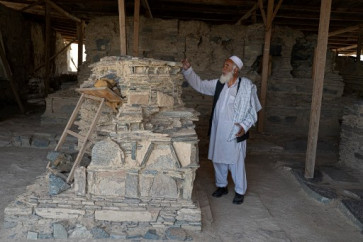
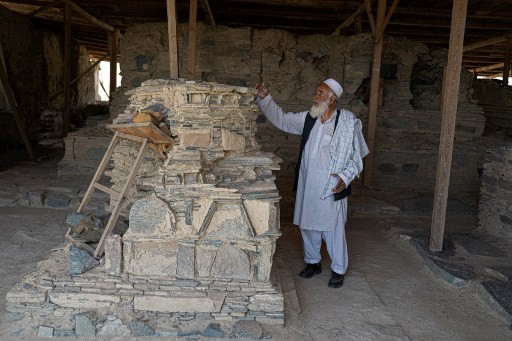 In this photograph taken on May 17, 2022, historical monuments department manager Jalat Surkhabi shows a structure uncovered at an archaeological site in Mes Aynak, in the eastern province of Logar. An ancient Buddhist city carved out of immense peaks near Kabul is in danger of disappearing forever, swallowed up by a Chinese consortium exploiting one of the world's largest copper deposits. Located at the confluence of Hellenistic and Indian cultures, Mes Aynak -- believed to be between 1,000 and 2,000 years old -- was once a vast city organised around the extraction and trade of copper.
(AFP /Wakil Kohsar )
In this photograph taken on May 17, 2022, historical monuments department manager Jalat Surkhabi shows a structure uncovered at an archaeological site in Mes Aynak, in the eastern province of Logar. An ancient Buddhist city carved out of immense peaks near Kabul is in danger of disappearing forever, swallowed up by a Chinese consortium exploiting one of the world's largest copper deposits. Located at the confluence of Hellenistic and Indian cultures, Mes Aynak -- believed to be between 1,000 and 2,000 years old -- was once a vast city organised around the extraction and trade of copper.
(AFP /Wakil Kohsar )
A
n ancient Buddhist city carved out of immense peaks near Kabul is in danger of disappearing forever, swallowed up by a Chinese consortium exploiting one of the world's largest copper deposits.
Located at the confluence of Hellenistic and Indian cultures, Mes Aynak -- believed to be between 1,000 and 2,000 years old -- was once a vast city organized around the extraction and trade of copper.
Archaeologists have uncovered Buddhist monasteries, stupas, fortresses, administrative buildings and dwellings, while hundreds of statues, frescoes, ceramics, coins and manuscripts have also been unearthed.
Despite looting at the beginning of the century, Mes Aynak is "one of the most beautiful archaeological sites" in the world, says Bastien Varoutsikos, an archaeologist for the French company Iconem, which is working to digitize the city and its heritage.
But the need for the Taliban -- who returned to power in August last year -- to find new revenue streams after international aid was frozen has made mining the project a priority, and could put an end to further archaeological work.
Mining consortium
Objects discovered date mainly from the 2nd to 9th century AD, but an earlier occupation is also believed likely, and pottery dating back to the Bronze Age -- well before the birth of Buddhism -- has also been found.


More from The Weekender

The weight of time
Richard Mille’s newest ultralight timepiece pares down haute horlogerie to its mechanical necessities, proving that sophistication often comes from knowing what to leave out.

At this wellness retreat, your poo is everybody’s business
Ayurvedagram promises balance through ancient Ayurvedic practices. For four days, I surrendered my schedule, my modesty and, almost, my digestive tract.

All aboard: The case for staying grounded
An eight-hour train ride from Jakarta to Surabaya shows that getting there can be half the fun.