Enjoy This Gifted Article!
You're reading this thanks to a The Jakarta Post subscriber.
Access is available for 30 days. For unlimited access, consider subscribing.
Can't find what you're looking for?
View all search resultsCan't find what you're looking for?

View all search resultsInvolving the public in wildlife sightings may become one of the keys in monitoring, and eventually safeguarding, Indonesia’s rich biodiversity.
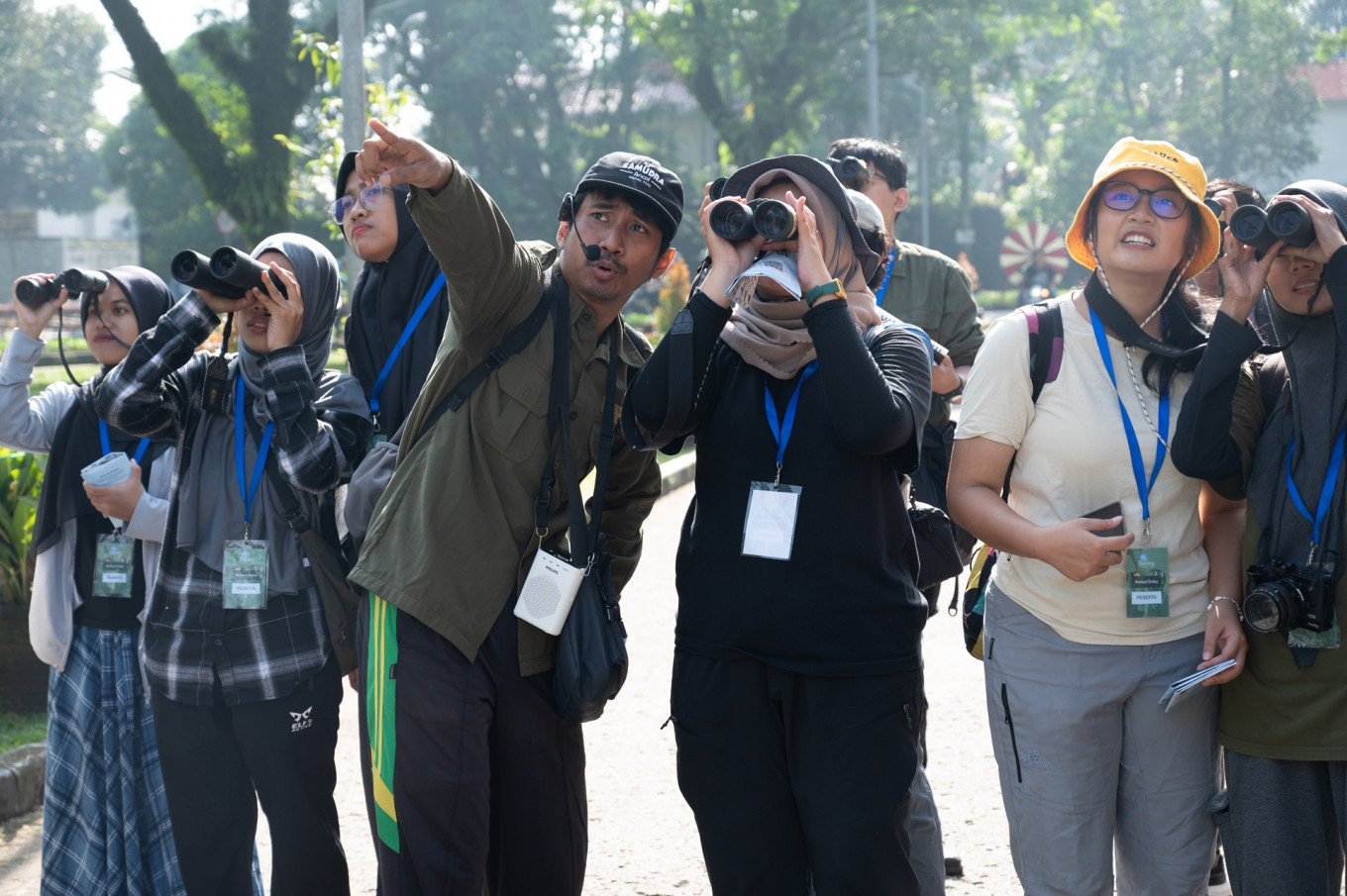
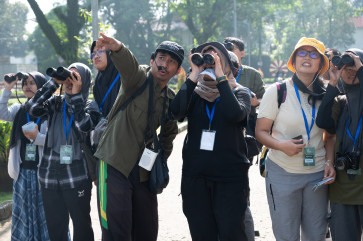
Peeking birds: A guide points while participants look for a bird during a birdwatching activity held by conservation group Burung Indonesia at the Bogor Agricultural University (IPB) in Bogor, West Java on Sept. 20, 2025. Weekend Birding is one of regular programs held by the group to engage the public to be involved in citizen science by observing and documenting various species of birds. (Courtesy of Burung Indonesia/-)
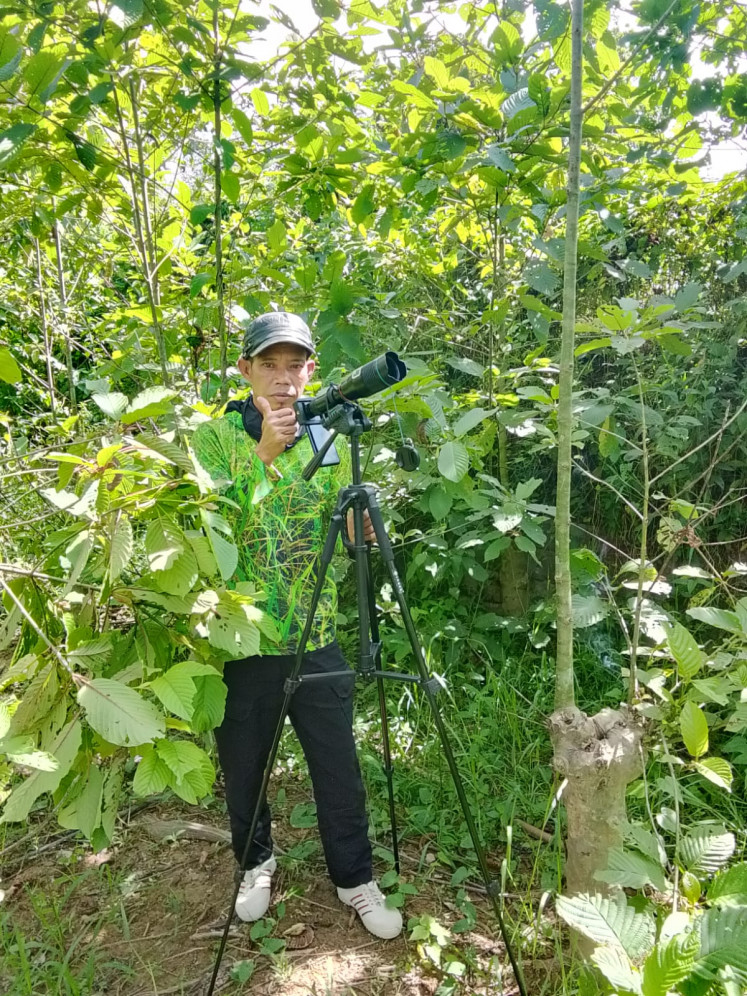
Every weekend, right after sunrise, Toni Espendi would walk from his home in Nanga Embaloh village, Kapuas Hulu regency, West Kalimantan to the nearby forest to look for birds.
Once spotting one or more, he would aim and shoot the birds using a telephoto lens attached to his phone. Toni would later upload the photos into an app as part of a program called KehatiKu, an initiative from the scientific consultancy company Borneo Futures in which local residents can assist in wildlife monitoring.
“Now we know the types of birds that roam in our village,” Toni said. “Birds that we previously couldn’t name, now we’re able to identify them.”
Capturing bird photos has become a regular side gig for Toni and other villagers that not only generates income, but also contributes to biodiversity conservation through the practice of citizen science, where members of the general public are involved in collecting and analyzing data for scientific research.
Bird shooter: Toni Espendi, one of the local villagers from Nanga Embaloh in Kapuas Hulu regency, West Kalimantan, poses with his phone on April 8, 2026 that is equipped with a telephoto lens while wearing a camouflage-patterned T-shirt during one of his outings to the forest. Toni has been documenting birds and other wildlife as part of the KehatiKu biodiversity conservation initiative. (Courtesy of KehatiKu/-)The concept of involving non-scientists is not new, with the term first used in the late 1980s. But an analysis by OECD in 2025 found that there has been an increase in citizen science practices in the past decade across a wide range of research, albeit still dominantly seen in Western countries such as the United States, the United Kingdom and Germany.
While citizen science may be unfamiliar for many in Indonesia, some initiatives, like KehatiKu, have already been underway.
Under KehatiKu, villagers across Kapuas Hulu gather wildlife data from their ground observation into an app in exchange for money. The data would be later analyzed by researchers at Borneo Futures to map the likelihood of a species being present in certain locations
First introduced in four villages in 2024, the initiative’s objective was to “increase the impact of wildlife conservation, making it much more transparent,” said Borneo Futures managing director Erik Meijaard.
“Our job is to verify the data, but the idea is that the information go back to the community and help them in decision-making,” Meijaard went on to say.
Read also: Deaths of two Sumatran elephants affect conservation efforts
His vision came to fruition in February, when villagers in Nanga Embaloh called for a meeting with local officials to make hunting illegal. The villagers even chipped in to install signs against hunting. Another village, Nanga Palin, followed suit by late May.
“This kind of stewardship is something that we can be proud of,” said KehatiKu coordinator Muhammad Syazwan Omar, “and we hope that as the program goes on, they continue to have valuable data and have a say in what is worth protecting.”
No hunting: Munawir Sejali stands in front of a newly-installed hunting ban signage on May 24, 2026, in Nanga Palin village, Kapuas Hulu regency, West Kalimantan. Nanga Palin became the second village to introduce a self-imposed hunting ban in and around their village as a result of engaging with Borneo Futures' KehatiKu community-based biodiversity monitoring program. (Courtesy of Mansur Batinsyah/-)As of May, there have been 800 observers across nine villages under the initiative, contributing to around 250,000 wildlife observations each year.
Using those data, Borneo Futures researchers managed to conduct occupancy analysis, or statistical analysis to determine whether a species is present or absent in a specific location, of 30 individual species, including the Bornean orangutan (Pongo pygmaeus), long-tailed macaque (Macaca fascicularis) and scarlet-rumped trogon (Harpactes duvaucelii).
Although the KehatiKu program is currently funded by donors, namely the Wildlife Futures and Arcus Foundation, Erik’s long-term vision would be for the whole system to be operated by authorities as part of their commitments towards biodiversity conservation.
“That's kind of where we want to go, that it sits with the government, they run it, they finance it. So, we're just running this as a pilot,” Erik said.
Big potential
Other local conservation organizations, such as Birdpacker Indonesia, have already engaged with local communities and citizens in monitoring biodiversity.
The group has an app called Burungnesia dedicated to wild bird observation, while the Amati Sangkar app focuses on observing all animals traded, kept as pets or hunted. A similar app called Kupunesia focuses on butterflies.
Under an integrated platform called Amaturalist, the three apps have been used by nature enthusiasts to keep tabs on the various species they observe.
Burungnesia has recorded 1.616 species of birds from 43,000 locations, while Kupunesia has 692 species recorded by 80 active observers.
Forest icon: A rhinoceros hornbill (Buceros rhinoceros) perches on a tree branch at a forest in Kapuas Hulu regency, West Kalimantan, on Feb. 25, 2026. The hornbill is a mascot of the regency and one of the most iconic birds ever documented by citizen scientist Toni Espendi. (Courtesy of Toni Espendi/-)The point of citizen science initiatives is empowering local people to help them see the value of biodiversity and protect it, rather than depending on outsiders such as NGOs or donor organizations, said Achmad Ridha Junaid, biodiversity research officer at Burung Indonesia.
Read also: Civil groups demand protection of indigenous rights in conservation law
The country’s biodiversity potential is huge, according to Swiss Winnasis, chief executive officer of conservation group Birdpacker Indonesia. The country harbors approximately 1,834 species of birds, 793 kinds of mammals and thousands of orchids, reptiles and amphibians.
“Who is going to be responsible for safeguarding them? It’s none other than us, the people who live there,” Swiss said in a webinar on April 15. “Our biodiversity is just way too abundant to be handled by professional scientists, who are very limited in numbers.”
Collaboration needed
Because common people have different levels of understanding of scientific processes, citizen science initiatives usually face challenges on the quality of the data. Unreliable collection methods may result in data that would be inadequate to yield some detailed information regarding a species.
However, Achmad of Burung Indonesia said citizen science’s strength lies not in the quality of individual data, but their cumulative value: “The more data we have, the more likely it can reveal some information.”
Aside from more participations, Achmad underlines the importance of acknowledgment from the government and academicians, so their data can help in generating insights for decision-making
One example is the usage of data from eBird, a platform developed by Cornell University’s Lab of Ornithology, to identify important bird areas in North America. The analysis then provides insights for policymaking on biodiversity conservation.
Read also: Can't go outside? Even seeing nature on a screen can improve your mood
Burung Indonesia also utilizes data from eBird to produce its annual Bird Status report. For instance, the platform recorded a sighting of a steppe eagle (Aquila nipalensis) above Mount Merapi in Yogyakarta in November 2025. Prior to such a finding, the eagle was never seen in Indonesia.
Collaboration between people collecting the information, NGOs executing the program and scientists analyzing the data is a key for a successful citizen science initiative, said Achmad.
“That way, the collected data would be able to yield valuable information that would be accessible to the public,” Achmad said. “Right now, we’ve still gotten a long way to go.”
In an act of rebellion against overexposure and performative social media, Gen Z are turning to smaller, controlled spaces on social media where they can be their authentic selves.
While millennial and Gen Z women were raised to chase careers, the same generation of men were not taught to do chores or be vulnerable. How can men step up?
We're scaling back the festivities and finding more meaning this Idul Fitri.
Share your experiences, suggestions, and any issues you've encountered on The Jakarta Post. We're here to listen.
Thank you for sharing your thoughts. We appreciate your feedback.
Quickly share this news with your network—keep everyone informed with just a single click!
Share the best of The Jakarta Post with friends, family, or colleagues. As a subscriber, you can gift 3 to 5 articles each month that anyone can read—no subscription needed!
Get the best experience—faster access, exclusive features, and a seamless way to stay updated.