The Jakarta Post
Please Update your browser
Your browser is out of date, and may not be compatible with our website. A list of the most popular web browsers can be found below.
Just click on the icons to get to the download page.


Popular Reads
Top Results
No results found. Please check your search term and try again
Can't find what you're looking for?
View all search results
Popular Reads
Top Results
No results found. Please check your search term and try again
Can't find what you're looking for?
View all search results‘Why Nations Fail’: Lessons for Indonesia
Nobel laureate James A. Robinson says Indonesia’s challenge is not geography but building institutions that spread opportunity and keep power from becoming too concentrated.
Change text size
Gift Premium Articles
to Anyone
Share the best of The Jakarta Post with friends, family, or colleagues. As a subscriber, you can gift 3 to 5 articles each month that anyone can read—no subscription needed!
 Set as preferred source
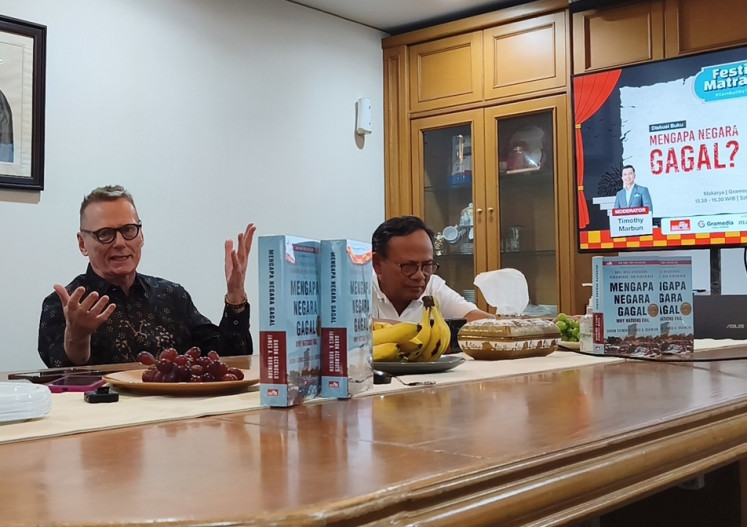
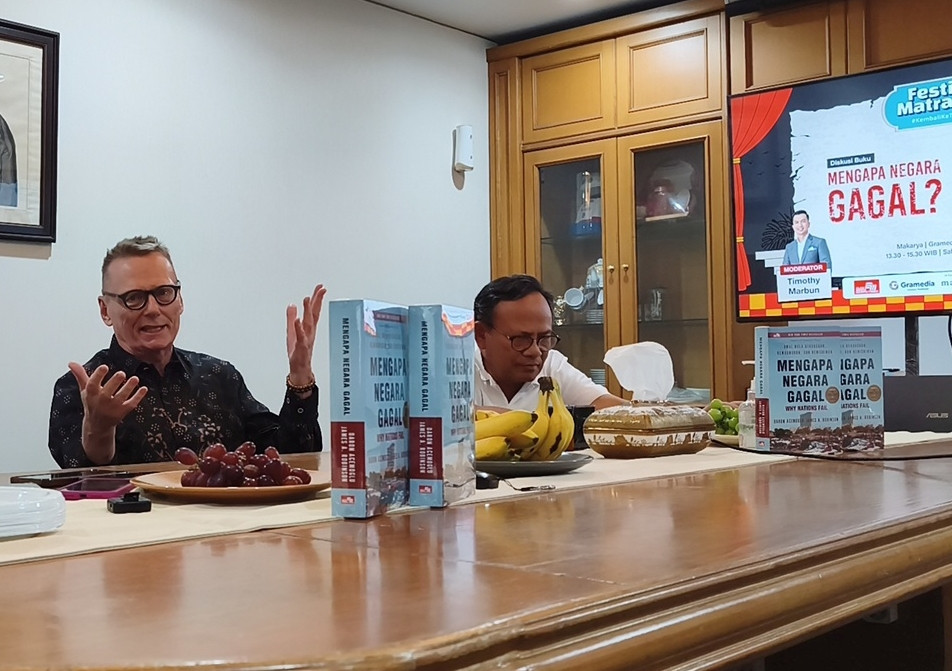 Spoken ideas: James A. Robinson (left) and Komaruddin Hidayat discuss Mengapa Negara Gagal on Aug. 29, 2026, at Gramedia Makarya in Central Jakarta.
(JP/Sylviana Hamdani)
Spoken ideas: James A. Robinson (left) and Komaruddin Hidayat discuss Mengapa Negara Gagal on Aug. 29, 2026, at Gramedia Makarya in Central Jakarta.
(JP/Sylviana Hamdani)
L
ately, it has been hard to shake the feeling that something is not quite right with Indonesia. Forest and land fires continue to burn, prices keep rising while people feel their purchasing power slipping, and statements from political and government figures often leave people scratching their heads, followed by policies that seem increasingly out of step with everyday realities.
These are unsettling and raise a question that few may say aloud: Where is Indonesia heading?
Against this backdrop, Gramedia held a book talk on Mengapa Negara Gagal: Awal Mula Kekuasaan, Kemakmuran dan Kemiskinan (Why Nations Fail: The Origins of Power, Prosperity and Poverty), the Indonesian translation of the 2012 book by economists Daron Acemoglu and James A. Robinson, at Gramedia Makarya, Central Jakarta, on Aug. 29.

Published in Indonesian in February 2026, with a second printing in July, the book drew a full house, with Robinson himself speaking to the audience.
“I’m very excited to be here in Jakarta, along with the Indonesian translation of my book,” Robinson said.
Robinson, a professor at the University of Chicago, the United States, shared the 2024 Nobel Prize in Economic Sciences with Acemoglu and Simon Johnson for their research on how institutions are formed and how they affect national prosperity.
“History suggests that inclusive societies don't come about because elites benevolently create them. They come about because people demand change and people demand different and more inclusive institutions.” — James A. Robinson, Nobel laureate economist

More from The Weekender

All aboard: The case for staying grounded
An eight-hour train ride from Jakarta to Surabaya shows that getting there can be half the fun.

Questioning and nurturing the self with Abell Octovan
The visual artist explores new grounds and mediums in his first solo exhibition, Am I an Artist.

Radio still gives you something an algorithm can't
You can choose almost anything you want to hear these days. So why are young people still tuning in to radio?