The Jakarta Post
Please Update your browser
Your browser is out of date, and may not be compatible with our website. A list of the most popular web browsers can be found below.
Just click on the icons to get to the download page.


Popular Reads
Top Results
No results found. Please check your search term and try again
Can't find what you're looking for?
View all search results
Popular Reads
Top Results
No results found. Please check your search term and try again
Can't find what you're looking for?
View all search resultsFood waste issue looms over free meals rollout
An assessment issued in April by Jakarta-based think-tank Center for Economic and Law Studies (Celious) estimated that between 62 million and 120 million packages of meals prepared and disbursed under the program were wasted each week.
Change text size
Gift Premium Articles
to Anyone
Share the best of The Jakarta Post with friends, family, or colleagues. As a subscriber, you can gift 3 to 5 articles each month that anyone can read—no subscription needed!
 Set as preferred source
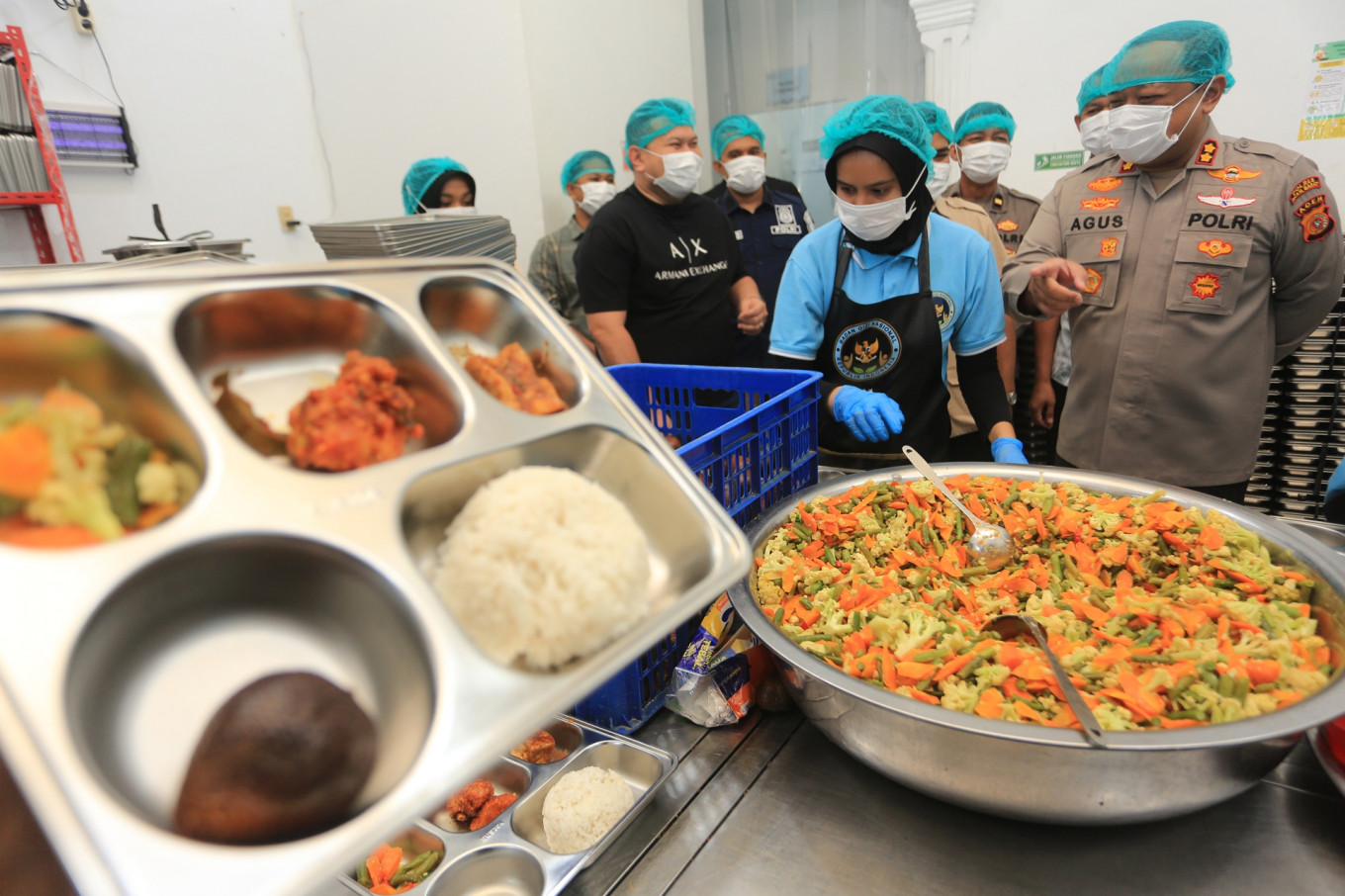 West Aceh Police chief Adj. Sr. Comr. Agus Sulistianto (right) inpects the food preparation for the free nutritious meal program at a kitchen managed by the West Aceh Police in West Aceh regency, Aceh on Aug. 6, 2026. The National Nutrition Agency (BGN) requires all free meal kitchen to have hygiene and sanitation certificates (SLHS) by Aug. 10 to avoid permanent closure. (Antara/Syifa Yulinnas)
C
oncerns have arisen about the mounting volume of food waste generated by President Prabowo Subianto’s flagship free nutritious meal program, prompting calls for stringent waste management, an aspect critics argue has been overlooked since its rollout in 2025.
An assessment issued in April by Jakarta-based think-tank Center for Economic and Law Studies (CELIOS) estimated that between 62 million and 120 million packages of meals prepared and disbursed under the program were wasted each week.
The weekly food waste included at least 7,700 tonnes of cooked rice and 3,400 tonnes of side dishes, causing the state to suffer up to Rp 1.27 trillion (US$71 million) in economic losses.
According to the National Nutrition Agency (BGN), which manages the free meals program, there are currently around 62 million beneficiaries across the country.
To address the problem, the Environment Ministry announced in early August a commitment to boost the circular economy approach to the free meals rollout, focusing on working with government-appointed kitchen partners across the country to manage food waste.
Deputy Environment Minister Diaz Hendropriyono said some kitchens had already implemented the approach by turning leftover food and wastewater into livestock feed and other materials for agricultural purposes.

“What we may achieve quickly is to make food production become circular,” Diaz said on Aug. 1, as quoted in a statement issued by the Environment Ministry.