The Jakarta Post
Please Update your browser
Your browser is out of date, and may not be compatible with our website. A list of the most popular web browsers can be found below.
Just click on the icons to get to the download page.


Popular Reads
Top Results
No results found. Please check your search term and try again
Can't find what you're looking for?
View all search results
Popular Reads
Top Results
No results found. Please check your search term and try again
Can't find what you're looking for?
View all search resultsIndonesia battles Mount Bromo wildfire as El Nino takes root
The fire started Monday near Mount Bromo in East Java, one of Indonesia's most visited tourist destinations but now closed until further notice.
Change text size
Gift Premium Articles
to Anyone
Share the best of The Jakarta Post with friends, family, or colleagues. As a subscriber, you can gift 3 to 5 articles each month that anyone can read—no subscription needed!
 Set as preferred source
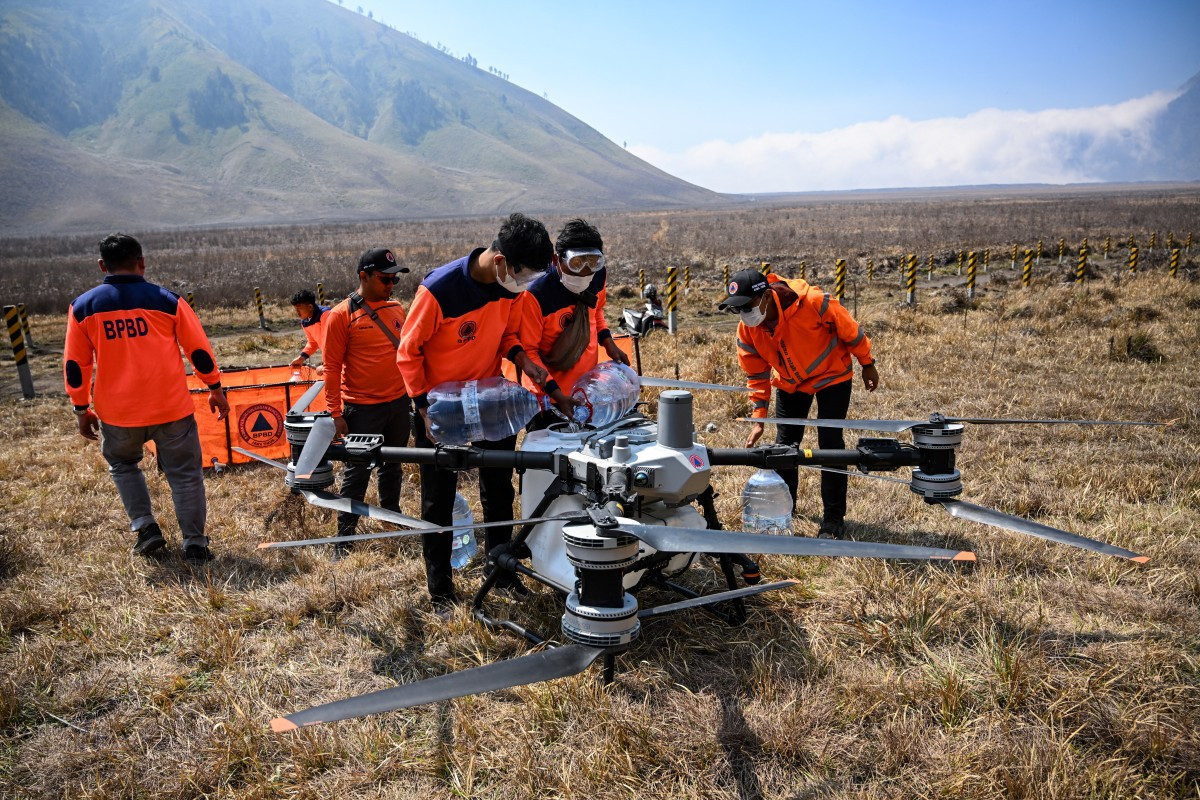 Officials from the East Java Provincial Disaster Management Agency fill a drone’s water tank to battle a wildfire in the Bromo Tengger Semeru National Park near Mount Bromo in Probolinggo, East Java, on August 6, 2026. (AFP/Juni Kriswanto)
T
he authorities battled Friday to contain a wildfire that has swept through Mount Bromo National Park in Java, destroying more than 120 hectares as the country braces itself for an extreme El Nino-fueled dry season.
The fire started Monday near Mount Bromo in East Java, one of Indonesia's most visited tourist destinations but now closed until further notice.
Local authorities deployed two water-bombing helicopters against the flames that have razed at least 127 hectares of national park land to date, fire official Bambang Setyo Antoko told AFP.
The destroyed area is equivalent to about 180 soccer fields.
"We're very dependent on wind conditions," Bambang said of the firefighting effort ahead.
National park official Rudijanta Tjahja Nugraha said the area on fire was in a steep, cliffside region, making it difficult for firefighters to reach.

It was not known how the fire started, but Bambang said the park was extremely dry as El Nino conditions take root in Indonesia.
Read also: Early wildfire surge raises alarm in Indonesia
Mount Bromo, famed for its volcanic scenery, previously caught fire in 2023.
That blaze broke out when a couple lit a flare during a pre-wedding photo shoot and destroyed more than 500 hectares of land.
The Meteorology, Climatology and Geophysics Agency (BMKG) has warned that the 2026 dry season will be more intense and prolonged than usual, with a higher risk for wildfires and drought due in part to El Nino.
According to the Forestry Ministry, more than 107,000 hectares of land burned in Indonesia between January and June this year -- more than double the area destroyed in forest fires in 2023.
The last El Nino helped make 2023 and 2024 the two hottest years globally on record.
El Nino is a naturally occurring climate phenomenon that brings worldwide changes in winds, air pressure and rainfall patterns.
In India and Southeast Asia, it typically causes drier conditions.