The Jakarta Post
Please Update your browser
Your browser is out of date, and may not be compatible with our website. A list of the most popular web browsers can be found below.
Just click on the icons to get to the download page.


Popular Reads
Top Results
No results found. Please check your search term and try again
Can't find what you're looking for?
View all search results
Popular Reads
Top Results
No results found. Please check your search term and try again
Can't find what you're looking for?
View all search resultsPraying for rain as fires, haze plague Kalimantan
Blamed partly on one of the worst episodes of the drought-inducing El Nino weather phenomenon in decades, the disaster threatens millions of people's access to necessities such as clean water and air -- even education.
Change text size
Gift Premium Articles
to Anyone
Share the best of The Jakarta Post with friends, family, or colleagues. As a subscriber, you can gift 3 to 5 articles each month that anyone can read—no subscription needed!
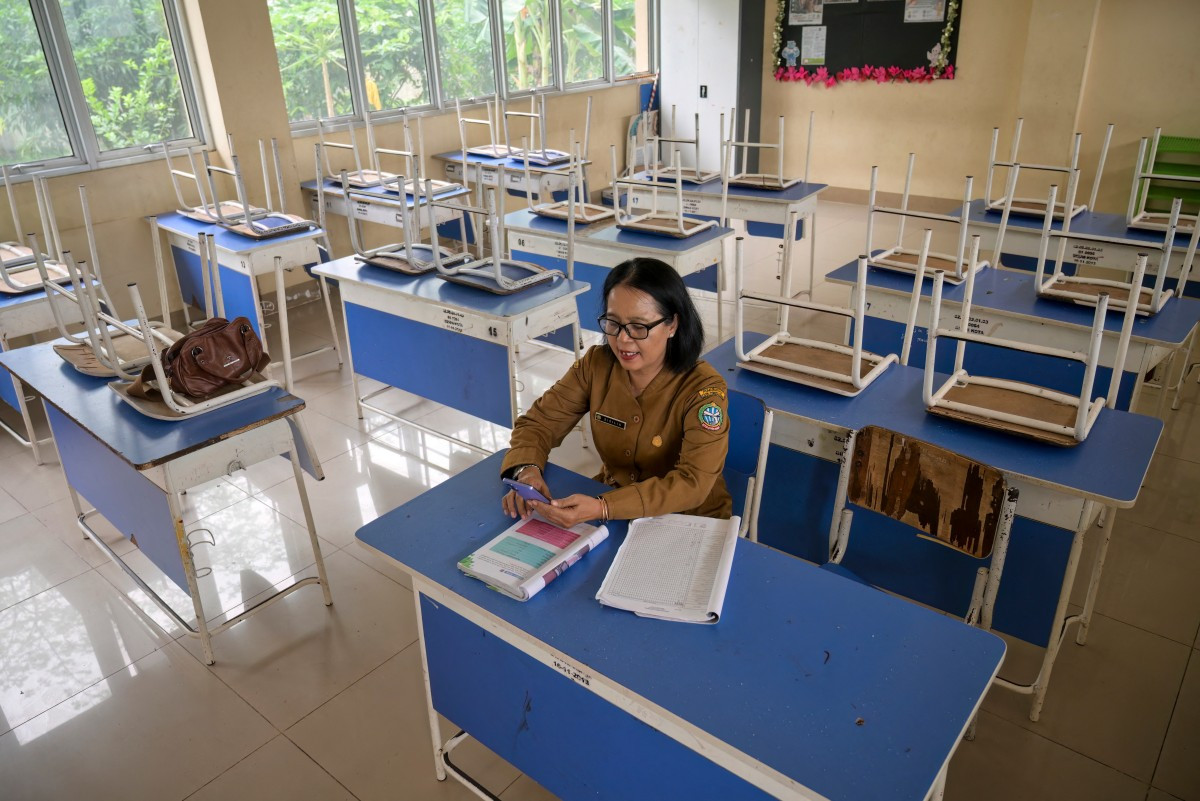 A junior high school teacher conducts an online lesson in an empty classroom after local authorities mandated remote learning due to haze from land and forest fires in Pontianak, West Kalimantan, on September 7, 2026. (AFP/Bay Ismoyo)
W
ildfires ravaging Kalimantan, the Indonesian part of Borneo, are choking communities as far away as Malaysia with putrid haze, testing the resources and resolve of those having to endure them.
Blamed partly on one of the worst episodes of the drought-inducing El Nino weather phenomenon in decades, the disaster threatens millions of people's access to necessities such as clean water and air -- even education.
Here is the situation as seen from the perspective of three community leaders in West Kalimantan, one of the worst-affected regions.
The teacher
Syarifah Hatifah, the 57-year-old vice principal of a junior high school in provincial capital Pontianak, fears some of her nearly 600 pupils may be falling behind.
They are in the third week of the second school closure this fire season. It's the longest closure Syarifah can remember in her 30-year career.

Hundreds of schools have been closed indefinitely in West Kalimantan due to air pollution, with about 200,000 pupils learning from home, according to the provincial education ministry.
The kids are being kept home for their health, Syarifah told AFP in a classroom empty but for two teachers presenting classes online, both with dozens of pupils scattered across their screens.
"The hope is that at home, in terms of health, they can be protected... because they are inside the house. They don't have to go through roads full of dust and smoke," she said.
But Syarifah said not every child has stable internet or access to a computer, making live sessions difficult for some.
"Sometimes... there is a power outage at their home, or they forget to charge their phones", and some students live in faraway areas with patchy connectivity, she said.
The school's teachers have been showing up every day as usual, giving lessons online in classrooms with no air purifiers. They work maskless so students can understand them clearly.
Syarifah said the school would offer extra lessons for free once in-person learning resumes.
"We hope that this haze will pass quickly. Usually after the rain falls, the haze will disappear," she said.
West Kalimantan's wetter season usually starts around October or November.
The health official
Iwansyah, head of the Kubu Raya regency's health agency, is responsible for the welfare of some 700,000 people spread over 123 villages, served by one general hospital and 21 clinics.
His staff focus on efforts to prevent illness caused by "the unhealthy air people inhale every day".
So far in September, more than 1,400 people in the regency have been treated or hospitalised for acute respiratory infections, said Iwansyah, who like many Indonesians has one name.
In August, the number was 6,396.
"We distribute masks to the public every day, about one thousand masks per day. Of course our stock is starting to run low," the official told AFP.
Iwansyah said the agency had requested additional masks from the provincial government, and was encouraging people to buy their own.
The agency also monitors cases of diarrhoea brought on by reduced access to clean water due to the drought, with 225 cases so far this month.
With Indonesia's BMKG weather agency warning of little respite in the weeks ahead, "we will have to work even harder on mitigation and preparing for a potentially very severe situation", said Iwansyah.
This includes stocking up on medicines and equipment at clinics and intensifying surveys of water and air quality.
"Hopefully there will be rain between now and November," Iwansyah said.
The hamlet head
For Yonas, deputy head of the Lintang Batang hamlet outside Pontianak, the priority is firefighting equipment.
"The residents here even pooled money to buy a (water pump) machine and hoses, and other equipment," he told AFP on Sunday night while battling a peatland fire that had been raging for four days, emitting acrid smoke.
"We're still short of hoses, which makes it hard for us to extinguish this fire."
Volunteer firefighters were using "whatever we have. Sometimes we use buckets, and even those aren't enough", said Yonas, adding that the teams were also in need of food and protective gear, including masks.
He said the smoke posed a danger especially for children, pregnant women, the elderly and people with asthma.
Scientific observations show the haze contains levels of toxic small particle pollution far exceeding the World Health Organization's recommended safe limit.
"It's very hazardous to the health of us who live in this village," said Yonas.