The Jakarta Post
Please Update your browser
Your browser is out of date, and may not be compatible with our website. A list of the most popular web browsers can be found below.
Just click on the icons to get to the download page.


Popular Reads
Top Results
No results found. Please check your search term and try again
Can't find what you're looking for?
View all search results
Popular Reads
Top Results
No results found. Please check your search term and try again
Can't find what you're looking for?
View all search resultsConstitutional Court orders end to military impunity
Jane Rosalina of Kontras said the Constitutional Court's ruling had broken through the wall of military impunity and offered an opportunity for the government, lawmakers and the Supreme Court to accelerate military justice reform.
Change text size
Gift Premium Articles
to Anyone
Share the best of The Jakarta Post with friends, family, or colleagues. As a subscriber, you can gift 3 to 5 articles each month that anyone can read—no subscription needed!
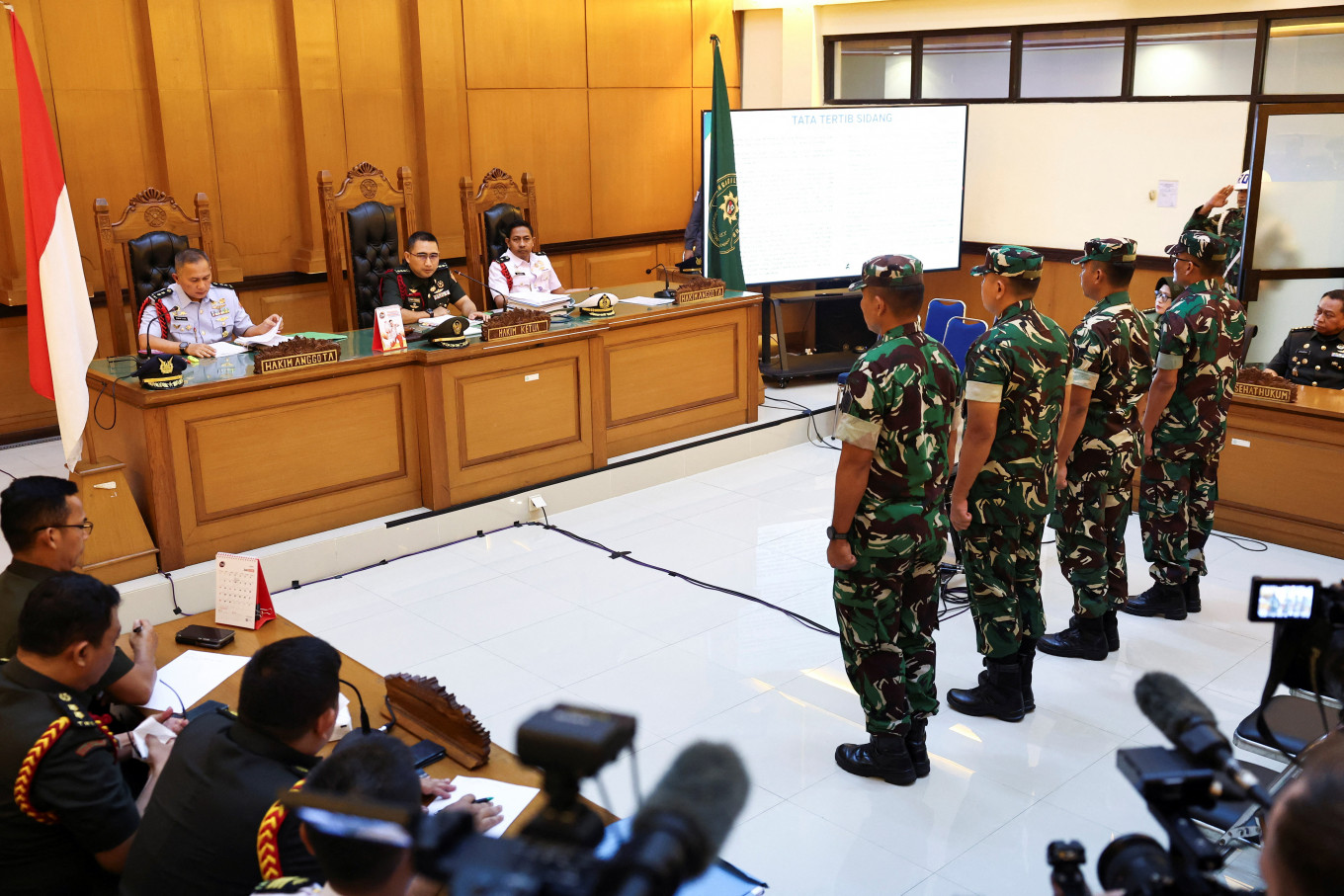 Military personnel Sami Lakka, Nandala Dwi Prasetya, Budhi Hariyanto Widhi Cahyono and Edi Sudarko charged over an acid attack on human rights activist Andrie Yunus, a deputy coordinator with the rights group Commission for Missing Persons and Victims of Violence (Kontras), known for campaigning against the expanding public role of the armed forces, stand at the courtroom for their verdicts at the Jakarta Military Court on June 10, 2026. (Reuters/Willy Kurniawan)
R
ights groups and petitioners have hailed a Constitutional Court ruling requiring Indonesian Military (TNI) personnel accused of general crimes to stand trial in civilian courts, urging the revision to the 1997 Military Tribunal Law without delay.
In a unanimous decision on Thursday, the court ruled that the three-decade-old law failed to clearly distinguish military offenses from general crimes, allowing soldiers accused of ordinary criminal acts to be tried in military courts.
The nine justices said the jurisdictions of military and civilian courts needed to be clearly defined, noting that military courts operated under a distinct system shaped by the military chain of command, subordinate responsibility and prioritization of military interests.

“When an offense does not have military characteristics but accountability for it remains within a system built on military principles [...], there is a structural risk that military interest may conflict with the need for independent and impartial legal process,” Justice Enny Nurbaningsih said while reading out the ruling.
When an offense lacked military characteristics, she added, “the justification for maintaining military court jurisdiction loses its basis.”
Read also: Military court slammed for reducing penalties in activist acid attack case

The court ordered the House of Representatives and the government to amend the law within two years, warning it would otherwise become unconstitutional.