The Jakarta Post
Please Update your browser
Your browser is out of date, and may not be compatible with our website. A list of the most popular web browsers can be found below.
Just click on the icons to get to the download page.


Popular Reads
Top Results
No results found. Please check your search term and try again
Can't find what you're looking for?
View all search results
Popular Reads
Top Results
No results found. Please check your search term and try again
Can't find what you're looking for?
View all search resultsLiving alone and in need of a hug during global shutdown
Shelley Howard, who still works as a graphic artist in the music industry, lives alone, so the confinement orders and the shutdown of non-essential business have left him isolated and cut off from almost all human contact.
Change text size
Gift Premium Articles
to Anyone
Share the best of The Jakarta Post with friends, family, or colleagues. As a subscriber, you can gift 3 to 5 articles each month that anyone can read—no subscription needed!
 Set as preferred source
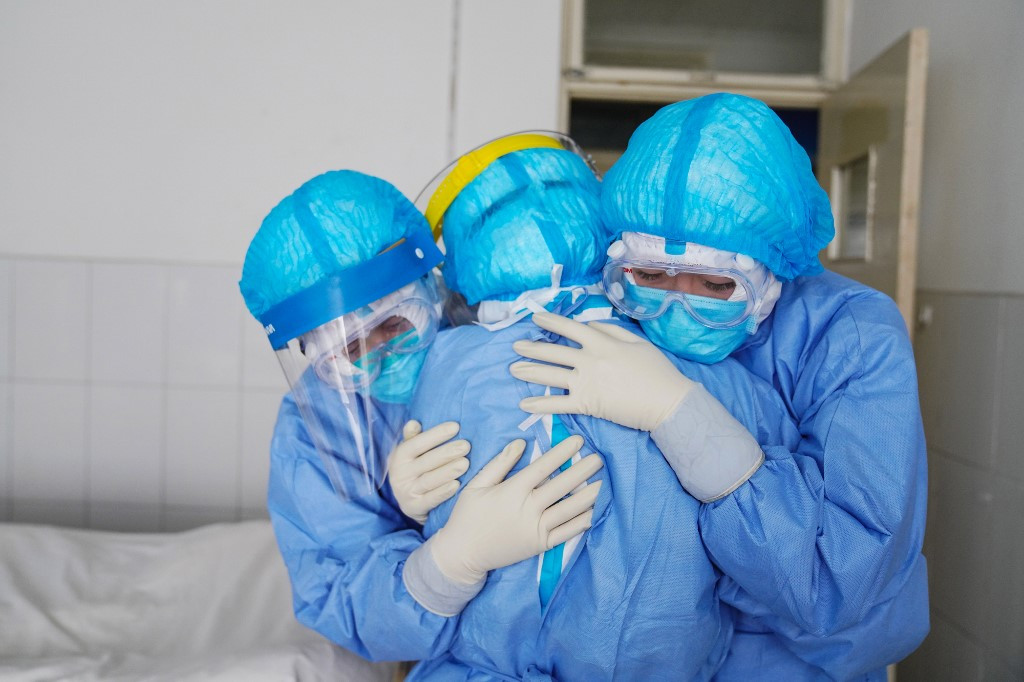 This photo taken on January 28, 2020 shows medical staff members hugging each other in an isolation ward at a hospital in Zouping in China's easter Shandong province. (STR/AFP/File)
S
ix nights a week, Shelley Howard could normally be found at a restaurant or bar in the famous Rush Street area of Chicago, dining out or having a drink with friends.
[gal:1]
A naturally social person, Howard, 73, regularly posted online pictures from his nights out, often showing him giving hugs or handshakes.
But for the past three weeks, like millions of people around the world, he has seen none of his friends -- instead, sitting at home to try to avoid the coronavirus pandemic.
Howard, who still works as a graphic artist in the music industry, lives alone, so the confinement orders and the shutdown of non-essential business have left him isolated and cut off from almost all human contact.
"I'm critically aware of that. I posted Springsteen's 'Human Touch' video on my Facebook page last week," Howard said.
"I'm a big hugger, and people like me. But it is what it is."
His experience is matched around the globe by those mourning the loss of daily physical contact that was once taken for granted, and which scientists say is vital.
"What happens with touch is a very physical change," said Tammy Field, director of the Touch Research Institute at the University of Miami's Miller School of Medicine.
"The nervous system is slowed. Heart rate decreases, blood pressure decreases, brainwaves change in the direction of more relaxation, and that in turn knocks down cortisol, which is the stress hormone."
Read also: 7 science-based strategies to cope with coronavirus anxiety
Staying in touch
Lilia Chacon, who works as the director of communications for the city of Santa Fe, New Mexico, also yearns for the return of simple human touch in her life.
Chacon, 65, lives alone and has been working from home.
"This is how fast your reality changes. I'll be watching TV and you'll see people all together at a table, all hugging and I'll say to myself, 'Oh my God, that would never happen today. No way!'" Chacon said.
To try to make up for the lack of hugs and handshakes, Chacon said she has been using video chats with friends.
"We find ways of maintaining friendships and intimacy. I've been really making a point of using FaceTime. I'm making a point of staying in touch with my friends in a visual way, not just phone calls. And it does help," Chacon said.
Older people are particularly affected, as they are highly vulnerable to the coronavirus and often live alone.
Mary Carlson is a neurobiologist at Harvard Medical School who became a sensory deprivation specialist studying babies who grew up in understaffed Romanian institutions during the 1990s.
"I would encourage people to engage in more social interaction through vision and hearing," she said.
"For those living alone, technology provides for phone and video interaction to compensate for this necessary -- and limited -- period of touch restriction."
She offered reassurance to the many people who worry that they won't remember how to interact normally after the coronavirus pandemic subsides.
"I always give the example of Nelson Mandela, who spent 27 years in jail," she said.
"We all know when he came out and when we saw him on TV and heard all the things he said that he didn't lose his social capacity at all, or his sensitivity to other people."
Read also: Kill time, not joy: How to be happy at home during the outbreak
When's your next handshake?
Field, from the Touch Research Institute, advised that people who live alone can try to benefit from their own touch.
"It can be yourself just rubbing your legs, or washing yourself in the shower, sitting on the floor and doing stretching, walking on the floor stimulating pressure receptors.
"But certainly it's more meaningful if someone else is doing it to you, especially someone you're close to," she said.
Charlotte Kullen, a 46-year-old owner of a Manhattan real estate public relations firm who lives alone and works from home, said the length of the restrictions was starting to cause concern.
"You can't conduct business now, because everyone is shut down; so there's nobody that you're going to be touching anyway," Kullen said, adding that as a cancer survivor with an auto-immune disease, the decision is one she welcomed, for now.
"One month inside is one thing, but if it goes 18 months, that will be another story," she said.
Back in Chicago, Howard has been compensating by promoting living-room concerts for a friend on social media, and has also come to rely on his two cats.
"It's not the same thing, but one of them sleeps right under my arm, so I spend ten hours holding onto this breathing, living thing," he said.
"And I have another one that sleeps on my knees or on my chest, so I do have touch with living things."