The Jakarta Post
Please Update your browser
Your browser is out of date, and may not be compatible with our website. A list of the most popular web browsers can be found below.
Just click on the icons to get to the download page.


Popular Reads
Top Results
No results found. Please check your search term and try again
Can't find what you're looking for?
View all search results
Popular Reads
Top Results
No results found. Please check your search term and try again
Can't find what you're looking for?
View all search resultsJapan, India sign civil nuclear pact
Japan and India have formally signed a civil nuclear pact in which Tokyo agreed to export civilian nuclear power equipment and technology, as the Japanese nuclear industry seeks markets overseas.
Change text size
Gift Premium Articles
to Anyone
Share the best of The Jakarta Post with friends, family, or colleagues. As a subscriber, you can gift 3 to 5 articles each month that anyone can read—no subscription needed!
 Set as preferred source
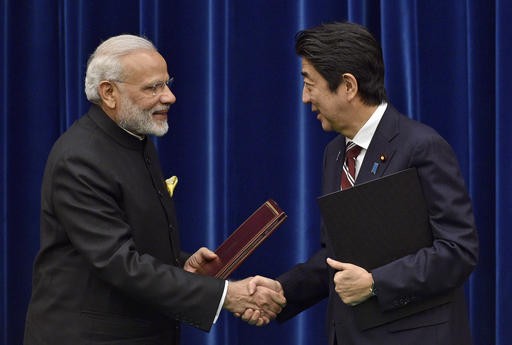 India's Prime Minister Narendra Modi (left) and Japan's Prime Minister Shinzo Abe shake hands after signing a joint statement at Abe's official residence in Tokyo, Japan, Friday, Nov. 11, 2016. (Pool Photo via AP/Franck Robichon)
Japan and India have formally signed a civil nuclear pact in which Tokyo agreed to export civilian nuclear power equipment and technology, as the Japanese nuclear industry seeks markets overseas.
Japanese Prime Minister Shinzo Abe and his Indian counterpart, Narendra Modi, also agreed during talks Friday to advance business and security cooperation.
The nuclear pact, though limited to peaceful commercial use, is controversial because India has not signed the Nuclear Non-Proliferation Treaty.
Abe's pro-business government seeks to export nuclear power plants because of shrinking business at home since the 2011 Fukushima nuclear disaster. Exports of infrastructure, including high-speed railway systems, are part of Abe's growth strategy.
On Saturday, Abe is to escort Modi on a Japanese shinkansen "bullet" train to visit a train factory in Kobe in western Japan.