TheJakartaPost
Please Update your browser
Your browser is out of date, and may not be compatible with our website. A list of the most popular web browsers can be found below.
Just click on the icons to get to the download page.


Popular Reads
Top Results
No results found. Please check your search term and try again
Can't find what you're looking for?
View all search results
Popular Reads
Top Results
No results found. Please check your search term and try again
Can't find what you're looking for?
View all search resultsAnalysis: Elites bargain behind NasDem-Gerindra ‘merger’ talks
Change text size
Gift Premium Articles
to Anyone
Share the best of The Jakarta Post with friends, family, or colleagues. As a subscriber, you can gift 3 to 5 articles each month that anyone can read—no subscription needed!
 Set as preferred source
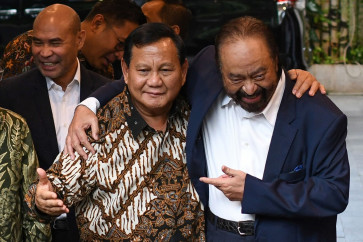
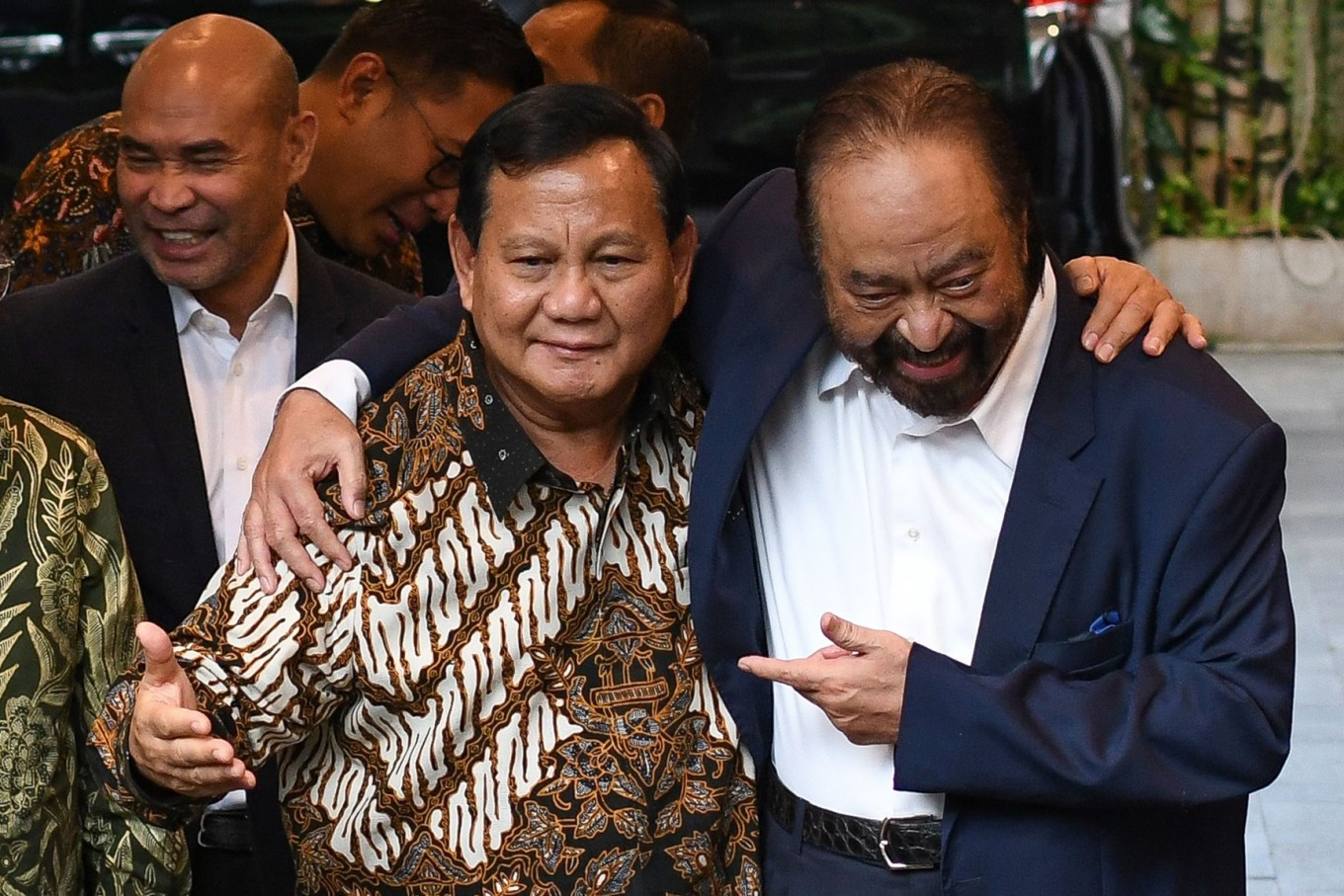 NasDem Party chair Surya Paloh (right) embraces then-president-elect and Gerindra Party chair Prabowo Subianto (left) on Tuesday after a meeting between the two party leaders at Prabowo's residence on Jl. Kertanegara in South Jakarta. Surya, who supported Prabowo's rival Anies Baswedan in the Feb. 14, 2024, election, said he would support Prabowo's administration. (Antara/Aditya Pradana Putra)
I
t is hard to conceive of a national political landscape without constant maneuvering among political parties, trying to shape its direction. Recent speculation over a potential unification of the NasDem Party and Gerindra Party has brought a recurring question to the forefront: Do parties function as institutional channels of representation, or have they become mere instruments of elite bargaining?
The issue escalated into a controversy on April 14, when hundreds of NasDem Party supporters rallied outside Tempomagazine’s office in West Jakarta. They had gathered to protest a cover story featuring party chairman Surya Paloh, which alluded to a possible merger between NasDem and President Prabowo Subianto’s Gerindra Party. NasDem swiftly rejected this characterization, insisting that the discussions concerned the formation of a “political bloc”: a looser yet potentially more durable configuration of power compared to a “merger”.
The discourse had gained traction following reports of a closed-door meeting in mid-February between the two political bigwigs at Prabowo’s private residence in Hambalang village, West Java. Gerindra executive chairman Sufmi Dasco Ahmad confirmed the meeting took place, but insider accounts suggested their discussion was far from informal, reportedly covering a proposal to raise the parliamentary threshold from 4 percent to 8 percent. According to these sources, the pair also discussed Surya’s stalled business ventures, specifically the Indonesia 1 twin towers project in Central Jakarta.
At the center of their meeting, however, was a political agenda: formalizing deeper cooperation that could evolve into a more consolidated arrangement. In fact, NasDem and Gerindra share a similar historical lineage: both were founded in the wake of post-reform internal fractures in the Golkar Party.
From a political economy perspective, these discussion areas are not incidental. They reflect a convergence of electoral strategy, regulatory engineering and economic interests, a pattern that has long characterized Indonesia’s party system.
At first glance, NasDem’s openness to forming a stronger political bloc appears paradoxical, as its electoral performance indicates increasing stability rather than a decline. Since its establishment in 2011, the party has demonstrated consistent growth: NasDem secured 6.68 percent (35 seats) of the vote in the 2014 election, increased its share to 9.05 percent (59 seats) in 2019, and gained 9.66 percent (69 seats) in 2024. Among mid-tier parties, this trajectory positions NasDem as one of the most resilient players.

NasDem also has significantly outperformed its peers. The Democratic Party, for instance, has experienced a steady decline since its 2009 peak, with its vote share falling to 7.43 percent in the last election. Meanwhile, the United Development Party (PPP), an Islamic outfit that recorded a comparable, albeit slightly higher, share of the votes in 2014, has since lost all seats in the House.