The Jakarta Post
Please Update your browser
Your browser is out of date, and may not be compatible with our website. A list of the most popular web browsers can be found below.
Just click on the icons to get to the download page.


Popular Reads
Top Results
No results found. Please check your search term and try again
Can't find what you're looking for?
View all search results
Popular Reads
Top Results
No results found. Please check your search term and try again
Can't find what you're looking for?
View all search resultsIndonesia-US defense cooperation: Between national interest and geopolitical pressures
Indonesia’s deepening military ties with the United States represent a high-stakes balancing act between necessary defense modernization and the preservation of its foundational "free and active" sovereign identity.
Change text size
Gift Premium Articles
to Anyone
Share the best of The Jakarta Post with friends, family, or colleagues. As a subscriber, you can gift 3 to 5 articles each month that anyone can read—no subscription needed!
 Set as preferred source
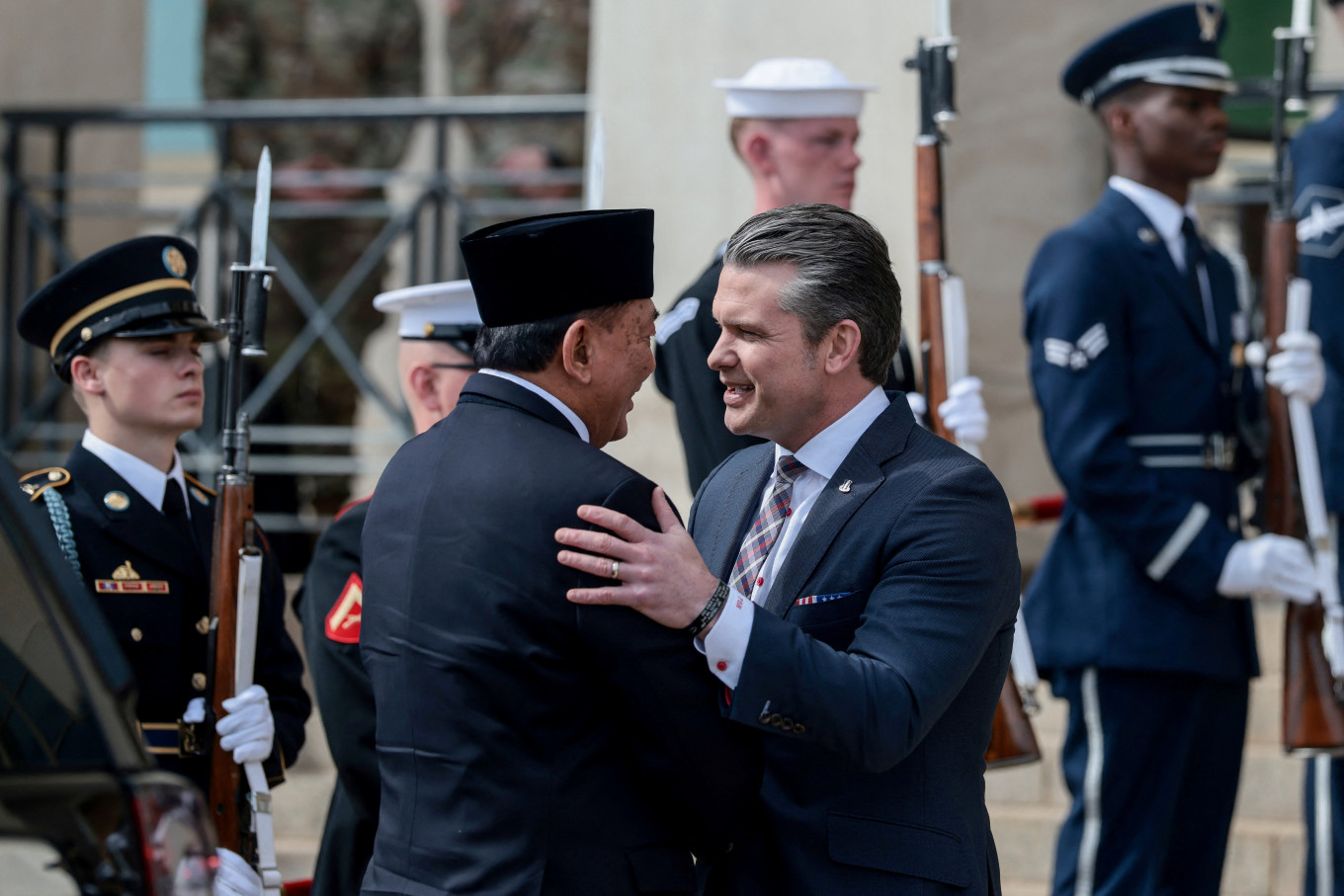 United States Defense Secretary Pete Hegseth (center right) greets Indonesian Defense Minister Sjafrie Sjamsoeddin on April 13, 2026, during an honor cordon at the Pentagon in Arlington, Virginia, just outside Washington, D.C. (Reuters/Evelyn Hockstein)
T
he newly signed major military cooperation between Indonesia and the United States should not be interpreted through a simplistic lens as a mere technical arrangement in the field of defense. Rather, it represents an intersection of constitutional, strategic and moral considerations that demand a clear, critical and proportionate assessment.
In a global landscape marked by rising tensions and geopolitical fragmentation, military cooperation is never neutral; it inevitably carries implications that extend far beyond the realm of security. From a constitutional perspective, this policy direction must be measured against the mandate of the Preamble to the 1945 Constitution, which affirms Indonesia’s commitment to contributing to a world order based on independence, lasting peace and social justice.
This principle is not merely symbolic; it serves as an ethical foundation and a benchmark for foreign policy. Consequently, any military cooperation that risks reinforcing global conflict structures or implicitly legitimizing international injustices deserves serious scrutiny. Public criticism, in this context, should not be viewed as resistance and rather as an expression of constitutional vigilance.
Within national law, the framework of Law No. 3/2002 on state defense and Law No. 37/1999 on foreign relations clearly stipulate that international cooperation must not compromise sovereignty, draw Indonesia into permanent military alliances or escape national political control. Indonesia’s long-standing "free and active" foreign policy tradition has consistently rejected bloc politics and defense pacts. Therefore, any defense partnership must remain limited, selective and carefully calibrated so as not to erode the country’s strategic autonomy.
The fundamental question is whether this cooperation with the US strengthens Indonesia’s self-reliance or opens the door to new, subtle yet systemic dependencies.
Nevertheless, the potential benefits of such a cooperation cannot be dismissed. Enhancing defense capacity through joint training, knowledge transfer and the professionalization of the Indonesian Military (TNI) constitutes a concrete advantage. Access to advanced military technology and the opportunity to bolster Indonesia’s bargaining position in the Indo-Pacific region are also significant incentives.

In the context of maritime security, particularly in strategic areas such as the North Natuna Sea, this cooperation may even serve as an instrument for maintaining regional stability. However, these benefits should not come at the expense of critical oversight.