The Jakarta Post
Please Update your browser
Your browser is out of date, and may not be compatible with our website. A list of the most popular web browsers can be found below.
Just click on the icons to get to the download page.


Popular Reads
Top Results
No results found. Please check your search term and try again
Can't find what you're looking for?
View all search results
Popular Reads
Top Results
No results found. Please check your search term and try again
Can't find what you're looking for?
View all search resultsIndonesia’s market fever needs a credibility cure
Investors need one of two things: better returns to compensate for risk, or lower risk to justify staying. Indonesia is giving them neither.
Change text size
Gift Premium Articles
to Anyone
Share the best of The Jakarta Post with friends, family, or colleagues. As a subscriber, you can gift 3 to 5 articles each month that anyone can read—no subscription needed!
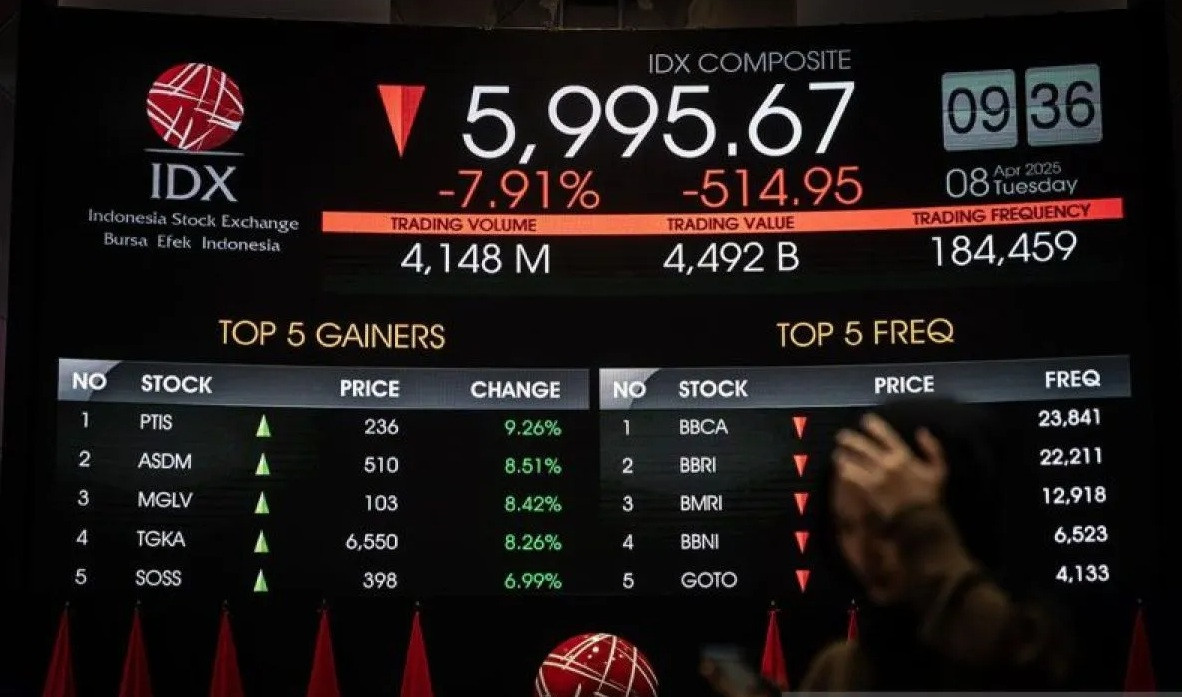 A woman walks pasts a digital screen displaying the movement of Indonesia Stock Exchange composite index on June 25, 2025. (Antara/Bayu Pratama)
W
hen Purbaya Yudhi Sadewa became finance minister last September, he made a promise that was hard to forget: stocks, he said, would go “to the moon” once confidence returned. The market has not gone to the moon. Instead, it has hit earth with a thud.
By June 4, the rupiah and the Indonesia Stock Exchange (IDX) Composite index were the worst performers in Asia. The currency had lost nearly 8 percent against the dollar year-to-date; the IDX had fallen about 32 percent. By May, foreign investors had pulled Rp 4.1 trillion (US$226.57 million) from equities and Rp 3.7 trillion from Indonesian government bonds.
The government can point to global turbulence. But Indonesia’s neighbors have faced the same storm. Their markets have started to recover, while Indonesia’s have not.
The problem is not only external shock. It is confidence, or rather, the loss of it.
In markets like these, investors need one of two things: better returns to compensate for risk, or lower risk to justify staying. Preferably, they need both. Indonesia is giving them neither.
Bank Indonesia (BI) has done its bit. On May 20, it raised the BI rate by 50 basis points. With growth still holding up, the move was supposed to stem outflows and make rupiah assets more attractive without badly hurting the economy. But this did not work out too well. Between the announcement and June 4, the rupiah lost almost another 2 percent against the dollar, while the IDX fell more than 8 percent, indicating the stubbornly low confidence in rupiah-based assets.

The problem is never about return per se; rather, it is also about the perceived risk profile. The yield spread between 10-year Indonesian government bonds and US Treasuries widened from 1.929 percentage points at the start of 2026 to 2.219 points on June 3. The gap between the BI rate and the Fed funds rate also widened, from 1 percentage point to 1.5 points after BI’s May hike. That means investing in rupiah-denominated assets is generally more profitable, at least on paper.