The Jakarta Post
Please Update your browser
Your browser is out of date, and may not be compatible with our website. A list of the most popular web browsers can be found below.
Just click on the icons to get to the download page.


Popular Reads
Top Results
No results found. Please check your search term and try again
Can't find what you're looking for?
View all search results
Popular Reads
Top Results
No results found. Please check your search term and try again
Can't find what you're looking for?
View all search resultsTrading our future: The financialization of nature
As governments turn forests into tradable carbon assets, local residents and indigenous communities are paying the price for a corporate climate shortcut that trades genuine emission cuts for green labels.
Change text size
Gift Premium Articles
to Anyone
Share the best of The Jakarta Post with friends, family, or colleagues. As a subscriber, you can gift 3 to 5 articles each month that anyone can read—no subscription needed!
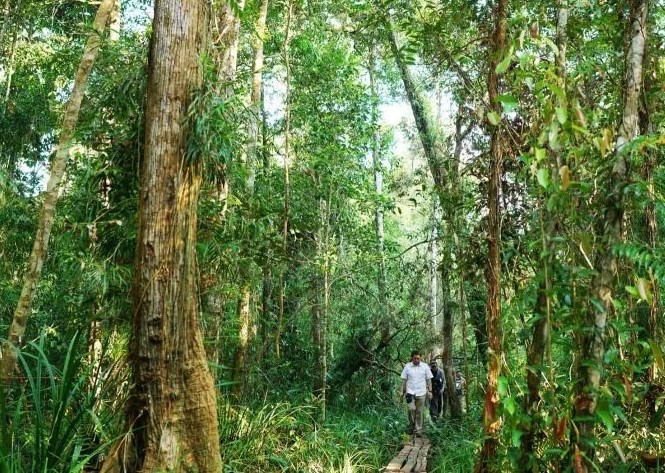 A group of people take a walk on May 20, 2022, in the Katingan Mentaya peatland, Southeast Asia’s largest, situated between two rivers of the same names and spanning over 150,000 hectares across the districts of Katingan and East Kotawaringin in Central Kalimantan. (Antara/PT Rimba Makmur Utama)
T
he emergence of the potential “Godzilla El Nino” serves as a grim reminder that the climate crisis is no longer a distant threat. Extreme weather events that were once considered rare are now occurring more frequently as global temperatures continue to rise.
This situation demands serious efforts to reduce greenhouse gas emissions, the primary cause of global warming. However, rather than pushing for fundamental changes to the production and consumption patterns that generate massive emissions, many countries are instead relying on market mechanisms as the primary instrument of climate action.
This approach did not emerge suddenly. It is rooted in the global climate governance regime that has evolved since the 1997 adoption of the Kyoto Protocol as the operational instrument of the United Nations Framework Convention on Climate Change (UNFCCC). One of the Kyoto Protocol’s most significant legacies is the introduction of various market-based, flexible mechanisms, including emissions trading and carbon offsets.
Through this approach, emissions reductions are no longer achieved solely by directly curbing pollution sources but also through tradable carbon credit transactions. In other words, one of the most dominant global responses to the climate crisis is the integration of the atmosphere, carbon and nature’s ecological functions into market mechanisms.
In the Indonesian context, various recent policies, including the forestry minister's regulation on carbon trading through the emissions balancing mechanism in the forestry sector and the presidential decree establishing the National Park Financing Task Force, demonstrate the government’s increasingly strong orientation toward mobilizing climate finance through forests. Proponents view these policies as a breakthrough capable of funding conservation while contributing to climate change mitigation.
However, they also raise a fundamental question: As forests are increasingly valued based on their carbon stocks and investment potential, are we protecting nature, or are we actually expanding market mechanisms into nature itself?

This question finds relevance when viewed through the lens of what communities living in and around forest areas have experienced so far.