The Jakarta Post
Please Update your browser
Your browser is out of date, and may not be compatible with our website. A list of the most popular web browsers can be found below.
Just click on the icons to get to the download page.


Popular Reads
Top Results
No results found. Please check your search term and try again
Can't find what you're looking for?
View all search results
Popular Reads
Top Results
No results found. Please check your search term and try again
Can't find what you're looking for?
View all search resultsThe AI rally may have finally met its match in the Fed
Signs have been multiplying that the AI mania is getting out of hand.
Change text size
Gift Premium Articles
to Anyone
Share the best of The Jakarta Post with friends, family, or colleagues. As a subscriber, you can gift 3 to 5 articles each month that anyone can read—no subscription needed!
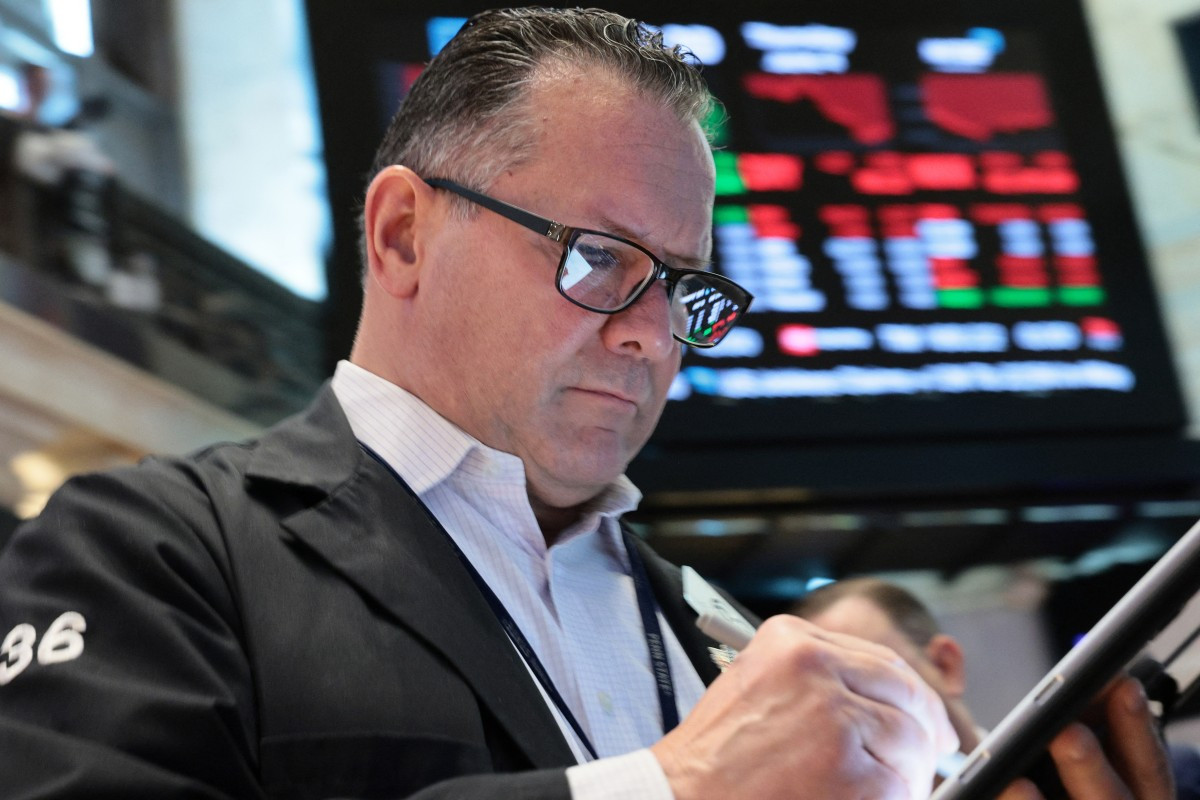 A trader looks at a tablet on the floor of the New York Stock Exchange during morning trading on June 4, 2026 in New York City, the United States. (AFP/Getty Images/Michael M. Santiago)
E
conomic expansions don't die of old age, and stock market rallies rarely do either. Some catalyst is needed to burst the bubble. In the case of the current AI boom, that may well be rising interest rates.
Economist Rudi Dornbusch famously said that aging expansions are killed by the Federal Reserve. Given the United States equity market's sharp pullback on Friday, particularly the move in tech, it looks like investors fear the Fed may strike again, only this time the main victim will be Wall Street.
The Nasdaq fell more than 4 percent on Friday, its biggest drop since the tariff turmoil around "Liberation Day" in April last year. Even more strikingly, the "SOX" chipmaker index plunged 10 percent, its biggest fall since the pandemic in 2020, and the fourth-largest drop since the index was launched in 1994.
True, the SOX had nearly doubled this year, but Friday's move was still seismic. All in all, some US$2 trillion was wiped off the value of US equities, more than half of that in chip stocks.
The selloff was notable not only for its ferocity but also its trigger: bumper US employment data. The rise in job growth in May came in at 172,000, double consensus expectations, while hiring in the previous two months was revised up sharply too.
Typically, this would be good news, a reflection of a strong economy and buoyant consumer demand that should, theoretically, boost firms' profits.

But Wall Street deemed the non-farm payrolls report to be "bad news" because it screamed "higher interest rates." Combine that with a market priced for perfection, and you have the recipe for a major reversal.
Signs have been multiplying that the AI mania is getting out of hand.
For one, there's the massive increase in AI capex forecasts, which naturally raises questions about future returns on that investment. Analysts at Goldman Sachs last week said they now expect $5.3 trillion of capex spending in 2025–2030 from the four largest hyperscalers, Meta, Microsoft, Amazon and Alphabet. That's up from $4.5 trillion before the first-quarter earnings season.
Then there's the eye-popping IPO blitz. The public listings of SpaceX, Anthropic and OpenAI are expected to deliver a combined market cap valuation just under $4 trillion.
That's a staggering figure, especially when you consider these firms' current revenues. SpaceX's 2025 sales were less than $20 billion, OpenAI's annualized revenue barely topped $20 billion, and Anthropic's first-quarter take this year was less than $5 billion. These figures will undoubtedly grow, but enough to justify these eye-watering IPO valuations?
Then there's the fear-of-missing-out or "FOMO" trade, with stocks recording huge one-day moves almost wholly divorced from fundamentals. Exhibit A: shares in Marvell Technology, a $100 billion company, rose 33 percent in one day last week after Nvidia CEO Jensen Huang said the smaller chipmaker would soon be a trillion-dollar company.
Bubble signs are flashing, to put it mildly.
Equity strategists at Citi last week warned that their global "bear market checklist" was at its frothiest level since the global financial crisis in 2008, and getting frothier.
The checklist comprises 18 "red flags", including earnings forecasts, fund flows, valuations, capex, investor sentiment, and equity issuance. Currently, on a global level, 10 out of 18 red flags are flashing, with 11.5 on the US checklist.
The checklist is not yet signaling the "overexuberance" that precipitated the 2000 and 2008 bear markets, Citi notes, but the direction of travel is worrying: "Once the count reaches double digits, it has historically tended to rise more rapidly, signaling a potential acceleration in risk."
Before Friday, it seemed like nothing would stop this equity juggernaut. Sure, rotation within tech and across sectors has picked up in recent months and some large tech companies had registered big short-term share price declines. But the benchmark indices continued to hit new high after new high.
So why might this pullback be different?
Bubbles tend not to be burst by a single trigger, but by a range of indicators moving into more extreme territory at the same time. Yet some triggers pack more of a punch than others. The cost of money is one of them.
Bond yields are rising, and so too are policy rate expectations. A quarter-point rate hike from the Fed by December is now almost fully priced. That doesn't sound like much, but before the Iran war, traders were expecting nearly three cuts.
Add an increasingly solid labor market to the US economy's high inflation and loose financial conditions, and the cost of money seems set to rise.
If so, history suggests economic growth is at risk. So is the runaway stock market.
---
The writer is a columnist for Reuters. The views expressed are personal.