The Jakarta Post
Please Update your browser
Your browser is out of date, and may not be compatible with our website. A list of the most popular web browsers can be found below.
Just click on the icons to get to the download page.


Popular Reads
Top Results
No results found. Please check your search term and try again
Can't find what you're looking for?
View all search results
Popular Reads
Top Results
No results found. Please check your search term and try again
Can't find what you're looking for?
View all search resultsAnalysis: Deindustrialization concerns return to the spotlight in Indonesia
Change text size
Gift Premium Articles
to Anyone
Share the best of The Jakarta Post with friends, family, or colleagues. As a subscriber, you can gift 3 to 5 articles each month that anyone can read—no subscription needed!
 Set as preferred source
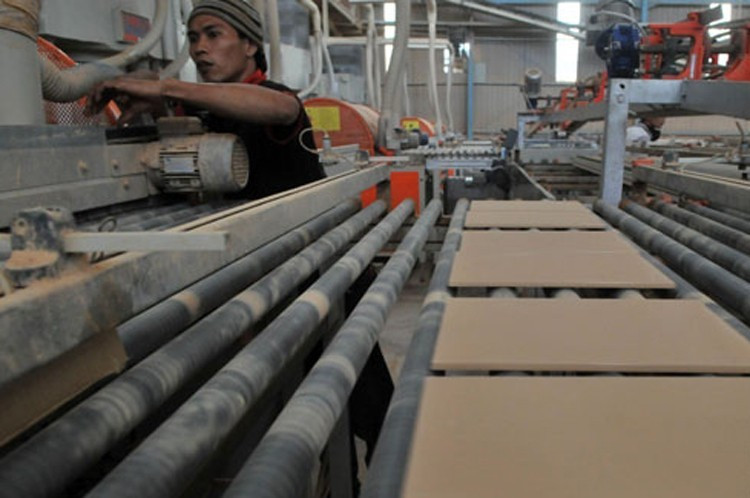 A worker works at a ceramics firm, PT Arwana Citramulia, in Serang, Banten. (Antara/Rosa Panggabean)
B
usiness groups in Indonesia are warning that regulatory uncertainty surrounding labor policies is accelerating premature deindustrialization, a phenomenon in which developing economies experience a decline in manufacturing's share of gross domestic product at a much lower income level than historically observed in advanced economies.
The debate has revived long-standing concerns over Indonesia's industrial trajectory since the 1998 Asian financial crisis and the effects of "Dutch disease," a form of resource curse associated with commodity booms that many observers argue has affected the post-Reform Era economy.
During deliberations on the Manpower Bill with House of Representatives Commission IX, the Indonesian Employers Association (Apindo) argued that business uncertainty, including frequent changes to wage regulations, has contributed to premature deindustrialization before Indonesia's GDP per capita reaches US$12,000. Apindo noted that four revisions to government wage regulations over the past decade have complicated long-term business planning, particularly for labor-intensive industries, by making labor costs harder to predict.
Apindo also argued that the Manpower Bill should support industrialization efforts. The association highlighted that manufacturing's share of GDP has fallen from around 30 percent during the New Order era to about 19 percent today, while manufacturing growth has lagged overall economic growth. According to Apindo, deindustrialization has contributed to the rise of informal employment, which now accounts for around 60 percent of the workforce. High informality, it argued, has also contributed to Indonesia's low tax ratio of 9.31 percent. The association further pointed to signs of Dutch disease, noting that commodities still account for around 65 percent of Indonesia's exports.
In response, the Industry Ministry argued that perceptions of deindustrialization are partly driven by misunderstandings of GDP data compiled by Statistics Indonesia (BPS) between 2005 and 2025. The ministry explained that several subsectors previously classified under manufacturing in the 2000 Indonesian Standard Industrial Classification (KBLI), including water supply, sewerage and waste management, remediation activities, information and communication, and certain service activities, were reclassified into separate sectors under KBLI 2010.
The ministry also noted methodological changes in GDP calculations. GDP based on 2000 constant prices was calculated using producer prices, while GDP based on 2010 constant prices uses basic prices before government interventions such as taxes and subsidies. It further highlighted that manufacturing grew by 5.3 percent in 2025, slightly faster than overall GDP growth of 5.11 percent. However, the ministry acknowledged that growth in the working-age population outpaced manufacturing job creation, with the former increasing by 11.82 percent and the latter by 8.62 percent between 2021 and 2025.

Manufacturing growth, measured using 2010 constant prices, rebounded strongly after contracting by 2.93 percent in 2020, a steeper decline than the economy-wide contraction of 2.07 percent during the COVID-19 pandemic. The sector subsequently grew faster than overall GDP for the first time since 2011. Manufacturing growth in 2025 also exceeded 5 percent for the first time since 2012. Nevertheless, it remained below the 6.26 percent growth recorded in 2011 and the 5.62 percent expansion achieved in 2012.