The Jakarta Post
Please Update your browser
Your browser is out of date, and may not be compatible with our website. A list of the most popular web browsers can be found below.
Just click on the icons to get to the download page.


Popular Reads
Top Results
No results found. Please check your search term and try again
Can't find what you're looking for?
View all search results
Popular Reads
Top Results
No results found. Please check your search term and try again
Can't find what you're looking for?
View all search resultsWhen schools become secondary to political agendas
When schools are bulldozed for glossy programs, education starts looking like collateral damage.
Change text size
Gift Premium Articles
to Anyone
Share the best of The Jakarta Post with friends, family, or colleagues. As a subscriber, you can gift 3 to 5 articles each month that anyone can read—no subscription needed!
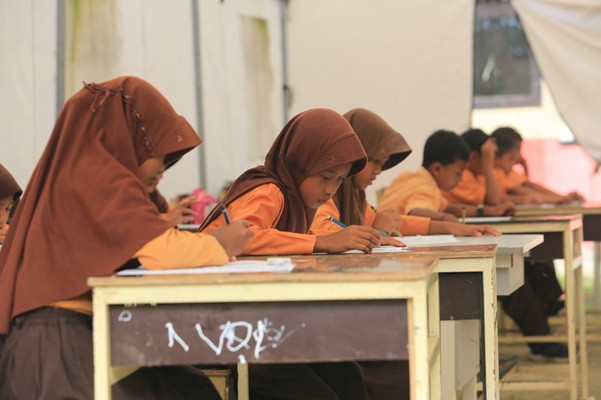 Temporary test: Students of SDN Alue Lhok elementary school in Jambak village, Pante Ceureumen district, West Aceh, take an exam inside a portable structure on June 5, 2026 due to a shortage of classrooms. (Antara/Syifa Yulinnas)
I
n Ende, East Nusa Tenggara, children recently watched their school demolished to make way for a Red and White Cooperatives (KDMP) facility. For those children, this was not a debate about economic development; it was the loss of the place where they learned, formed bonds and imagined their futures.
Similar episodes elsewhere point to a worrying pattern. In Majalengka, West Java, a severely damaged elementary school stood beside a newly built kitchen for the government's free nutritious meal program. In Bandung, West Java, parents at a state-run school for students with disabilities SLBN A Pajajaran protested after classrooms were dismantled during examination periods to make way for preparations of the Sekolah Rakyat program, officials later stated the school was being renovated, not displaced. An uncomfortable question arises: Why do schools so often appear negotiable when other priorities or flagship programs emerge?
Taken together, these episodes point to a troubling shift in how education is understood. Increasingly, education seems to be treated not as a foundational public institution but as a by-product of welfare programs.
The underlying assumption seems straightforward: if children are fed, villages prosper and poverty falls, educational progress will follow. Such logic is deeply flawed. It confuses what supports education with what education actually is.
Education is a public good. More fundamentally, it is a democratic common good. UNESCO argues that education should be understood not merely as a service delivered by the state or an investment in human capital, but as a shared social institution through which societies reproduce collective knowledge, values and capacities.
As educational theorist Gert Biesta puts forward, education serves purposes that exceed measurable outcomes; it helps form autonomous subjects capable of acting and judging in the world. Political theorist Danielle Allen similarly describes education as part of the civic infrastructure that enables trust, democratic participation and equality. Schools therefore serve a purpose that extends well beyond preparing people for work; they prepare people for citizenship.

This idea is shared among a broad tradition of democratic thought. Amy Gutmann underlines that democratic societies depend on education because it equips citizens to participate in collective self-government. Martha Nussbaum likewise warns against reducing education to economic utility, insisting that democracy requires citizens capable of critical thinking, independent judgment and empathy. These capacities are not secondary benefits of development. They are among its central goals.