The Jakarta Post
Please Update your browser
Your browser is out of date, and may not be compatible with our website. A list of the most popular web browsers can be found below.
Just click on the icons to get to the download page.


Popular Reads
Top Results
No results found. Please check your search term and try again
Can't find what you're looking for?
View all search results
Popular Reads
Top Results
No results found. Please check your search term and try again
Can't find what you're looking for?
View all search resultsBeyond 'look East': Japan, Malaysia build partnership for uncertain age
Beyond formal military alliances, the evolving Japan-Malaysia partnership proves that decades of accumulated trust can be just as strategically valuable as a defense pact in an uncertain Indo-Pacific.
Change text size
Gift Premium Articles
to Anyone
Share the best of The Jakarta Post with friends, family, or colleagues. As a subscriber, you can gift 3 to 5 articles each month that anyone can read—no subscription needed!
 Set as preferred source
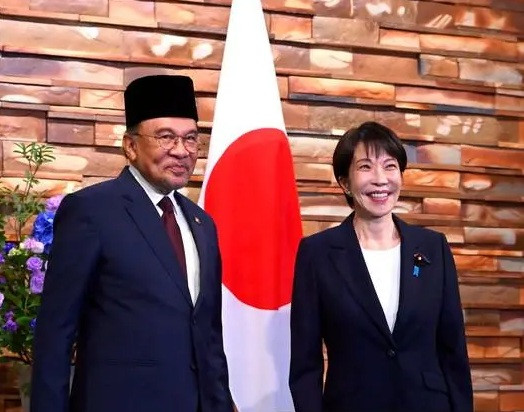 Japanese Prime Minister Sanae Takaichi (right) and Malaysian Prime Minister Anwar Ibrahim pose for photographs ahead of their bilateral meeting at the Prime Minister’s Office in Tokyo, on June 10, 2026. (Reuters/Pool/David Mareuil)
J
ust recently Malaysian Prime Minister Anwar Ibrahim made his third visit to Tokyo since taking office in November 2022. The visit marked a new stage in the Japan–Malaysia Comprehensive Strategic Partnership established in 2023.
The significance of the June 10 summit between Anwar and Japanese Prime Minister Sanae Takaichi lies not merely in the breadth of issues covered, but in the extent to which previously agreed initiatives have begun to produce tangible outcomes. Many of the priorities identified during then-prime minister Shigeru Ishiba’s visit to Malaysia in January 2025, including maritime security cooperation, energy security, critical minerals and the environment, have now moved beyond broad policy commitments.
Several developments illustrate this trend. The two governments welcomed the signing of a memorandum of cooperation between the Japan Coast Guard and the Malaysian Maritime Enforcement Agency, while reaffirming their commitment to deepening maritime cooperation in the Strait of Malacca and the South China Sea.
In the economic sphere, Malaysia pledged to maintain stable exports of liquefied natural gas (LNG), naphtha, urea and other strategic products to Japan. Anwar cited Japan's long-standing support for Malaysia's energy sector and the trust cultivated over decades between Petronas and Japanese firms.
The two sides also signed new agreements on energy security, energy transition and environmental sustainability. Progress was also reported on the ASEAN Power Grid initiative. Beyond policy coordination, projects such as the world’s first ammonia-fueled gas turbine power generation initiative and new sustainable aviation fuel (SAF) production facilities have already entered the construction phase.
At the same time, the agenda itself has expanded. Japan committed to supporting Malaysia’s capacity-building efforts in nuclear energy; the two governments agreed to establish a Japan–Malaysia AI platform; and both sides launched discussions on promoting local-currency settlement in trade and investment.

Beyond the individual projects themselves, a broader theme runs through the joint statement: the growing importance of security and resilience in both the maritime and economic domains.