The Jakarta Post
Please Update your browser
Your browser is out of date, and may not be compatible with our website. A list of the most popular web browsers can be found below.
Just click on the icons to get to the download page.


Popular Reads
Top Results
No results found. Please check your search term and try again
Can't find what you're looking for?
View all search results
Popular Reads
Top Results
No results found. Please check your search term and try again
Can't find what you're looking for?
View all search resultsThe price of centralization: Inside the regional budget crisis
As Jakarta starves the regions provinces of vital funds to bankroll high-profile national projects, the country’s decentralized governance is fracturing under the weight of an unprecedented, manufactured regional budget crisis.
Change text size
Gift Premium Articles
to Anyone
Share the best of The Jakarta Post with friends, family, or colleagues. As a subscriber, you can gift 3 to 5 articles each month that anyone can read—no subscription needed!
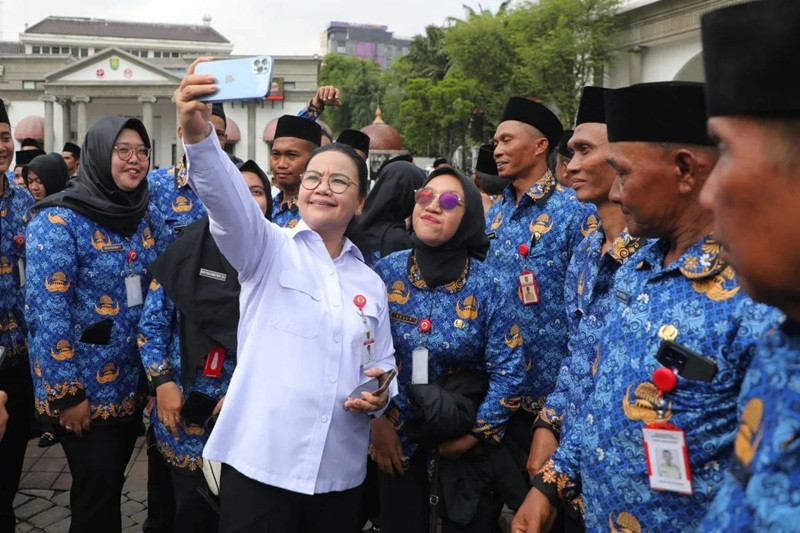 Semarang Mayor Agustina Wilujeng Pramestuti takes a selfie with newly recruited part-time government contract workers on Dec. 10, 2025, at Semarang City Hall in the Central Java capital. (Antara/Semarang Municipal Government)
A
crippling failure of regional public finance is currently sweeping across the country. While state budgets are drafted in Jakarta through the clinical lens of national priorities, the reality of these allocations in the provinces is being measured in unpaid wages and burning barricades.
When an angry crowd of government contract workers (PPPK) in North Maluku’s Tidore Islands recently set fires and clashed with security personnel to protest local plans to lay off 2,000 of their colleagues, it was not a localized administrative anomaly. It was the boiling point of a systemic squeeze.
How can an administration in North Maluku, a nickel-rich province boasting a staggering 34 percent economic growth rate, find itself functionally bankrupt in cash?
The paradox has continued in Lhokseumawe, Aceh, where the municipal treasury is equally empty: Around 3,000 contract employees were left without their July salary and 13th-month pay because the administration simply ran out of funds.
On Java, the Cirebon regent has openly pleaded for the central government to take back the crushing payroll burden. Meanwhile in East Nusa Tenggara (NTT), a whopping 9,000 out of 12,000 nonpermanent workers face the imminent threat of contract nonrenewal.
This contagion is nationwide. Home Minister Tito Karnavian recently confirmed that the central government was preparing an emergency top-up scheme for around 39 local administrations that were completely unable to meet their salary obligations for PPPK.

The immediate driver of this regional crunch is a severe, top-down reduction in revenue transfers. The central government has allocated Rp 693 trillion (US$38 billion) for regional transfers (TKD) in the 2026 state budget. This represents a stunning 20 percent drop from the already reduced Rp 869 trillion allocation for 2025, marking the lowest nominal funding level for the country’s regions in nearly two decades.