The Jakarta Post
Please Update your browser
Your browser is out of date, and may not be compatible with our website. A list of the most popular web browsers can be found below.
Just click on the icons to get to the download page.


Popular Reads
Top Results
No results found. Please check your search term and try again
Can't find what you're looking for?
View all search results
Popular Reads
Top Results
No results found. Please check your search term and try again
Can't find what you're looking for?
View all search resultsWhy NU's leadership race matters beyond Indonesia
The upcoming leadership transition at Nahdlatul Ulama is not just an internal election; it is a high-stakes contest that will shape the future of global Islam, democratic resilience and Indonesia's trajectory toward 2029.
Change text size
Gift Premium Articles
to Anyone
Share the best of The Jakarta Post with friends, family, or colleagues. As a subscriber, you can gift 3 to 5 articles each month that anyone can read—no subscription needed!
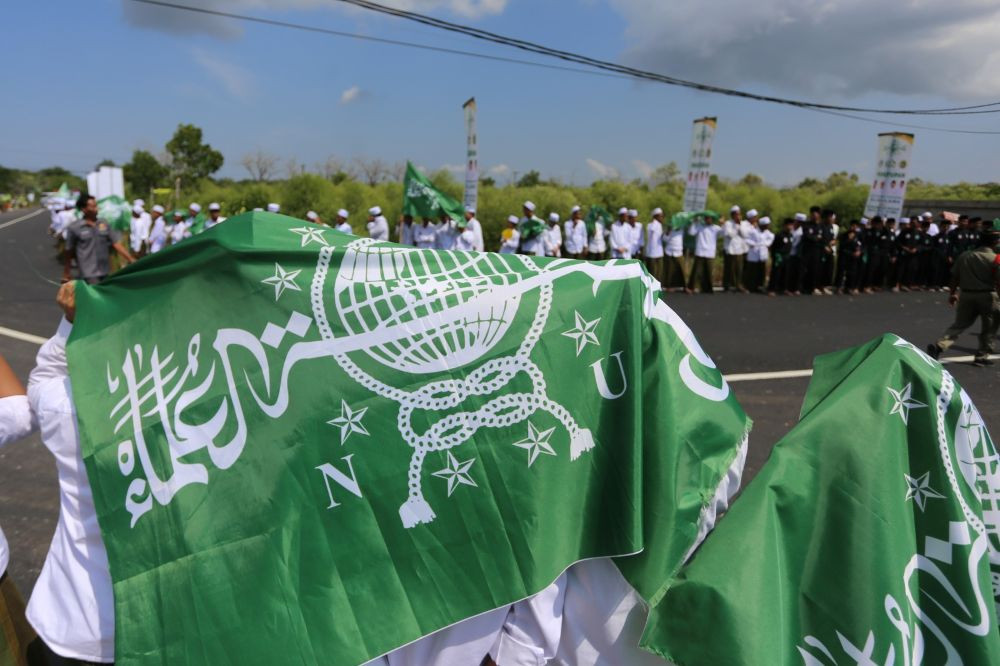 Bated breath: Groups of santri (Islamic boarding school students) hold aloft the flag of Muslim organization Nahdlatul Ulama (NU) as they wait along a road for the presidential motorcade to arrive on June 23, 2026, ahead of the closing ceremony of the NU National Conference of Islamic Scholars and Grand Conference at the Syachona Mohammad Cholil Islamic Institute in Bangkalan, East Java. (Antara/Moch. Asim)
W
hen Indonesians discuss the upcoming congress of Nahdlatul Ulama (NU), the world’s largest Muslim organization, the conversation often centers on a familiar question: Who will become the next chairman? That question, while valid, misses the larger story.
The real significance of NU’s 35th National Congress, scheduled for Aug. 27-31 in Jombang, East Java, extends well beyond an internal leadership contest. The outcome will influence how Indonesia’s largest Islamic civil society organization responds to profound global transformations, from artificial intelligence and demographic change to shifting geopolitical competitions and the future of democratic governance. Furthermore, the results will shape the relationship between religion, the state, and civil society as Indonesia moves toward its 2029 presidential election.
For international observers, NU is far more than just another religious organization. Boasting tens of millions of followers, thousands of pesantren (Islamic boarding schools), universities, hospitals, charitable foundations and deep community networks, NU represents a foundational pillar of Indonesian civil society.
Few organizations anywhere in the Muslim world possess a comparable combination of religious authority, social legitimacy, and institutional reach. This is precisely why NU’s leadership transition deserves close attention beyond Indonesia’s borders.
Throughout its first century, NU demonstrated a remarkable ability to reconcile Islamic tradition with democratic citizenship. Scholars like Robert W. Hefner have described NU as a vital contributor to Indonesia’s democratic resilience, while Greg Barton has highlighted its capacity to adapt to changing political and social environments without abandoning its traditional roots.
Crucially, NU’s influence has never rested solely on theology; it derives equally from its ability to mediate conflict, promote moderation, and maintain social cohesion in a country defined by extraordinary diversity.

However, the challenges facing NU today differ fundamentally from those encountered by its founding generation.