The Jakarta Post
Please Update your browser
Your browser is out of date, and may not be compatible with our website. A list of the most popular web browsers can be found below.
Just click on the icons to get to the download page.


Popular Reads
Top Results
No results found. Please check your search term and try again
Can't find what you're looking for?
View all search results
Popular Reads
Top Results
No results found. Please check your search term and try again
Can't find what you're looking for?
View all search resultsThe rise of dynasties and politicization of meritocracy in the TNI
As the TNI swaps rigid seniority for an ill-defined model of "meritocracy," the rhetoric of professional advancement increasingly serves as a convenient cover for dynastic privilege and political patronage.
Change text size
Gift Premium Articles
to Anyone
Share the best of The Jakarta Post with friends, family, or colleagues. As a subscriber, you can gift 3 to 5 articles each month that anyone can read—no subscription needed!
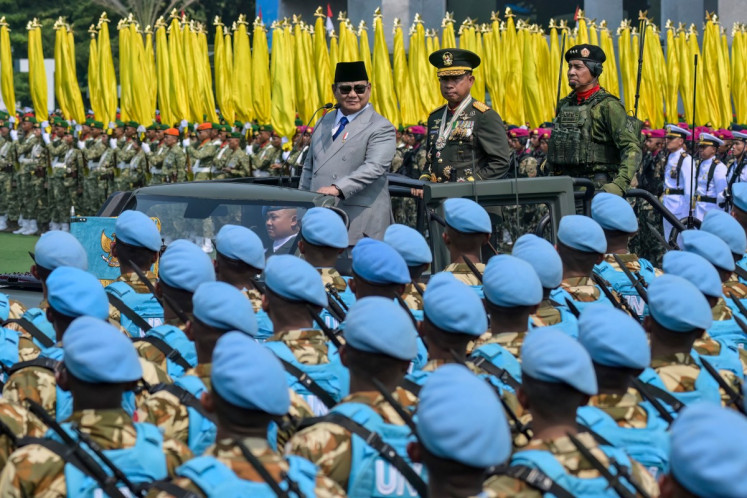
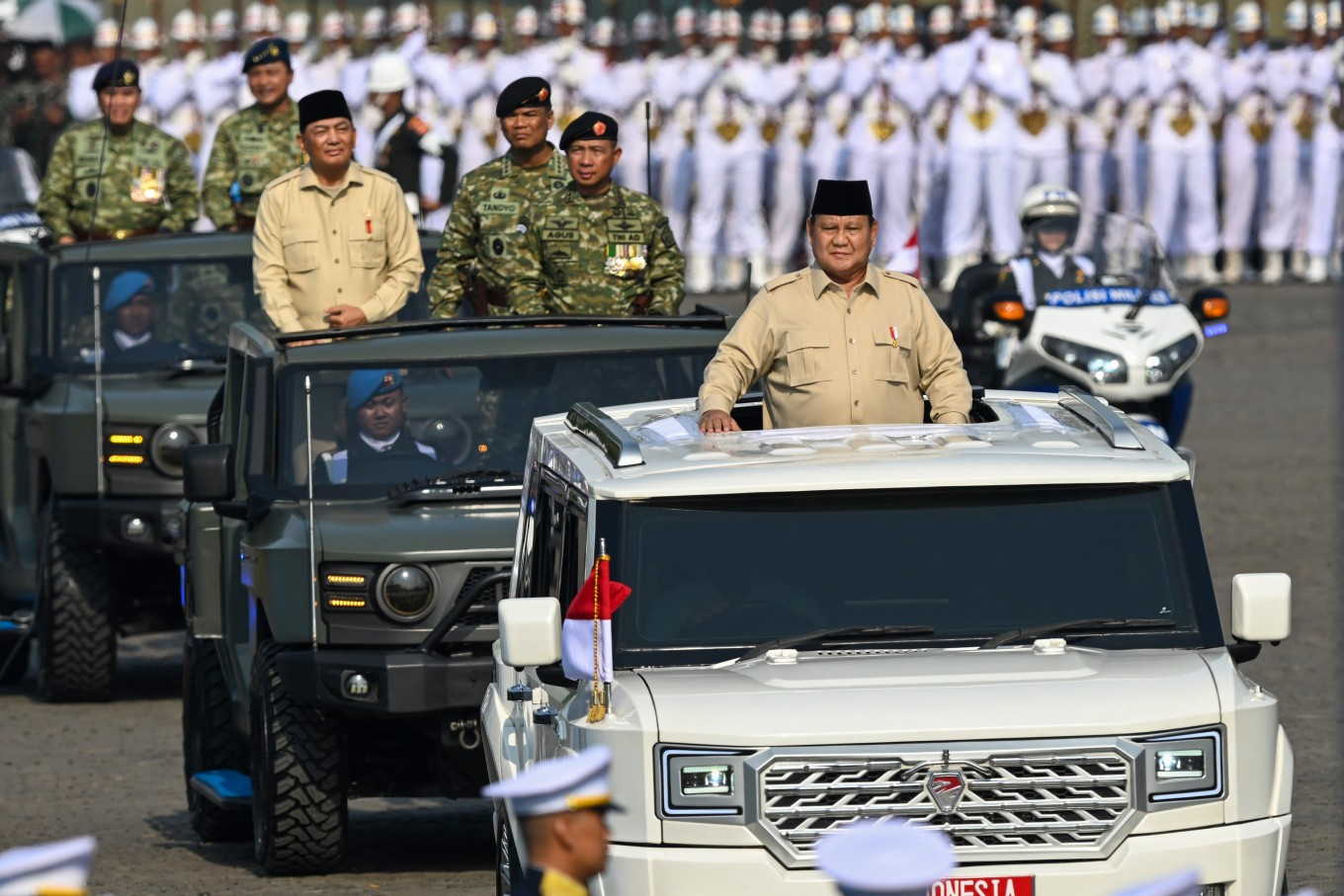 President Prabowo Subianto (front), accompanied by Defense Minister Sjafrie Sjamsoeddin (left, second row), Indonesian Military (TNI) commander Gen. Agus Subiyanto (right, second row) and other military leaders, inspects forces from his presidential vehicle in October ahead of a ceremony to celebrate the 80th anniversary of the TNI at the National Monument (Monas) complex in Central Jakarta. (Antara/Fauzan)
T
he promotion architecture within the Indonesian Military (TNI) is undergoing a significant structural shift under President Prabowo Subianto. Seniority and conventional command rotations, long the bedrock of military advancement, are increasingly being superseded by a broader, more subjective set of criteria: competence, achievement, dedication and nationalism.
In principle, this modernizing shift is designed to fast-track high-performing officers into strategic commands. In practice, however, these criteria lack clear benchmarks and transparent procedures. Without consistent, measurable metrics, the rhetoric of "meritocracy" risks becoming a convenient facade for institutional discretion and political favoritism.
This tension sits at the heart of the TNI’s contemporary personnel crisis. As security challenges evolve, the armed forces undeniably require specialized expertise in cyber operations, intelligence, defense diplomacy, technological procurement and logistics. Officers commanding these domains may not follow traditional combat-arms trajectories, and their specialized skills may warrant accelerated promotion.
Yet, exceptional advancement only retains institutional legitimacy when anchored by explicit criteria and a compelling defense rationale. Replacing seniority with an ill-defined concept of "achievement" does not inherently foster equity; instead, it creates a vacuum where external interference and subjective judgment dictate who is deemed exceptional.
Formally, senior appointments are vetted by the High-Ranking Promotion and Position Council (Wanjakti). While Wanjakti has historically served as a battleground for factional rivalries and personal networks, it has traditionally provided a layer of procedural order and institutional oversight. Today, that oversight is under strain. When an officer’s career trajectory appears to depend on palace proximity, dynastic ties or factional alignment, internal confidence in Wanjakti, and the perceived integrity of the entire promotion system, erodes.
A prominent flashpoint for this debate is the trajectory of Lt. Col. Teddy Indra Wijaya. An active-duty Army officer and long-time aide-de-camp to Prabowo, Teddy was appointed Cabinet Secretary, a civilian post, shortly after the inauguration. Presidential Regulation No. 148/2024 subsequently restructured the Cabinet Secretariat, creating a legal mechanism that allowed him to retain his active military status.

Critics viewed this as a bespoke institutional workaround designed to insert an active-duty officer into the core of civilian governance. The core issue is not Teddy’s personal competence, but rather the elasticity of regulations to accommodate individuals close to the executive, blurring established civil-military boundaries.