The Jakarta Post
Please Update your browser
Your browser is out of date, and may not be compatible with our website. A list of the most popular web browsers can be found below.
Just click on the icons to get to the download page.


Popular Reads
Top Results
No results found. Please check your search term and try again
Can't find what you're looking for?
View all search results
Popular Reads
Top Results
No results found. Please check your search term and try again
Can't find what you're looking for?
View all search resultsDevelopment economics for an age of upheaval
As the boundaries that once separated sectors become blurred, prosperity increasingly depends on how economies build the ecosystems that sustain technological progress and nurture new productive capacity.
Change text size
Gift Premium Articles
to Anyone
Share the best of The Jakarta Post with friends, family, or colleagues. As a subscriber, you can gift 3 to 5 articles each month that anyone can read—no subscription needed!
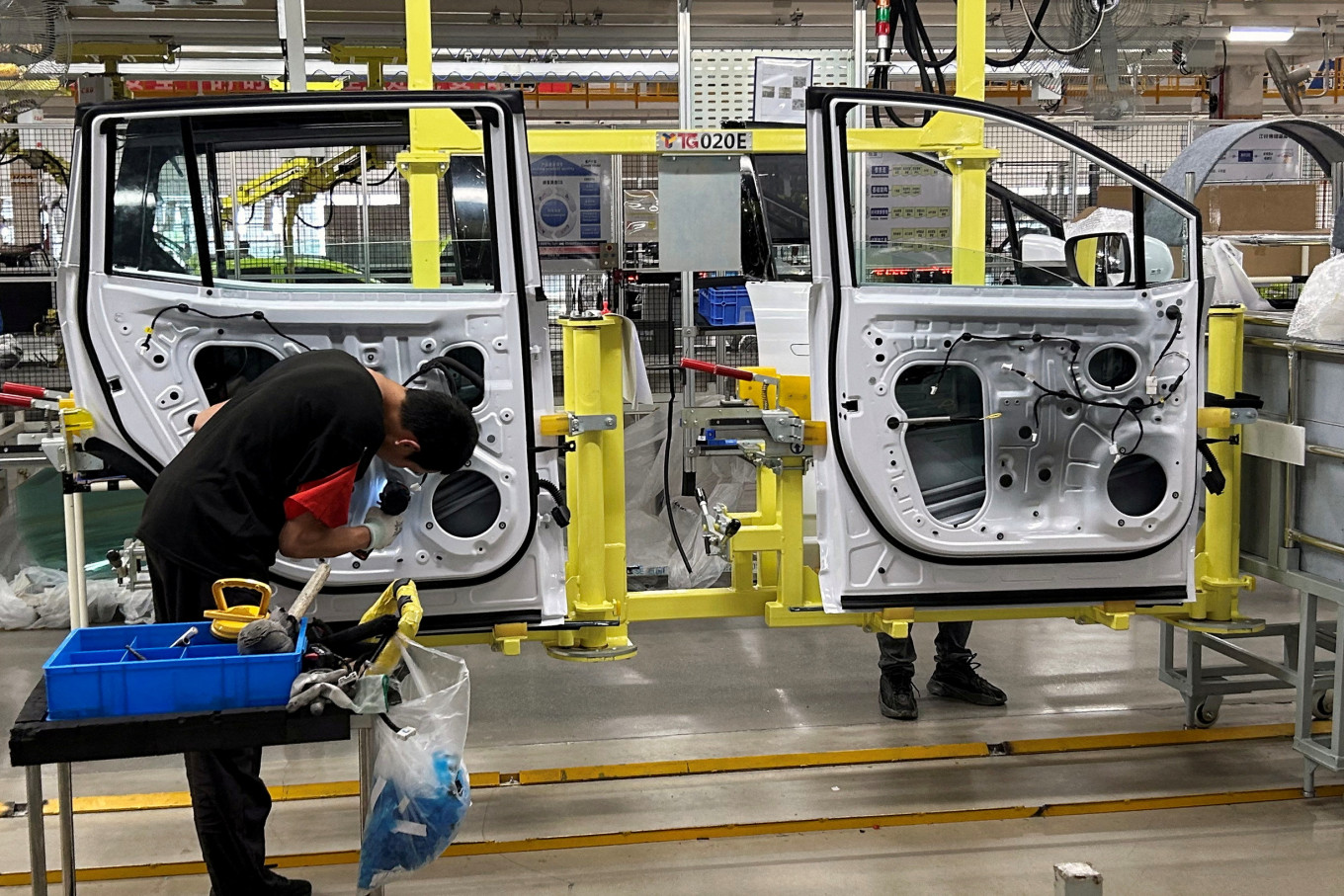 Employees work on an electric vehicle production line during an organized media tour to a factory under Jiangling Group Electric Vehicle (JMEV), in Nanchang, Jiangxi province, China, on May 22, 2024. (Reuters/Kevin Krolicki)
T
he economist Dani Rodrik recently reopened one of development economics’ most enduring debates, arguing that developing countries should shift their attention from manufacturing to productivity-enhancing services. In doing so, he has challenged the long-held assumption that manufacturing remains the primary engine of development.
But the deeper issue is not whether services should replace manufacturing. It is whether structural transformation should still be understood primarily as the movement of resources between sectors. That framework, which guided development economics for more than half a century, is increasingly out of step with how modern economies actually create value.
From W. Arthur Lewis and Raúl Prebisch to Albert Hirschman and Nicholas Kaldor, structural transformation was understood as the reallocation of labor and capital from low-productivity activities to more productive ones. Manufacturing occupied center stage because it combined economies of scale, technological learning and sustained productivity growth. But that framework reflected the realities of an era in which factories were at the heart of technological progress and income growth.
The objectives of development have not changed since then, as productivity, technological learning and economic complexity remain the foundations of long-term prosperity. What has changed is where, and how, those capabilities emerge.
Three factors are driving this shift. AI is rapidly reshaping the relationship between labor and production, while geopolitical fragmentation has brought industrial policy back to the center of economic strategy. At the same time, the clean-energy transition is reorganizing production around new technologies, critical minerals and low-carbon industries. Although none of these developments diminishes the importance of manufacturing, together they suggest that it no longer defines structural transformation.
Increasingly, what matters is not the sectors themselves but the productive capabilities they encompass. Modern manufacturing depends on software, logistics, finance and digital platforms, while agriculture relies on biotechnology, satellite imagery and precision engineering. Sophisticated services now drive the technological learning, innovation and export dynamism once associated almost exclusively with manufacturing. As a result, the boundaries once separating these sectors are steadily blurring.

In many respects, capabilities have always been the true engine of structural transformation. And given that productive services increasingly perform the role historically played by manufacturing, the most important question is which activities continuously expand an economy’s productive capacity. The answer lies in ecosystems that integrate manufacturing and engineering with research, digital infrastructure, finance and public institutions.