The Jakarta Post
Please Update your browser
Your browser is out of date, and may not be compatible with our website. A list of the most popular web browsers can be found below.
Just click on the icons to get to the download page.


Popular Reads
Top Results
No results found. Please check your search term and try again
Can't find what you're looking for?
View all search results
Popular Reads
Top Results
No results found. Please check your search term and try again
Can't find what you're looking for?
View all search resultsForget crude. War pushes refiners to the brink
The renewed disruption to traffic through Hormuz has once again choked off regional exports, threatening hopes for a recovery in Asian or Middle Eastern refinery activity.
Change text size
Gift Premium Articles
to Anyone
Share the best of The Jakarta Post with friends, family, or colleagues. As a subscriber, you can gift 3 to 5 articles each month that anyone can read—no subscription needed!
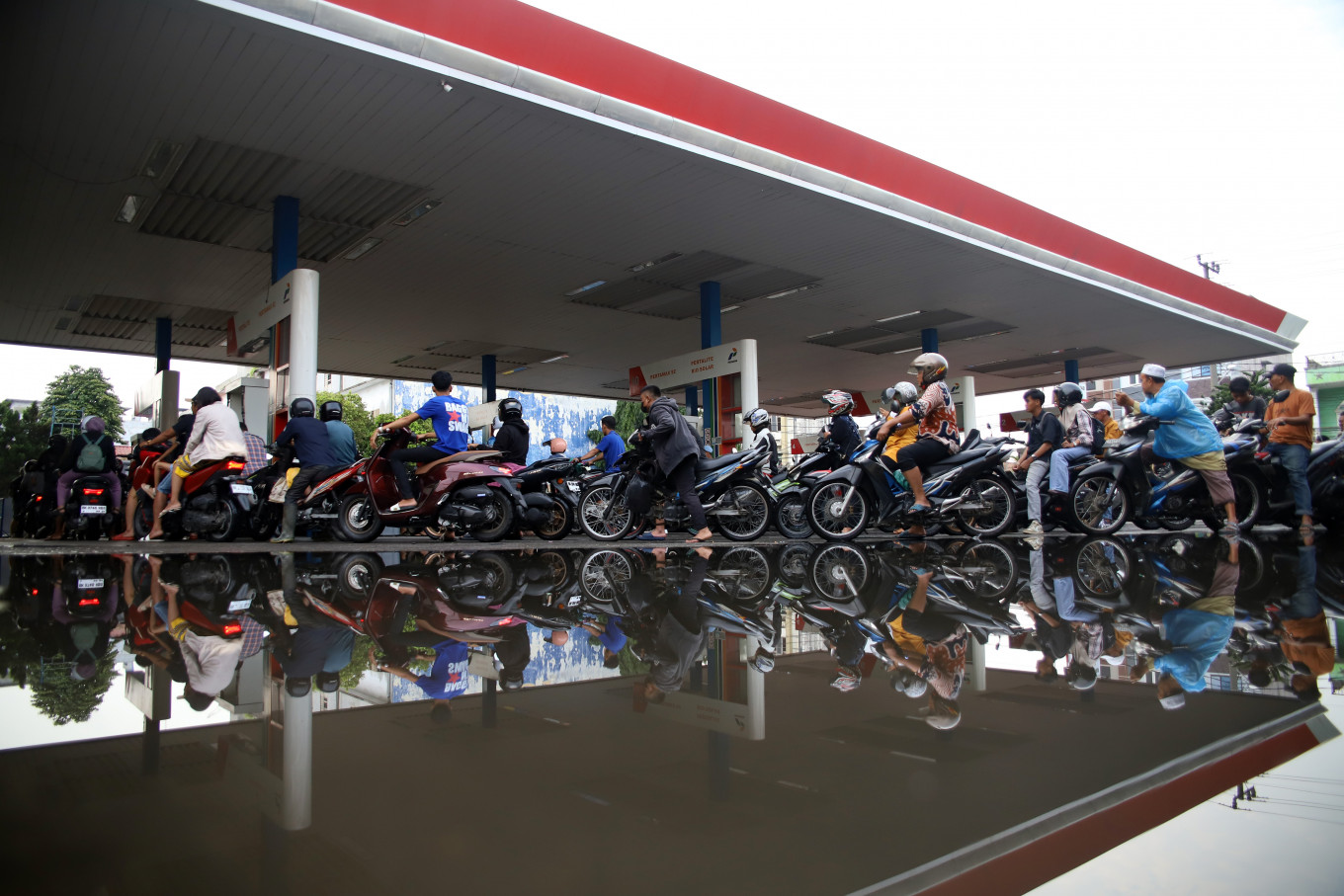 Motorists queue to buy Pertalite gasoline on July 16 at a gas station in Medan, North Sumatra. (Antara/Yudi Manar)
T
he global oil refining industry is flashing warning signs. The supply chain for the products that fuel the global economy is under growing stress as conflicts in the Middle East and Russia ripple through energy markets.
Benchmark crude prices have retreated sharply from the highs of US$118 a barrel reached during the height of the Iran war and are now hovering around $85, suggesting many investors believe the threat of an energy crisis has faded.
While crude supplies have partially recovered, the system that converts crude into fuels is still struggling after months of disruption from conflicts in Russia and the Middle East.
Gasoline and diesel inventories sit near multi-year lows, refining margins have surged to record levels and refinery throughput remains severely curtailed across key producing regions.
Households and industry consume refined products, not crude, so this is the stress they should be monitoring.
Refineries have proven to be tempting targets.

In the Middle East, major refineries in Saudi Arabia, Bahrain, Kuwait and the United Arab Emirates remain either partially or entirely offline after the outbreak of the Iran conflict on February 28 triggered the closure of the Strait of Hormuz.
China, meanwhile, has sharply reduced refinery runs to compensate for the massive decline in imports during the Iran conflict. Across Asia, refiners have also been forced to reduce operations because of constrained crude supplies.
And Russia's refining sector has been battered by sustained Ukrainian drone attacks, triggering domestic fuel shortages that have forced Moscow to curb diesel exports in a bid to contain soaring local prices.
Taken together, those disruptions removed roughly 5 million barrels per day of global refining output in the second quarter compared with a year earlier, with refinery runs averaging around 78 million bpd, according to the International Energy Agency.
The temporary reopening of Hormuz following the United States-Iran ceasefire on June 17 briefly eased some of the pressure. But even though Gulf producers rushed crude exports through the waterway, refined product flows remained far weaker. According to Kpler data, the region exported around 4 million bpd of crude in June, but only 1 million bpd of oil products, totaling a quarter of pre-war levels.
Now, the renewed disruption to traffic through Hormuz — due to escalating hostilities between the US and Iran — has once again choked off regional exports, threatening hopes for a recovery in Asian or Middle Eastern refinery activity.
Buffers and time are both running short.
The US emerged as the world's refinery of last resort in the first half of this year, ramping up exports of crude, gasoline, diesel and aviation fuel to compensate for disruptions elsewhere.
But it is now running out of steam.
US crude inventories, including commercial stocks and those in the government's emergency reserve, have fallen since the start of the Iran war to their lowest level since 1984. Gasoline stocks are at their thinnest seasonal level since 2012, while diesel inventories only recently recovered from their lowest levels in more than two decades.
At the same time, total US crude and product exports have started to retreat as refiners meet rising domestic demand. Weekly exports fell to 10.7 million bpd last week, the weakest since March, after reaching a record 14.2 million bpd in April.
With domestic stockpiles under pressure and summer fuel demand at its seasonal peak, Washington's ability to keep supplying the rest of the world looks increasingly constrained.
Perhaps the clearest signal of distress comes from refining profits.
The benchmark US 3-2-1 refining margin, or crack spread, recently surged to nearly $70 a barrel, an all-time high. In Northwest Europe, refining margins climbed to seasonal records near $30 a barrel.
Diesel markets appear particularly tight. European diesel margins have jumped to a record of around $65 a barrel, while US gasoline margins are hovering near the record levels reached during the energy shock of 2022 after Russia’s full-scale invasion of Ukraine.
Markets do not pay refiners such extraordinary premiums unless consumers are competing for scarce fuel supplies.
As the Iran crisis enters its fifth month, traders have become increasingly convinced that US President Donald Trump will do almost anything to avoid a politically damaging spike in US fuel prices.
But the bright flashing warning signs coming out of the refining system suggest the US president may struggle to prevent one.
A rapid recovery in global refinery output remains unlikely. Several major refining hubs remain impaired, due to conflict, supply disruptions or export restrictions, just as summer demand for road fuels and jet fuel is reaching its peak. Diesel stocks typically build during summer ahead of winter.
Refining output in Russia will likely take months, if not years, to recover, assuming no further Ukrainian strikes — an assumption few are willing to make. Middle East refineries will also require months to ramp up operations once flows through Hormuz are normalized — whenever that is.
As inventories run dry, the only remaining market lever would be demand destruction, which could curtail economic activity around the world.
Energy markets have handled the chaotic first half of 2026 remarkably well, but with global fuel stocks now running worryingly thin, the global economy finds itself dangerously exposed.
---
The writer is a columnist for Reuters. The views expressed are personal.