TheJakartaPost
Please Update your browser
Your browser is out of date, and may not be compatible with our website. A list of the most popular web browsers can be found below.
Just click on the icons to get to the download page.


Popular Reads
Top Results
No results found. Please check your search term and try again
Can't find what you're looking for?
View all search results
Popular Reads
Top Results
No results found. Please check your search term and try again
Can't find what you're looking for?
View all search resultsWho will sit atop the next world order?
American hegemony has given way to a new formulation based on rivalry and competition among several major powers, where there is no longer a fixed, codified set of rules.
Change text size
Gift Premium Articles
to Anyone
Share the best of The Jakarta Post with friends, family, or colleagues. As a subscriber, you can gift 3 to 5 articles each month that anyone can read—no subscription needed!
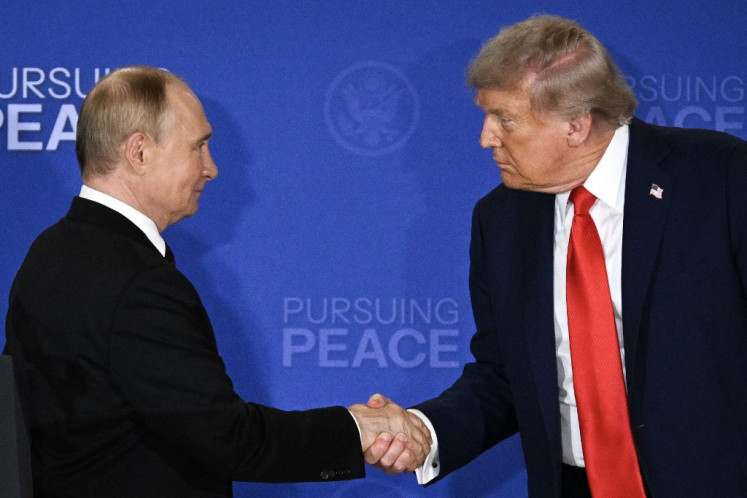
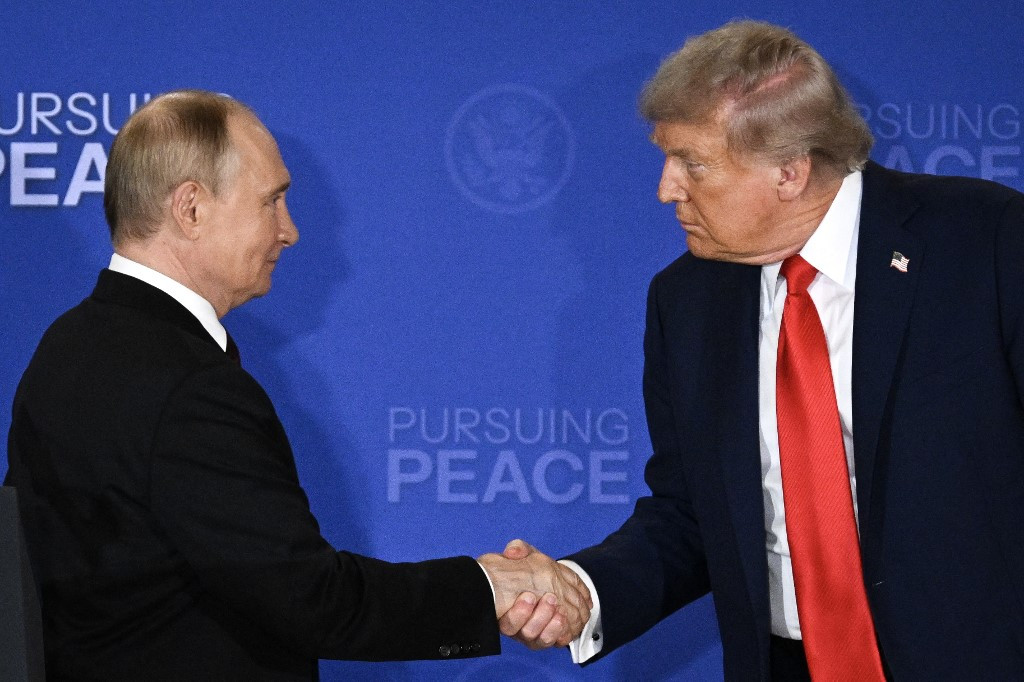 United States President Donald Trump (right) and Russian President Vladimir Putin shake hands at the end of a joint press conference after participating in a US-Russia summit on Ukraine at Joint Base Elmendorf-Richardson in Anchorage, Alaska, on August 15, 2025. (AFP/Drew Angerer)
T
he era in which global order rested on a United States monopoly over military and economic power and values has finally come to an end, taking Europe’s long period of stability with it. The world has become significantly more turbulent and uncertain, and the near future will bring even more instability.
In the past, the contours of the world order were clearly reflected in the G7/G8 format, which brought together the leading industrialized countries. But now there are competing formats such as the China-led Shanghai Cooperation Organization, the Russia-led Eurasian Economic Union, and the BRICS+ (Brazil, Russia, India, China, South Africa, and a half-dozen other members, plus 10 partner countries), all consisting predominantly of emerging economies.
American hegemony has given way to a new formulation based on rivalry and competition among several major powers, where there is no longer a fixed, codified set of rules. Instead, there is only economic, technological and military power, which implies a greater risk of conflict and even war between nuclear heavyweights.
This new order is anything but stable. The wars in Ukraine, in the Persian Gulf, and a civil war in Myanmar that no one is even bothering to try to end, attest to that, as does the persistent threat of war between China and Taiwan or on the Korean Peninsula. The two outright wars, coupled with Iran’s blockade of the Strait of Hormuz, have already had a significant impact on the global economy, owing to higher costs for oil, gas, fertilizer and other essentials. Many people are dying in both conflicts, and the risk of escalation continues to grow.
It is not surprising that Ukraine and Iran are attracting the most public attention. But these conflicts also have the character of proxy wars, because their strategic implications cannot be understood without accounting for the historic struggle between the US, the current top power, and China, the rising challenger. China is keeping a low profile, and quietly gaining the upper hand, as the US flails desperately in the Gulf and lashes out at longstanding friends and allies.
This high-level power struggle is a duel between vastly different systems that will shape the 21st century. The US is a highly competitive market economy and the world’s oldest democracy, albeit one that is currently besieged by tech-industry oligopolies.

China, by contrast, is a centralized state ruled by an all-powerful party that can exercise absolute control over the economy, the military and society. Within a single generation, it has transformed itself from a desperately poor, underdeveloped country into a realistic contender for the top spot in the world order. That is a colossal success no matter how you spin it.