The Jakarta Post
Please Update your browser
Your browser is out of date, and may not be compatible with our website. A list of the most popular web browsers can be found below.
Just click on the icons to get to the download page.


Popular Reads
Top Results
No results found. Please check your search term and try again
Can't find what you're looking for?
View all search results
Popular Reads
Top Results
No results found. Please check your search term and try again
Can't find what you're looking for?
View all search resultsThe ‘Sturm und Drang’ of a teenage girl and Indonesia’s transition to authoritarianism
Framed against the violent communist purges of 1965, Tari Lang’s debut memoir My Neighbour the Dictator weaves a gripping, Anne Frank–like coming-of-age story of a teenager thrust into Indonesia’s dangerous underground resistance.
Change text size
Gift Premium Articles
to Anyone
Share the best of The Jakarta Post with friends, family, or colleagues. As a subscriber, you can gift 3 to 5 articles each month that anyone can read—no subscription needed!
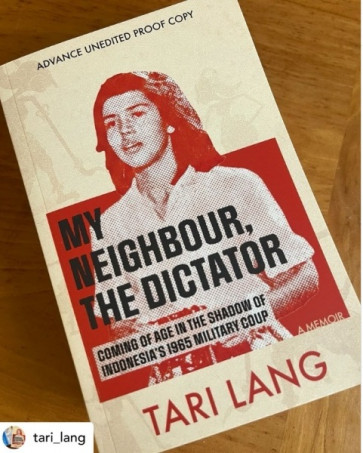
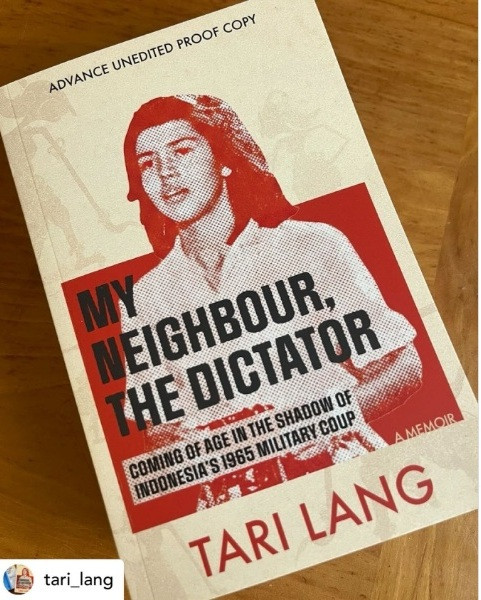 Tari Lang's memoir My Neighbour, the Dictator (Instagram/@tari_lang)
W
hy are coming of age stories immensely popular? Most likely because in varying degrees and forms, we all go through this Sturm und Drang period in our lives. It is the universal human experience of personal transformation from childhood to young adulthood, often marked by powerful emotions, raging hormones, existential questions, intense first loves and the dialectic between the discovery of one’s inner self, with an exploration of the outside world.
Tari Lang experienced all this. Furthermore, her personal transformation coincided and was acutely affected by Indonesia’s political transition from Sukarno’s leftist, anti-Western "Old Order" to Soeharto’s military-backed, capitalist "New Order”.
It was a violent, military-led succession sparked by the alleged 1965 coup attempt, leading to the purge of communists, ranking among the largest mass killings in the 20th century, and the transfer of power to Gen. Soeharto, whose authoritarian regime focused on economic growth and anticommunist stability. It was a seismic shift in Indonesia’s political landscape, which also reshaped global Cold War dynamics and Southeast Asian geopolitics.
Tari is the author of the recently published and immensely readable, page turner debut memoir My Neighbour the Dictator, published by Monsoon in May this year. The Indonesian version was published in September last year by Gramedia, with the title Rumah dengan Pintu Biru (The House with the Blue Door).
The original title of the book refers to the color of the door of one of the safe houses for fugitives after 1965. The English title, catchier for Western readers, fits the fact that Soeharto lived on Jl. Cendana which was only 750 meters away from where Tari and the Budiardjos lived since 1958 on Jl. Teuku Umar, Central Jakarta.
Disclosure: Tari is an old friend, from way back in the 1970s, when I did my BSc in sociology at City University between 1976 and 1979. I knew her through her mother, Carmel Budiardjo, who in 1973, famously founded Tapol, the British Campaign for Human Rights in Indonesia.

I first met her in 1977 when I went to see a play about political prisoners in Indonesia at the Half Moon Theatre, a fringe theater in London. In the foyer, a middle-aged woman was selling political badges. When I spoke to her, to my surprise, she replied in fluent Indonesian. That was the beginning of my decades-long friendship with Carmel, and subsequently, her two children, Tari and Anto, and her grandchildren, but primarily Tari, who is three years older than me.