The Jakarta Post
Please Update your browser
Your browser is out of date, and may not be compatible with our website. A list of the most popular web browsers can be found below.
Just click on the icons to get to the download page.


Popular Reads
Top Results
No results found. Please check your search term and try again
Can't find what you're looking for?
View all search results
Popular Reads
Top Results
No results found. Please check your search term and try again
Can't find what you're looking for?
View all search resultsCharting China's rise as a global superpower
As China’s modern navy reclaims the global footprint of its ancient treasure fleets, Southeast Asia faces a crucial test of strategic survival, led by an Indonesia that must assert its independence before regional stability slips away.
Change text size
Gift Premium Articles
to Anyone
Share the best of The Jakarta Post with friends, family, or colleagues. As a subscriber, you can gift 3 to 5 articles each month that anyone can read—no subscription needed!
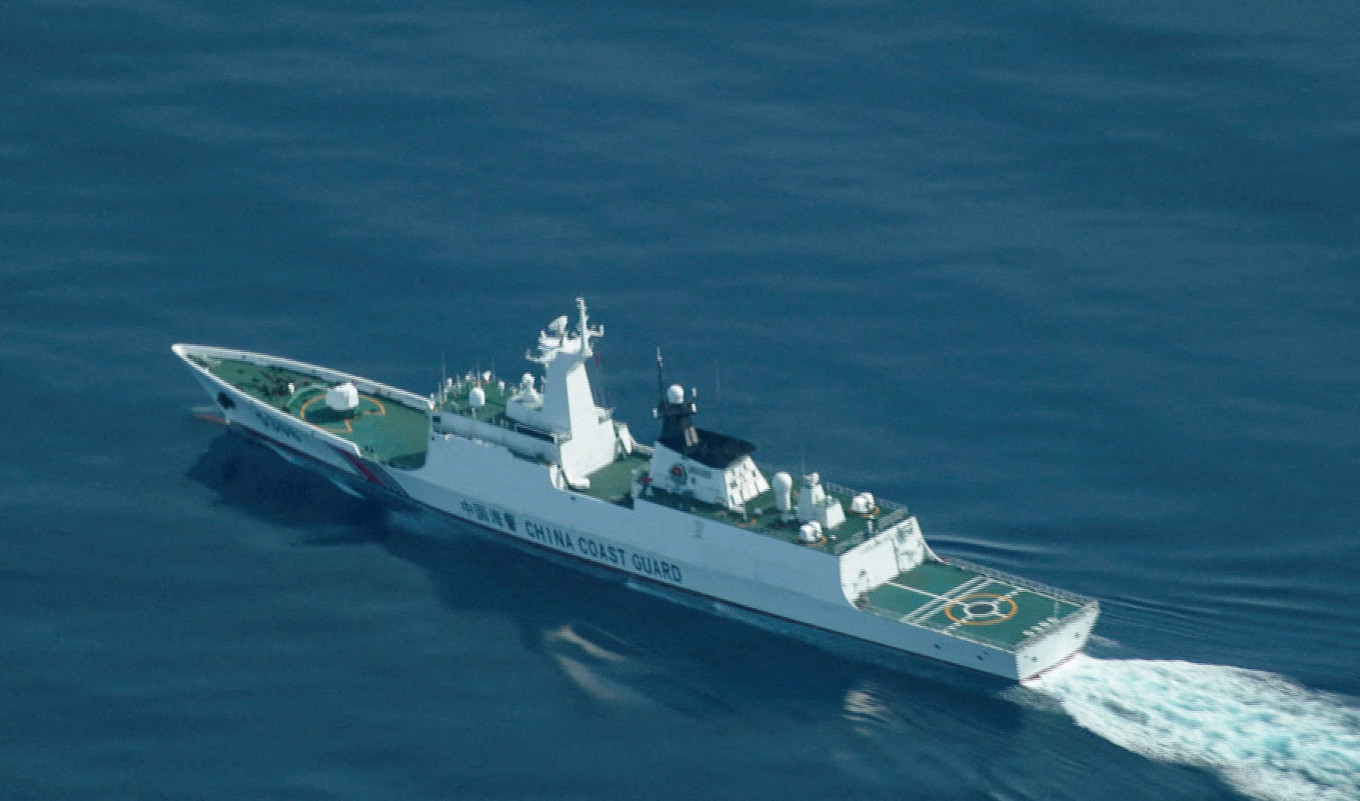 A China Coast Guard ship sails on Aug. 13, 2025, in waters near the disputed Scarborough Shoal in the South China Sea. (Reuters/Adrian Portugal)
F
or six centuries, the memory of Adm. Zheng He’s treasure fleets lay dormant in China’s strategic imagination. Today, that memory has been reawakened, not by wooden junks but by aircraft carriers, deepwater container ports and a coast guard patrolling waters thousands of kilometers from the mainland.
Understanding how China arrived at this juncture, and where it intends to venture next, is no longer an academic exercise for Indonesia and Southeast Asia. It is a matter of strategic necessity.
China’s relationship with maritime power is not a 21st-century invention; it is a deliberate revival.
In the early 1400s, Zheng led seven Ming dynasty voyages across the Indian Ocean to East Africa. Commanding fleets far larger and more technologically advanced than anything Europe would produce for another century, he projected imperial authority and established a China-centric maritime order without formal colonization, building upon the ancient Han dynasty’s maritime Silk Road that linked the Chinese coast to Southeast Asia, South Asia and the Middle East.
A long strategic retreat followed. Wary of the threat that seaborne trade posed to the Confucian social order, the Ming court turned inward after Zheng’s death, banning the construction of oceangoing vessels. This self-imposed maritime weakness coincided with China’s period of greatest historical humiliation, spanning from the Opium Wars to the Japanese occupation.
Beijing’s contemporary maritime assertiveness must be read against that historical trauma: It represents not merely raw geopolitical ambition but also a civilizational corrective, a resolve never again to leave its ocean flanks vulnerable. This posture follows a logic older than the modern navy itself.

Sun Tzu’s The Art of War, written some 2,500 years ago, posited that supreme victory is won without direct battle: It is achieved by shaping conditions until an adversary’s resistance becomes futile before the first shot is fired. Much of Beijing’s modern statecraft functions as a contemporary application of that maxim, prioritizing indirect maneuvering and economic leverage over open warfare to secure dominance.