The Jakarta Post
Please Update your browser
Your browser is out of date, and may not be compatible with our website. A list of the most popular web browsers can be found below.
Just click on the icons to get to the download page.


Popular Reads
Top Results
No results found. Please check your search term and try again
Can't find what you're looking for?
View all search results
Popular Reads
Top Results
No results found. Please check your search term and try again
Can't find what you're looking for?
View all search resultsWorld Cup 2026: The great and the good, the bad and the ugly
The 2026 FIFA World Cup delivered a thrilling 48-team spectacle culminating in Spain’s tactical triumph, yet behind the five-billion-viewer celebration lies a troubling balance sheet. From player burnout and commercial exclusion to political intrusion, this comprehensive autopsy reveals why soccer's stewards must urgently address systemic flaws before 2030.
Change text size
Gift Premium Articles
to Anyone
Share the best of The Jakarta Post with friends, family, or colleagues. As a subscriber, you can gift 3 to 5 articles each month that anyone can read—no subscription needed!
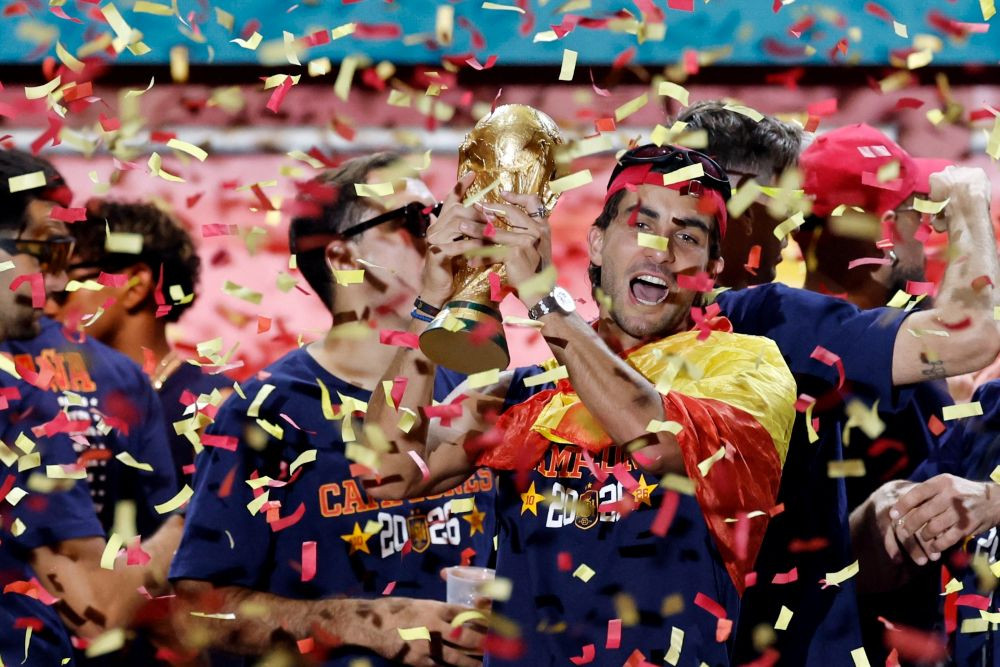 Heroes’ welcome: Spain forward Ferran Torres (center right) raises the FIFA World Cup 2026 trophy as his teammates celebrate on a stage at Cibeles Square in Madrid on July 20, 2026, one day after winning the country’s second World Cup title with a 1-0 victory over Argentina. (AFP/Oscar Del Pozo)
A
fter 39 days and 104 matches across the United States, Canada and Mexico, the 2026 FIFA World Cup concluded with Spain deservedly lifting its second trophy, defeating Argentina 1-0 in the final. Accumulating a cumulative global audience of five billion viewers, the tournament demonstrated the enduring power of soccer as a unifying cultural phenomenon. Yet behind the global spectacle, the expanded mega-event offered a complex balance sheet of structural achievements, tactical triumphs, operational missteps and systemic vulnerabilities that FIFA and future host nations - Spain, Portugal and Morocco in 2030 - must critically examine.
The great: Format success
The primary success of the 2026 edition lay in the validation of FIFA’s expanded 48-team format. Skeptics who warned of diluted competition and uninspiring group-stage matches were silenced by high-stakes drama and unprecedented competitive depth. Tiny Cabo Verde’s spirited encounters with former world champions demonstrated that global tactical standards are rapidly converging. Furthermore, the addition of a Round of 32 provided a high-intensity knockout barrier, forcing genuine title contenders to establish operational discipline and momentum early in the tournament.
Spain’s championship campaign showcased the ultimate triumph of collective philosophy over individual stardom. Under coach Luis de la Fuente, a squad boasting extraordinary talents like Rodri, Pedri, Lamine Yamal, Ferran Torres and Mikel Oyarzabal operated under an uncompromising ethos of mutual service and tactical cohesion. Navigating an exceptionally demanding knockout route - eliminating bitter rivals Portugal, a formidable Belgium and a clinical French side before subduing Argentina - Spain fielded the tournament’s most complete team, underpinned by a rock-solid defense and fluid, suffocating ball possession.
Beyond pure tactical execution, the cross-border organization across North America set an exemplary benchmark for venue execution, stadium atmosphere and crowd management. Law enforcement and local organizing committees successfully preserved order, preventing the fan volatility historically associated with major tournaments. On the pitch, Norway’s historic run to the quarterfinals, propelled by Erling Haaland and amplified worldwide by the viral "Viking Rowing" fan celebrations, highlighted the unique cultural resonance and emotional magic of the World Cup.
The good: Individual brilliance

The tournament also delivered notable individual achievements and institutional progress. Despite missing out on the trophy, legendary icons enhanced their global legacies: 39-year-old Lionel Messi defied age by recording eight goals and four assists, while France’s Kylian Mbappé captured the Golden Boot with 10 goals. However, Spain’s eventual victory with Mikel Oyarzabal as its top scorer (five goals) reinforced a fundamental soccer truth: comprehensive squad depth and collective commitment will always outweigh reliance on isolated superstars.