The Jakarta Post
Please Update your browser
Your browser is out of date, and may not be compatible with our website. A list of the most popular web browsers can be found below.
Just click on the icons to get to the download page.


Popular Reads
Top Results
No results found. Please check your search term and try again
Can't find what you're looking for?
View all search results
Popular Reads
Top Results
No results found. Please check your search term and try again
Can't find what you're looking for?
View all search resultsASEAN's 'flash point'
The joint comminuque resulting from last week's AMM made clear that ASEAN foreign ministers are fully cognizant of the region's parallels with the Mideast conflict, not least the issues pertaining to the vital South China Sea and its own pariah state, Myanmar.
Change text size
Gift Premium Articles
to Anyone
Share the best of The Jakarta Post with friends, family, or colleagues. As a subscriber, you can gift 3 to 5 articles each month that anyone can read—no subscription needed!
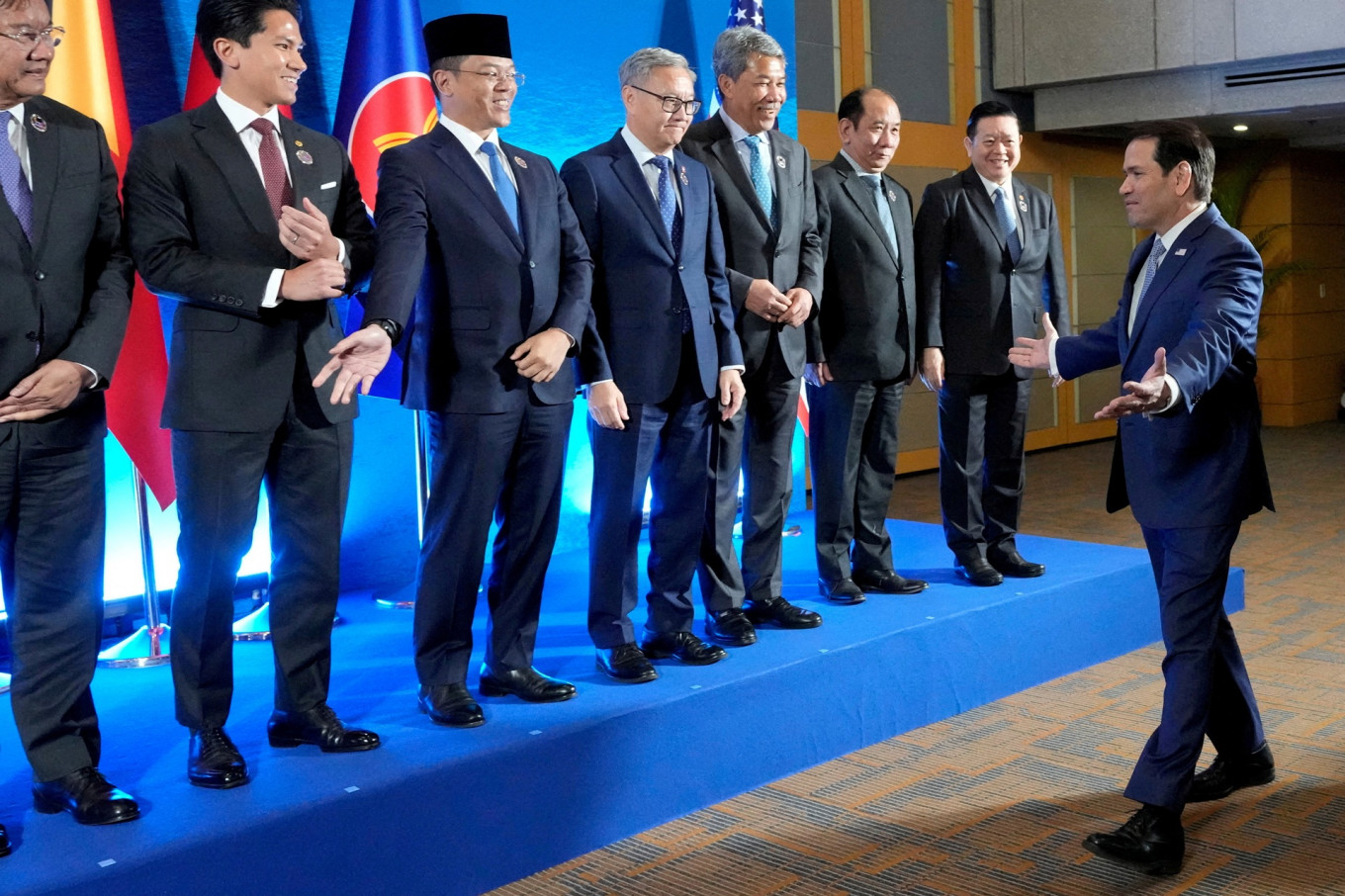 ASEAN foreign ministers (from left) Prak Sokhonn of Cambodia, Prince Abdul Maseen Bolkiah of Brunei, Sugiono of Indonesia, Thongsavanh Phomvihane of Laos, Mohamad Hasan of Malaysia and Hau Khan Sum of Myanmar, along with ASEAN Secretary-General Kao Kim Hourn, react as United States Secretary of State Marco Rubio (right) he arrives for a group photo during the ASEAN Post-Ministerial Conference with the US on July 22, 2026, on the sidelines of the ASEAN Foreign Ministers' Meeting (AMM) in Manila. (Reuters/Pool/Aaron Favila)
A
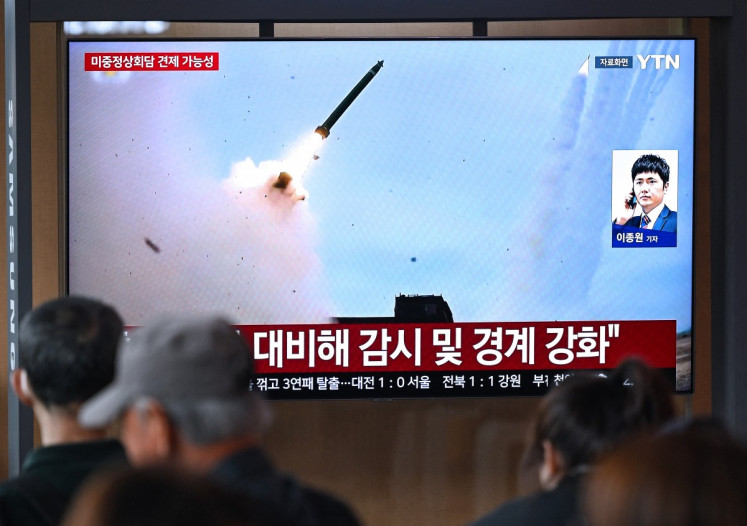
SEAN almost seemed to be prophesying its own destiny last week when its foreign ministers' meeting (AMM) in Manila focused predominantly on the United States-Israeli war on Iran, followed by the escalating military tension in the South China Sea. What is happening in the Middle East could one day happen in this region, too.
The war weighed heavily on the bloc for two reasons: Its economies depend heavily on Middle East energy, and the region’s contested waters carry a similar potential for global upheaval if they are mismanaged.
The US-Israel war on Iran dominated both the AMM and the ASEAN Regional Forum, attended by nearly all the world's major military powers, including Chinese Foreign Minister Wang Yi and US Secretary of State Marco Rubio.
But ASEAN also sits astride one of the world's busiest straits, the Malacca, where a conflict would be no less dangerous than that currently occurring over Hormuz.
Manila sits on the front line of the South China Sea dispute against China, which claims nearly the entire resource-rich sea as its own, though this has been rejected by the United Nations. Brunei, Malaysia and Vietnam also claim smaller portions of the vital waterway.
The South China Sea issue has seen little real progress, a concern that is reflected in the ministers' joint communique: strongly worded but diplomatically cautious. They appear to recognize that ASEAN could become the next source of global instability if the region is not handled with care by all sides.

On the Middle East war, the ministers called on all parties to exercise utmost restraint, avoid actions that could worsen the situation and resolve differences through diplomacy and dialogue to preserve regional peace and stability.