The Jakarta Post
Please Update your browser
Your browser is out of date, and may not be compatible with our website. A list of the most popular web browsers can be found below.
Just click on the icons to get to the download page.


Popular Reads
Top Results
No results found. Please check your search term and try again
Can't find what you're looking for?
View all search results
Popular Reads
Top Results
No results found. Please check your search term and try again
Can't find what you're looking for?
View all search resultsIBSA offers Indonesia a stronger Global South role
This diplomatic moment offers a second opportunity built on the India-Indonesia relationship: closer cooperation with the India-Brazil-South Africa Dialogue Forum, or IBSA.
Change text size
Gift Premium Articles
to Anyone
Share the best of The Jakarta Post with friends, family, or colleagues. As a subscriber, you can gift 3 to 5 articles each month that anyone can read—no subscription needed!
 Set as preferred source
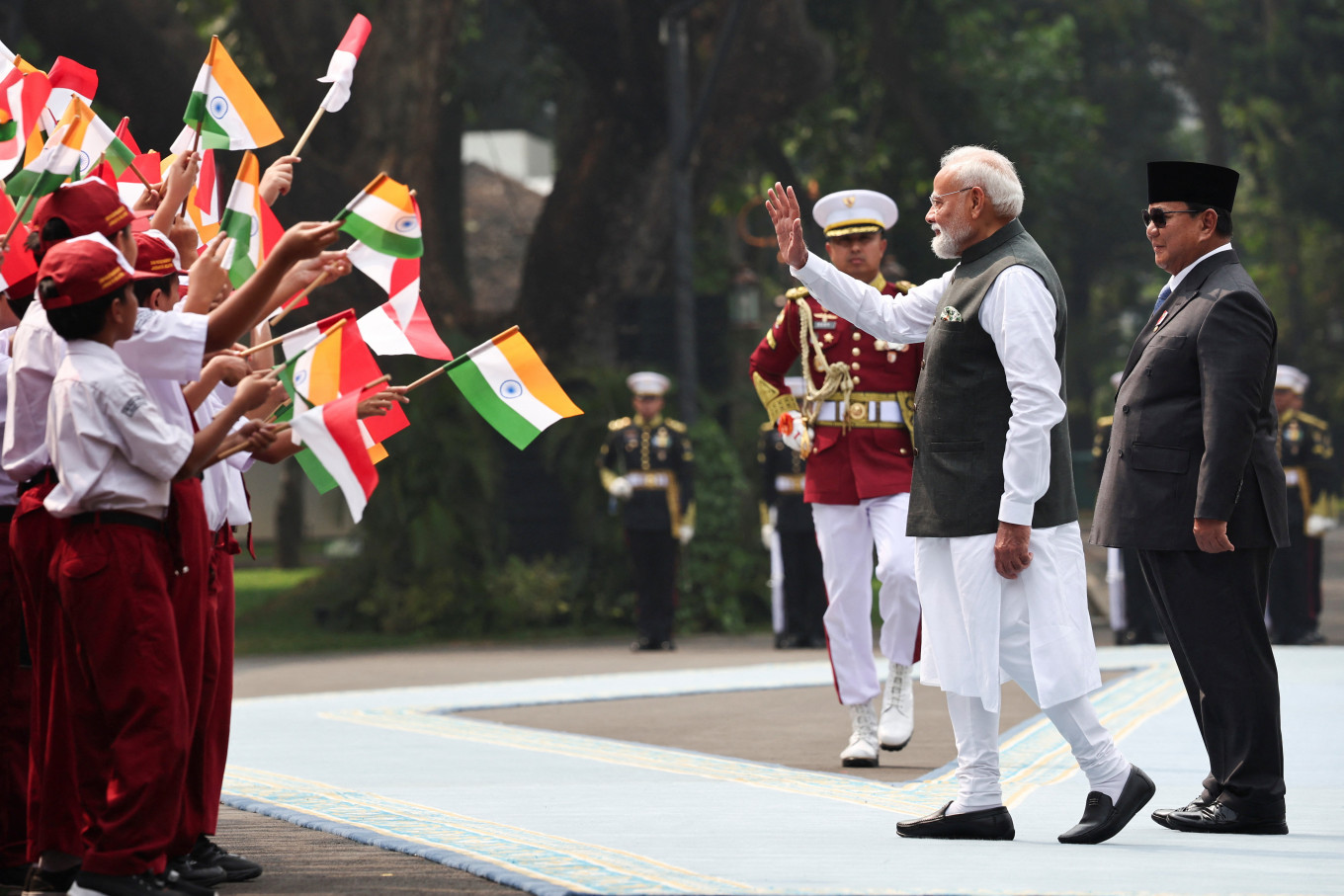 Indian Prime Minister Narendra Modi, accompanied by President Prabowo Subianto, waves to students during a welcoming ceremony on July 7 upon their meeting at the Merdeka Palace in Jakarta. (Reuters/Willy Kurniawan)
W
hen Indian Prime Minister Narendra Modi left Jakarta on July 8, he left behind the densest package of India-Indonesia agreements in years — spanning critical minerals and rare earths, solar energy, green hydrogen, bioenergy and civil nuclear cooperation.
The visit capped 18 months of unusual diplomatic momentum: President Prabowo Subianto's Republic Day visit to New Delhi in January 2025, the first foreign ministers' Joint Commission Meeting in four years this June and now the first bilateral summit between the two leaders.
The strategic rationale is strong on both sides. Indonesia holds the world's largest nickel reserves and accounts for more than half of global production, but its refining sector is dominated by a single foreign partner; India offers diversification and a vast market for battery materials. India, meanwhile, added roughly 26 GW of solar capacity in the first half of 2026 and has built digital public infrastructure at continental scale, while Indonesia's solar fleet remains modest despite its equatorial potential. The rare-earths memorandum, the SAIL–Krakatau Steel joint venture and the clean-energy commitments in the joint statement all point in the right direction.
The bilateral agenda deserves the momentum it has. At the same time, the scale of Indonesia’s energy transition calls for a wider circle of partners with similar development realities. The Just Energy Transition Partnership, launched with a US$20 billion pledge at the Bali G20 in 2022, demonstrated Indonesia's ability to mobilize international support.
But delivery has lagged: the United States has stepped back, only about $3.1 billion of the enlarged $21.4 billion pledge has been approved, early coal retirements have yet to begin, and renewables supplied around 18 percent of electricity generation in April 2026.
The lesson is not that international finance has failed, but that no single financing platform, however well-intentioned, can carry a transition of this scale. Indonesia is right to widen its options.

This diplomatic moment therefore offers a second opportunity built on the India-Indonesia relationship: closer cooperation with the India-Brazil-South Africa Dialogue Forum, or IBSA. The promise is not another large pledge, but a different model of partnership among peers that have built solar programs, biofuel economies and digital public infrastructure at scale.