The Jakarta Post
Please Update your browser
Your browser is out of date, and may not be compatible with our website. A list of the most popular web browsers can be found below.
Just click on the icons to get to the download page.


Popular Reads
Top Results
No results found. Please check your search term and try again
Can't find what you're looking for?
View all search results
Popular Reads
Top Results
No results found. Please check your search term and try again
Can't find what you're looking for?
View all search resultsThe primacy of security logic over indigenous rights: The Wanam case
By prioritizing military expansion and resource extraction over indigenous land rights, Indonesia’s strategic development in Papua risks sacrificing constitutional protections and human safety for state control.
Change text size
Gift Premium Articles
to Anyone
Share the best of The Jakarta Post with friends, family, or colleagues. As a subscriber, you can gift 3 to 5 articles each month that anyone can read—no subscription needed!
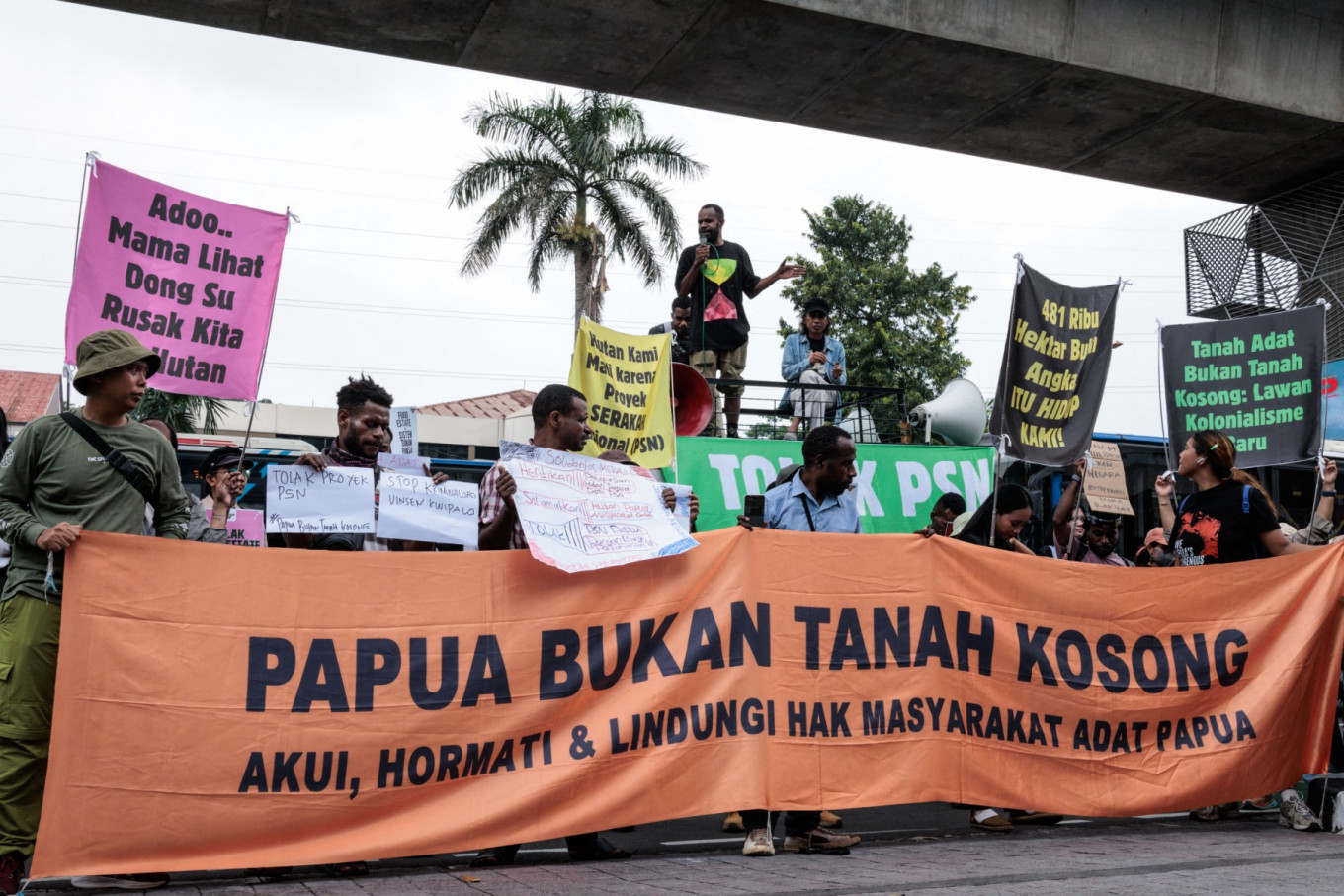 Demonstrators hold a banner reading “Papua is not vacant land” on Oct. 7, 2025, during a rally in front of the Agrarian and Spatial Planning Ministry office in South Jakarta against a plan to release forest areas in South Papua for national strategic projects (PSN) on food, energy and defense. (AFP/Yasuyoshi Chiba)
T
he government has designated the Wanam area of Merauke regency as an integrated satellite for National Strategic Projects (PSN). This zone merges national food reserve initiatives, via a large-scale food estate program, with palm oil and sugarcane-based agro-industrial bioenergy development.
Parallel to these economic endeavors, the state is establishing strategic defense industries in the region, including ammunition manufacturing facilities. This cross-sectoral integration is supported by expansive logistical infrastructure, such as the Wanam integrated port, irrigation networks, airport access, and a 130-kilometer corridor road connecting production centers in Wanam with maritime distribution nodes in neighboring Boven Digoel.
The Indonesian Military (TNI), in collaboration with state-owned arms producer PT Pindad, has anchored Wanam as a strategic defense hub through the construction of a 226-hectare soft (low) explosive manufacturing plant. Located in Ilwayab District, the facility is designed for an annual capacity of 1,250 tonnes of propellant and 170 million rounds of ammunition to advance national defense self-sufficiency.
Concurrently, the TNI is constructing a headquarters for the Territorial Infantry Battalion (Yonif TP). Groundbreaking ceremonies for both military installations took place in early this month.
Although these spatial plans were articulated as early as September 2025, following Coordinating Economic Minister Regulation No. 16/2025, which revised and expanded the list of priority state projects, no detailed planning documents were disclosed to the public prior to the groundbreaking day. Surrounding communities received no advance information regarding the ammunition plant’s construction, underscoring a deficit in public transparency within state strategic project governance.
This opacity is alarming given that the entire project footprint overlays customary lands belonging to Indigenous Papuans (OAP). The development directly disrupts the socio-economic and cultural fabric of local communities, threatening both fragile ecosystems and spiritual traditions while compromising physical safety. This top-down spatial integration effectively bypasses fundamental human rights and undermines the long-term sustainability of local populations.

Locating defense infrastructure on customary land directly violates Article 30 of the United Nations Declaration on the Rights of Indigenous Peoples (UNDRIP), which restricts military activities on indigenous territories unless justified by a relevant public interest or conditioned upon Free, Prior, and Informed Consent (FPIC).