TheJakartaPost
Please Update your browser
Your browser is out of date, and may not be compatible with our website. A list of the most popular web browsers can be found below.
Just click on the icons to get to the download page.


Popular Reads
Top Results
No results found. Please check your search term and try again
Can't find what you're looking for?
View all search results
Popular Reads
Top Results
No results found. Please check your search term and try again
Can't find what you're looking for?
View all search resultsMalaysian voters should not gamble with the country’s future
When faced with imperfect political options, Negeri Sembilan voters must choose steady reform over high-stakes experimentation, because a vote cast in frustration shouldn't gamble away the nation's stability.
Change text size
Gift Premium Articles
to Anyone
Share the best of The Jakarta Post with friends, family, or colleagues. As a subscriber, you can gift 3 to 5 articles each month that anyone can read—no subscription needed!
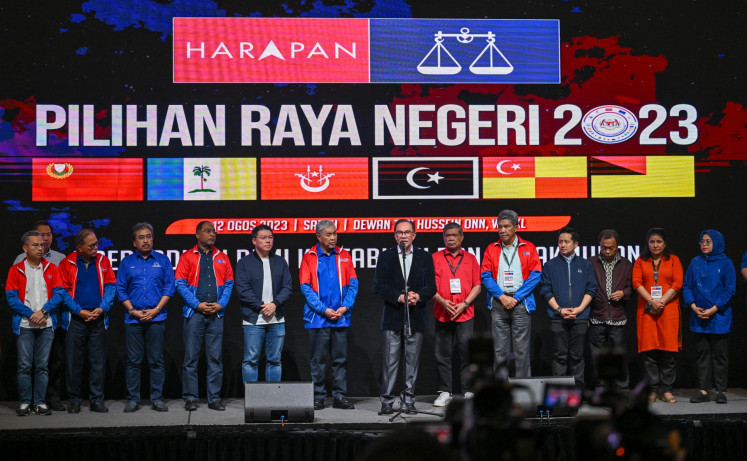
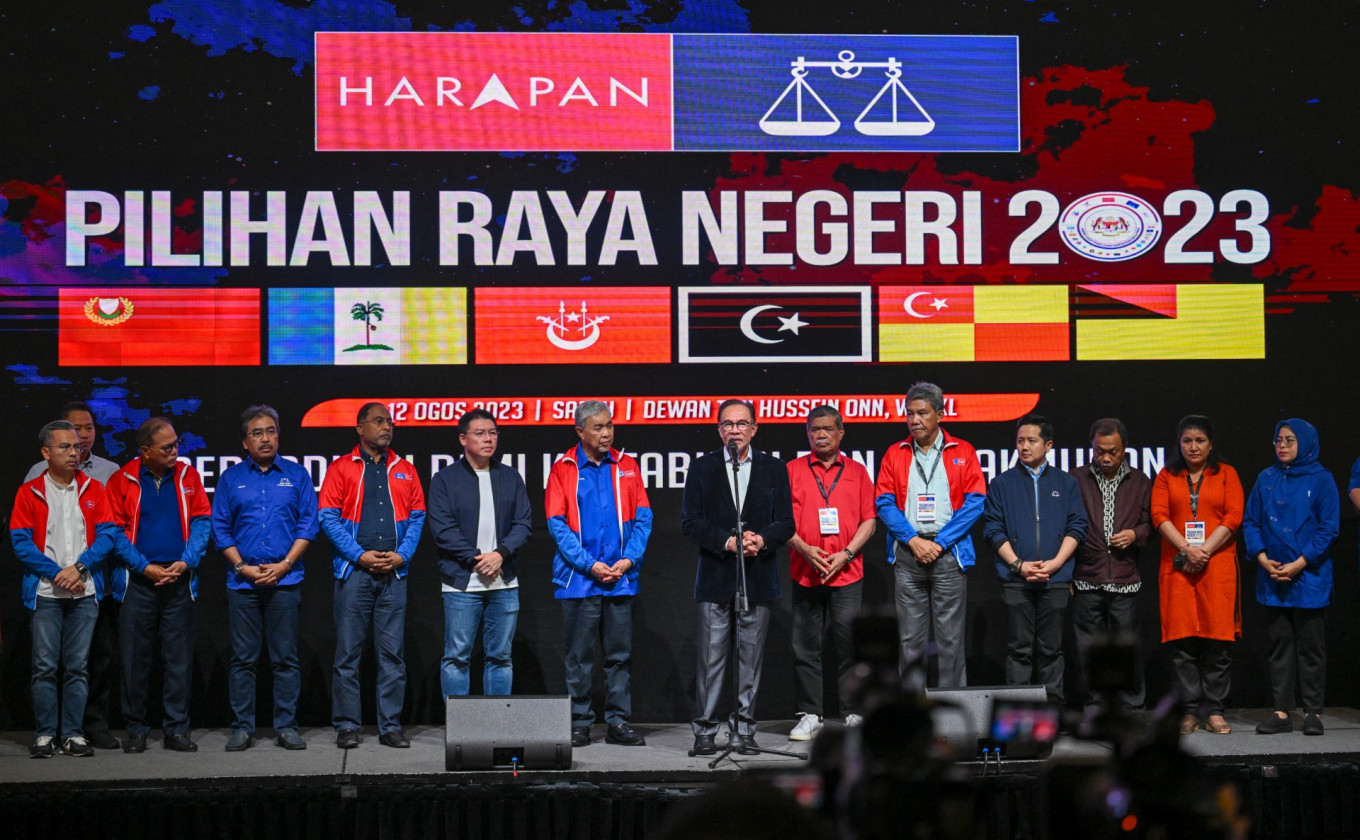 Malaysia's Prime Minister Anwar Ibrahim (center) speaks during a press conference after the release of state election results at the World Trade Centre in Kuala Lumpur on Aug. 12, 2023. (AFP/Mohd Rasfan)
A
s Negeri Sembilan approaches another defining state election this week, voters are confronted with a decision larger than the election itself. It is a choice between continuing along a path of gradual, if imperfect, reform, or embarking on yet another political experiment with uncertain consequences.
Every election naturally becomes a lightning rod for public dissatisfaction. Rising living costs, uneven economic recovery, bureaucratic inefficiencies, and governance shortfalls are genuine concerns that no responsible observer should dismiss. Governments must be held accountable, and Pakatan Harapan (PH), as the leading force in the Unity Government, deserves scrutiny where it has fallen short.
Yet accountability should not be confused with recklessness. The primary danger in Negeri Sembilan is not simply that voters might punish an incumbent administration, but that frustration could evolve into a willingness to gamble with the nation’s future without thoroughly scrutinizing the alternative.
Islamic political wisdom offers a timeless principle that remains remarkably relevant today: when confronted with two imperfect options, one should choose the path of lesser shortcomings rather than embrace greater uncertainty. This concept is rooted in the practical understanding that governance is rarely about achieving absolute perfection; rather, it is about minimizing harm while maximizing public welfare.
Politics is fundamentally the art of managing imperfection. Every government inherits old problems and creates new ones. Every coalition harbors internal disagreements. Every administration makes mistakes. The true measure of a government is not whether flaws exist, but whether those flaws remain manageable within a constitutional and democratic framework.
Seen through that lens, the situation in Negeri Sembilan deserves careful reflection.

The Unity Government has restored political stability after years of extraordinary turbulence. Since 2018, Malaysia has weathered repeated changes in leadership, shifting parliamentary alliances, and prolonged policy uncertainty. Businesses delayed investments, markets adopted a wait-and-see posture, and ordinary citizens grew weary of endless political maneuvering. For the first time in recent years, Malaysia has a genuine opportunity for continuity.