The Jakarta Post
Please Update your browser
Your browser is out of date, and may not be compatible with our website. A list of the most popular web browsers can be found below.
Just click on the icons to get to the download page.


Popular Reads
Top Results
No results found. Please check your search term and try again
Can't find what you're looking for?
View all search results
Popular Reads
Top Results
No results found. Please check your search term and try again
Can't find what you're looking for?
View all search resultsBuilding institutions for Indonesia's solar push
Provinces know their own resources, their needs and their communities in ways no minister in Jakarta can.
Change text size
Gift Premium Articles
to Anyone
Share the best of The Jakarta Post with friends, family, or colleagues. As a subscriber, you can gift 3 to 5 articles each month that anyone can read—no subscription needed!
 Set as preferred source
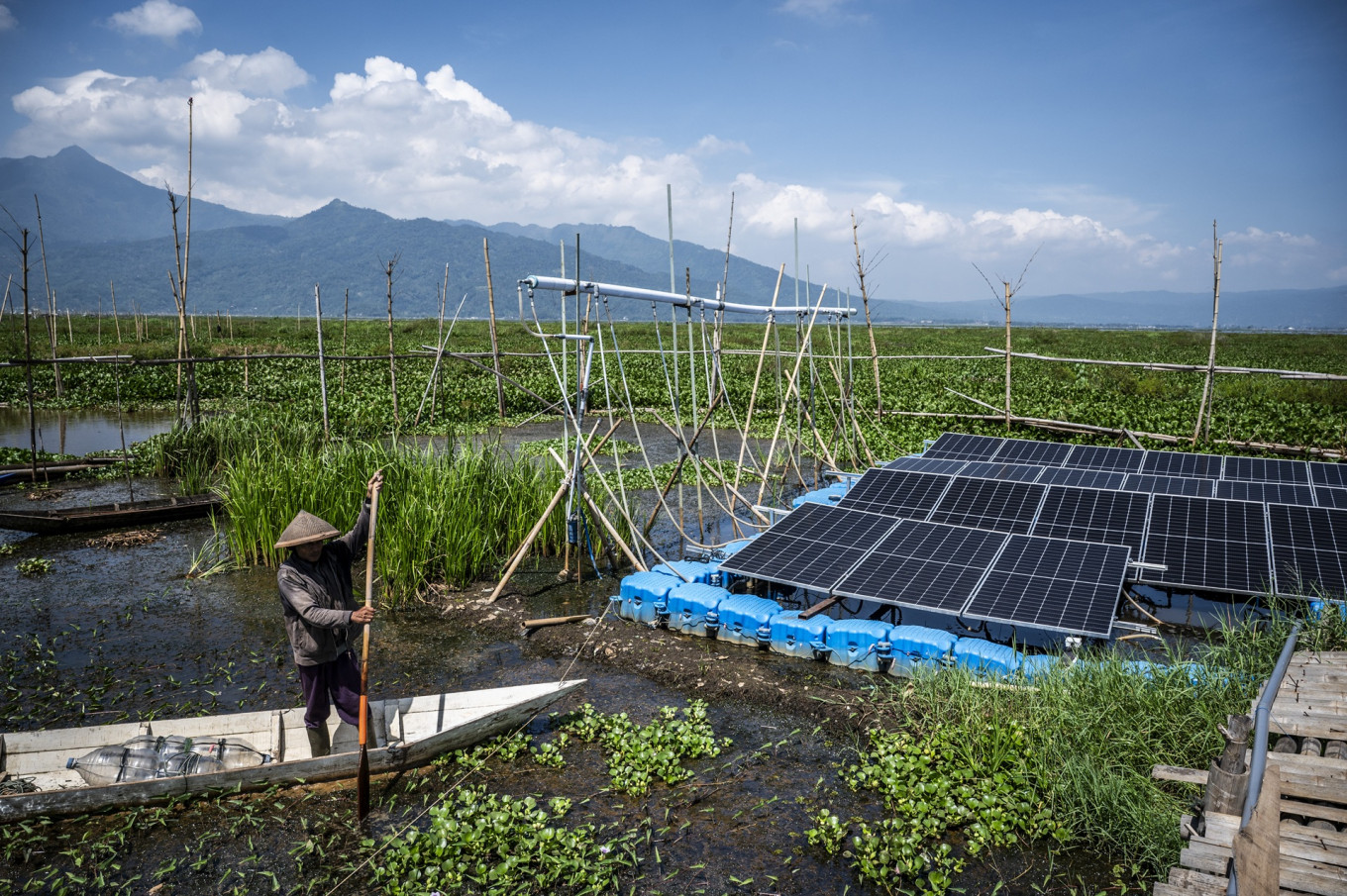 A farmer stands on a boat passing through solar panels installed as part of the Rawa Pening floating solar photovoltaic plant on Oct. 12, 2025, in Tuntang, Semarang regency, Central Java. (Antara/Aprillio Akbar)
P
resident Prabowo Subianto has set a target of 100 GW of solar power within two to three years, building on the 100 GW ambition the previous administration announced last year. Under the initial plan, 80 GW of decentralized solar, a 1 MW each will go into 80,000 villages, each paired with a 4-MWh battery energy storage system (BESS) to keep supply steady. The remaining 20 GW will come from centralized, utility-scale solar.
Reintroduced amid the Strait of Hormuz crisis, the program is meant to do far more than extend electricity supply for the Red and White Cooperatives (KDMP). By swapping diesel for solar and storage and adding large-scale and rooftop capacity, it aims to strengthen energy security, cut our reliance on imported fuel, and push jobs and investment out to provinces far from Java, meeting the energy transition goal. For the first time, energy security, economic development and climate action are not being pursued through separate strategies, but through a single one, delivered as a single program.
The harder question is whether Indonesia can build the institutions and the delivery machinery to match an ambition this large. Right now, of the 80,000 planned village cooperatives, only about 1,000 are actually operating, and none has installed solar power yet. Set that against everything the country has committed to, from the roughly 17 GW of solar in state utility PLN's electricity supply business plan (RUPTL) to the 100 GW it is aiming for, and the gap is daunting.
The technology, frankly, is the easiest part: buy the cheapest reliable panels, learn by doing and follow established practice. Implementation is the hard part.
This program reaches across several ministries and a crowd of investors, manufacturers, financiers and lenders. It has to land in more than thousands of cooperatives spread over 500-plus regencies and cities in 38 provinces. Pulling that off will take a world-class program management office (PMO) at the national level, and equally capable delivery teams in each of the 38 provinces, planning and executing their own solar targets.
India's National Solar Mission is something we can learn from. Launched in 2010, it later adopted a 100 GW solar target that many wrote off at the time as fanciful. A decade on, India is one of the world's largest solar markets, not because it has the best sunshine, the cheapest panels or the lowest bids, but because it built institutions that could deliver at scale.

A single dedicated agency managed the project pipeline, unlocked financing and ran standardized procurement. Most importantly, it held policy on a straight line through every election and every bout of upheaval. Over time that consistency drew in an entire ecosystem of vendors and stakeholders, all pulling in the same direction.