The Jakarta Post
Please Update your browser
Your browser is out of date, and may not be compatible with our website. A list of the most popular web browsers can be found below.
Just click on the icons to get to the download page.


Popular Reads
Top Results
No results found. Please check your search term and try again
Can't find what you're looking for?
View all search results
Popular Reads
Top Results
No results found. Please check your search term and try again
Can't find what you're looking for?
View all search resultsThe long game: Why politics, not evidence alone, drives welfare reform in Indonesia
Democratic governments can pursue long-term improvements without abandoning politically salient commitments to social welfare.
Change text size
Gift Premium Articles
to Anyone
Share the best of The Jakarta Post with friends, family, or colleagues. As a subscriber, you can gift 3 to 5 articles each month that anyone can read—no subscription needed!
 Set as preferred source
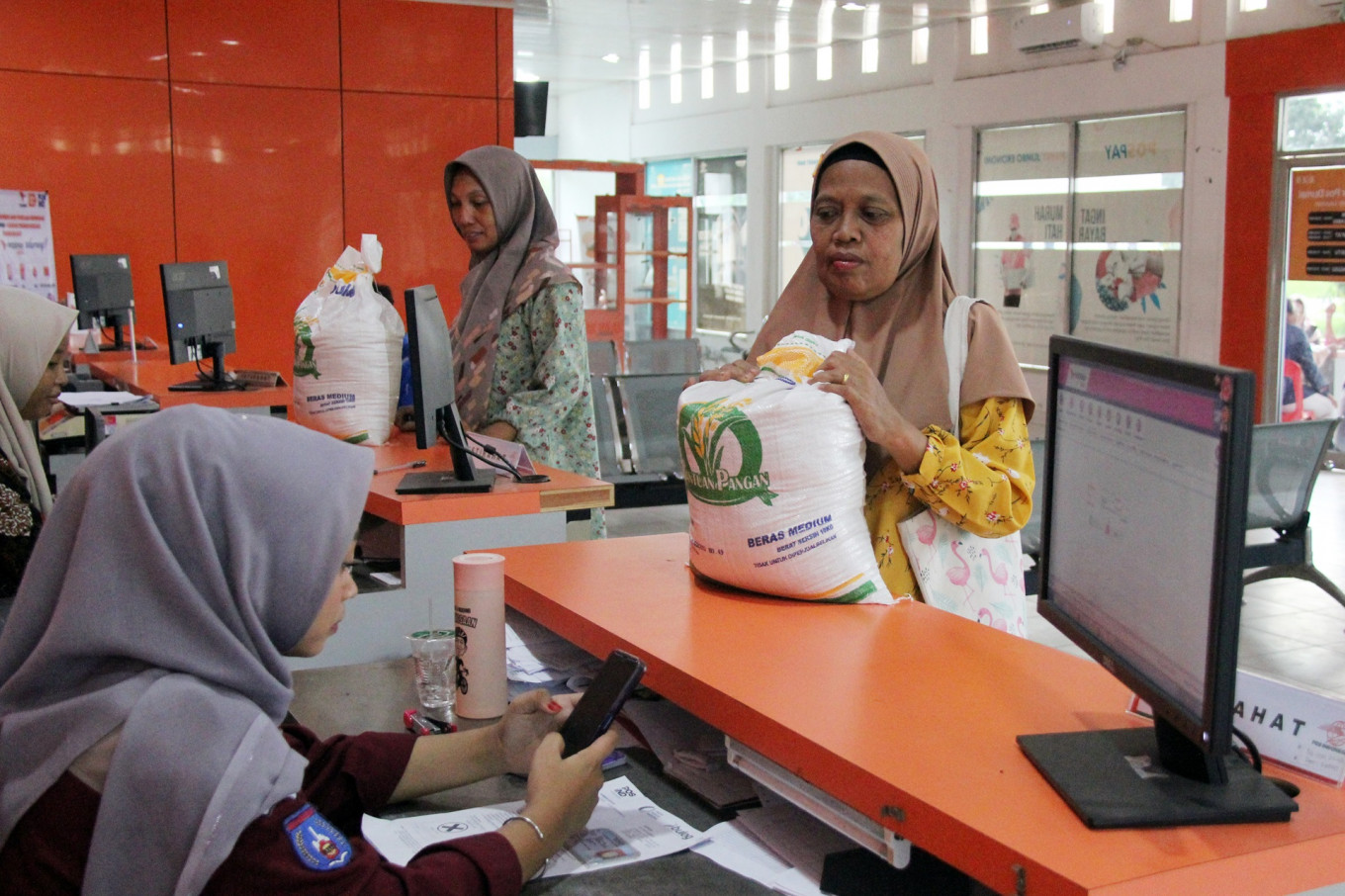 A social aid recipient (right) receives a sack of rice from the government's food reserves distribution program at the Dumai Post Office in Riau on Oct. 29, 2024. (Antara/Aswaddy Hamid )
A
cross Southeast Asia, governments face a familiar challenge: Voters reward policies that provide immediate and visible benefits, while long-term development requires reforms whose gains may take years to materialize.
The tension between democratic responsiveness and developmental effectiveness is frequently portrayed as a trade-off. Indonesia’s 24-year transformation of its food assistance system suggests a more nuanced story.
In 1998, Indonesia created an emergency rice distribution program, in nine weeks, in the middle of economic collapse and political transition. It was improvised, imperfect and immediately popular. The program was also intended to be temporary. But it developed into Raskin, rice for poor families, and ran for 15 years. Raskin was a subsidized rice transfer program aimed at the poorest 40 percent of households. Beneficiaries purchased rice at a heavily subsidized price. However, studies repeatedly found that beneficiaries received less than their official entitlement, sharing benefits among non-eligible households, and facing irregular delivery schedules. Nevertheless, Raskin survived.
Why? Because millions of Indonesian families depended on it, and no government wanted to be the one that took rice away from the poor. Technical shortcomings alone rarely determine whether a program survives. Raskin had become a visible symbol of state support for low-income households and a politically sensitive program that successive governments were reluctant to alter. Reform carried the risk of being portrayed as reducing support for the poor, making even well-evidenced alternatives difficult to advance.
It was not until the 2014 presidential election that reform was implemented: the government replaced subsidized rice distribution with digital cash transfers, a program known as Non-Cash Food Assistance (BPNT). However, the reform was not because of the overwhelming evidence, which had been known for years. It happened because the 2014 election created a political opening that allowed years of policy experimentation, evidence generation and coalition-building to translate into reform.
A team of economists, development practitioners and policy reformers, centered in the National Team for Acceleration of Poverty Reduction (TNP2K), had spent years developing, piloting and evaluating digital transfer alternatives. They had the evidence, but what they lacked was the political backing.

In the years before the reform, TNP2K and its partners invested heavily in building the foundations for change. Earlier initiatives, including the introduction of Social Protection Cards (KPS) in 2013, improved beneficiary targeting and demonstrated how evidence-based adjustments could strengthen program delivery. Reformers also developed improved beneficiary databases, tested digital delivery systems, and generated evidence on alternative approaches. These efforts ensured that a viable policy alternative was ready when the political opportunity emerged.
However, the shift from Raskin to BPNT was not a clean break. Reformers were careful to preserve the symbolic commitment to food support, and program recipients could still use their digital vouchers to buy rice, among other staples.
While the mechanism of the program changed, the political promise it carried did not. This was strategic. By protecting the core commitment to food support, reformers neutralized the most powerful argument against change, that the government was abandoning the poor.
The reform illustrates how democratic governments can pursue long-term improvements without abandoning politically salient commitments to social welfare. As a result, the government was able to deliver support to the same households more efficiently, with less leakage, more beneficiary choice, and better targeting, while remaining politically viable. The lesson is that successful reform can work within political constraints.
Indonesia’s experience is not unique. Across Southeast Asia, governments manage programs that are politically entrenched but suboptimal. Similar dynamics can be seen in debates over fuel subsidies, agricultural support and other welfare programs across the region, where governments often understand the limitations of existing policies but face substantial political barriers to change.
The lesson from Indonesia is that reform coalitions need to do two things simultaneously: build the evidence and institutional capacity for alternatives during stable periods and be ready to move when political transitions create openings. The timing of the reform matters as much as the content of reform.
BPNT later evolved into Program Sembako, expanding the range of food items available to beneficiaries and reflecting a broader focus on nutrition. Yet the reform process remained incomplete, and implementation challenges persisted. This matters because Indonesia is now embarking on another major social policy initiative.
The current government’s flagship free nutritious meal program was launched in 2025 with evaluation mechanisms still evolving and amid growing debate over implementation challenges and fiscal sustainability.
Unlike BPNT, which followed years of experimentation and preparation, the free meals program has been rolled out rapidly as a flagship political commitment. The risk is familiar: a politically popular program, launched at scale, without the accountability architecture needed to learn from and correct early failures. Indonesia has been through this before. Whether it applies the lessons of its own reform history to the free meals program remains to be seen.
The standard argument about democracy and development frames them in tension: democratic pressure for short-term benefits slows the long-term reforms that drive growth.
Indonesia’s experience suggests that democracy and development need not be opposing forces. Democratic transitions can create opportunities for reform, but only when governments have invested in the evidence, institutions and coalitions needed to act when those opportunities emerge.
For Southeast Asian countries seeking both economic progress and accountable governance, the challenge is not merely to design better policies, but to be ready when politics makes reform possible.
---
The writer is a public policy and political science researcher at the University of Melbourne, Australia. This article is part of a special series to mark this year’s Southeast Asia Oration hosted by Asialink and Asia Institute, University of Melbourne, with support from the ASEAN-Australia Centre.