The Jakarta Post
Please Update your browser
Your browser is out of date, and may not be compatible with our website. A list of the most popular web browsers can be found below.
Just click on the icons to get to the download page.


Popular Reads
Top Results
No results found. Please check your search term and try again
Can't find what you're looking for?
View all search results
Popular Reads
Top Results
No results found. Please check your search term and try again
Can't find what you're looking for?
View all search resultsThe dollar's outer defenses have been breached
The puzzle of why the Trump administration is so concerned with a falling yen has historical parallels not to the 1930s or the 1980s, but to the 1960s, when US officials feared that a crisis elsewhere could spread to America. With US bond yields spiking, Treasury Secretary Scott Bessent is getting desperate.
Change text size
Gift Premium Articles
to Anyone
Share the best of The Jakarta Post with friends, family, or colleagues. As a subscriber, you can gift 3 to 5 articles each month that anyone can read—no subscription needed!
 Set as preferred source
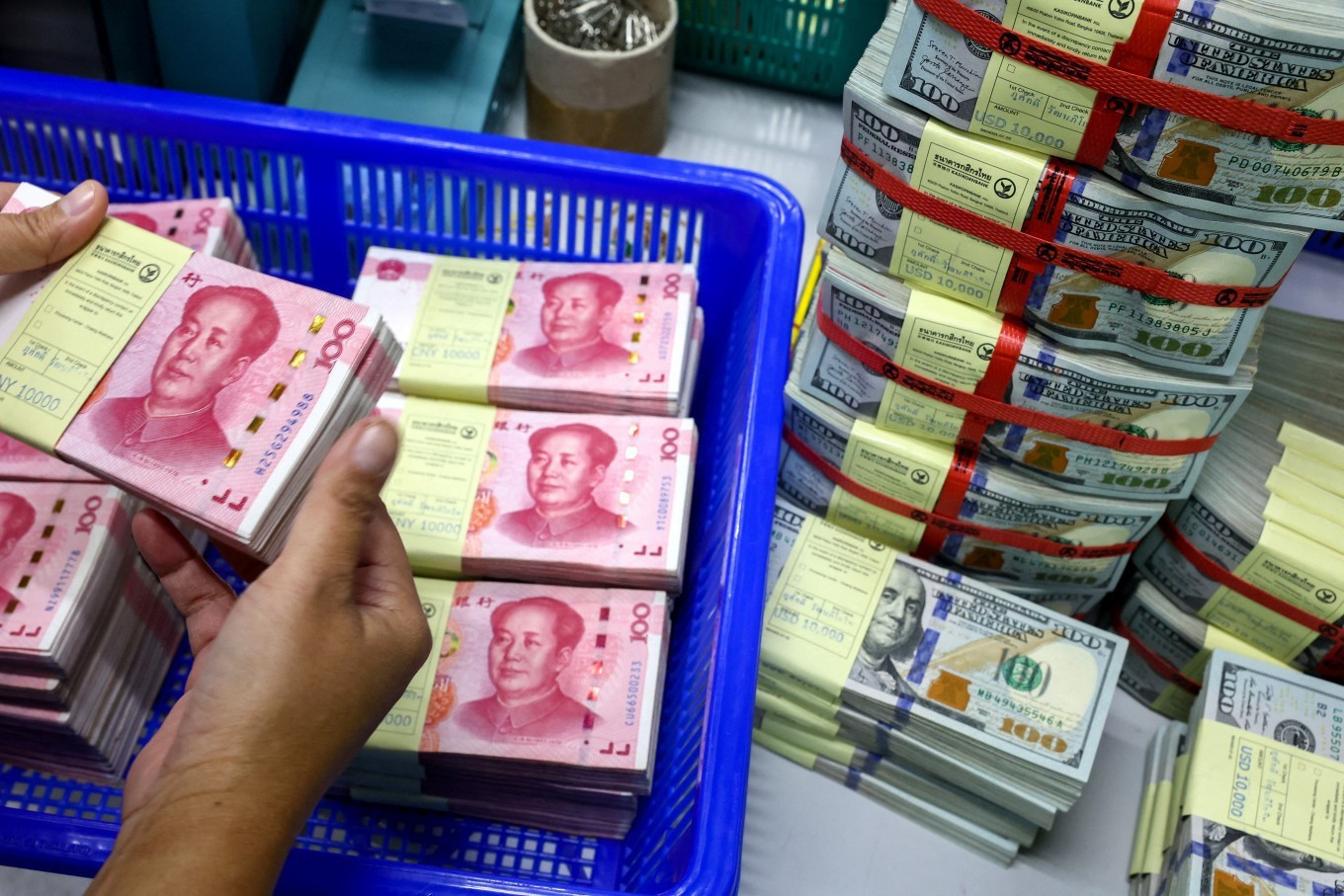 A bank employee counts Chinese renminbi notes next to United States dollar bills on Jan. 25, 2023, at a Kasikornbank branch in Bangkok. (Reuters/Athit Perawongmetha)
I
n a Reuters photo from late July, United States Treasury Secretary Scott Bessent can be seen holding a to-do list with just one item: purchase US$5 billion to $10 billion worth of yen. As he explained soon thereafter, invoking the famous phrase that then-European Central Bank president Mario Draghi used to save the euro in 2012, US President Donald Trump’s administration will do “whatever it takes” to prop up the Japanese currency.
Bessent’s public rationale for this surprise intervention was that the yen is undervalued, and that the US does not want to see a round of currency wars in which countries try to prop up their exports by undervaluing their currencies. Such conflicts do carry a powerful historical echo, given their role in destroying the world economy and threatening international peace in the 1930s. The victorious Allied powers organized the 1944 Bretton Woods Conference precisely to prevent the kind of protectionism and currency wars that had produced World War II.
But currency wars did return in the 1980s, when a surging dollar led Americans to believe that the yen (along with Germany’s Deutsche mark) was undervalued. These suspicions then generated much academic research into whether currency interventions are effective. The overwhelming consensus was that they are not. A single intervention might move the markets for a short time, but in the longer run, economic fundamentals will reassert themselves and market pressures will return. The only enduring solution is to alter existing policy regimes.
Both in the 1980s and now, a Japanese effort to address underlying fundamentals would involve higher interest rates and perhaps also a fiscal contraction, with the US simultaneously lowering interest rates and issuing less debt (implying its own fiscal contraction). But neither side is likely to undertake such measures. Japanese Prime Minister Sanae Takaichi has made it clear that she thinks interest rates are high enough; and barring a dramatic economic downturn, lower US rates would only fuel stock-market exuberance and inflation concerns.
Exactly as economic theory would suggest, the yen has already started to fall again since its immediate post-intervention surge. More and more interventions will be needed to achieve Bessent’s desired exchange-rate effect, but markets will treat them with increasing skepticism. Since everyone knows how interventions play out, they are typically reserved for dramatic market situations. Not since the Fukushima disaster in 2011 has the US sold yen, and not since the height of the 1997–98 Asian financial crisis has it bought yen.
In any case, fears of currency and trade wars probably do not reflect the Trump administration’s real motive, considering that it has been openly following the 1930s playbook on tariffs. Nor should we believe Trump’s own explanation: that propping up the yen is a “signal of friendship” to a country that has “been very good to us, with the exception, of course, of Pearl Harbor.” Usually, the president’s measure of “friendship” is the trade balance, on the assumption that countries with a surplus must be taking advantage of the US. Yet US goods exports to Japan in 2025 totaled roughly $82.1 billion, while imports from Japan reached $149.8 billion.

For his part, Bessent has rather oddly mentioned other undervalued currencies alongside the yen, including the South Korean won and the Chinese renminbi. But if he cares about these currencies, too, he should support a big international currency reordering, a reworking of Bretton Woods. In reality, Bessent and Trump’s only genuine motive is to help the US. In its August intervention, the US Treasury sold euros rather than dollars because it wanted to make clear that it would not approve of Japan (or anyone else) offloading US Treasuries.