The Jakarta Post
Please Update your browser
Your browser is out of date, and may not be compatible with our website. A list of the most popular web browsers can be found below.
Just click on the icons to get to the download page.


Popular Reads
Top Results
No results found. Please check your search term and try again
Can't find what you're looking for?
View all search results
Popular Reads
Top Results
No results found. Please check your search term and try again
Can't find what you're looking for?
View all search resultsWho gets to feel the state is ‘beside them’?
A capable state must do more than deliver programs, it must ensure that all citizens can hold power accountable and participate as equals.
Change text size
Gift Premium Articles
to Anyone
Share the best of The Jakarta Post with friends, family, or colleagues. As a subscriber, you can gift 3 to 5 articles each month that anyone can read—no subscription needed!
 Set as preferred source
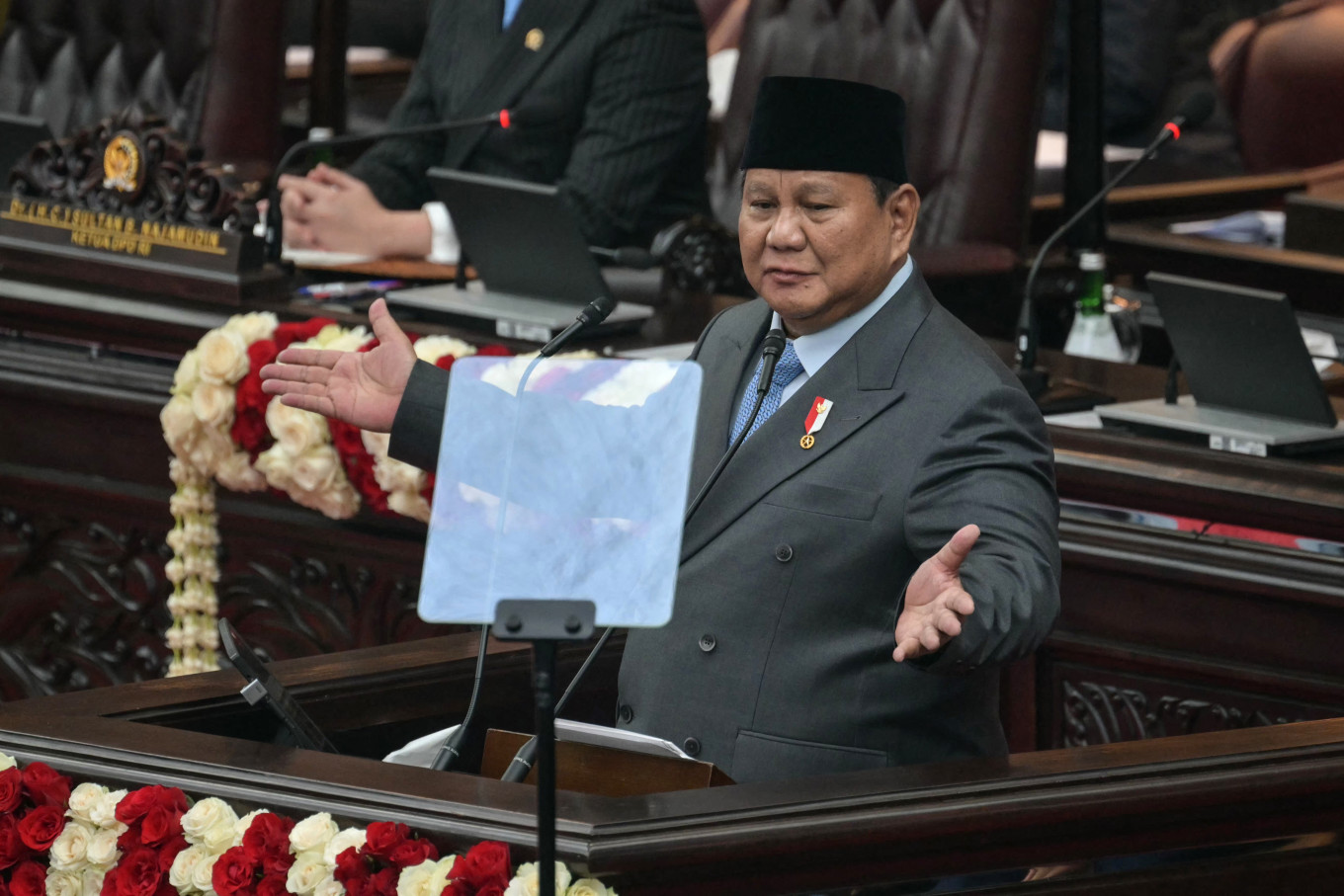 President Prabowo Subianto delivers his annual State of the Nation Address, ahead of the country's Independence Day celebrations, in Jakarta on Aug. 14, 2026. (AFP/Bay Ismoyo)
L
ast week, Indonesia celebrated 81 years of independence with grand ceremonies in Jakarta. Yet just two days earlier, a magnitude-7.7 earthquake struck Flores, East Nusa Tenggara, killing dozens and displacing thousands. The contrast is uncomfortable, but it raises a fundamental democratic question: What does it mean for citizens to experience the state as being “beside them”?
The question is central to President Prabowo Subianto’s State of the Nation address on Aug. 14. Prabowo argued that the republic was established so that people would never feel alone and would feel that the government was “beside them”.
Much of Prabowo’s speech highlighted the government's achievements, from providing free nutritious meals and schools, to cooperatives and economic growth. Throughout the speech, citizens appear primarily as beneficiaries of state action rather than as political agents who organize, disagree, challenge policies, scrutinize officials, defend rights and help determine state priorities.
This distinction matters; a state that is present for citizens is not necessarily a republic (res publica) in which citizens are present in the exercise and control of state power.
State capacity matters. But an effective government does not automatically produce democratic accountability. Democracy asks not only whether the state can deliver, but also whether citizens can meaningfully influence what it delivers, how decisions are made and how power is exercised. This becomes especially important when citizens encounter state institutions as sources of precarity.
For many indigenous communities, for example, the state appears less as a protector than as an institution entangled in competing claims over land and natural resources. The Alliance of Indigenous Peoples (AMAN) reported 135 cases of customary-territory dispossession in 2025 alone, affecting 109 communities with 162 people experiencing violence or criminalization. The issue is not simply who owns a particular piece of land, but whether indigenous communities are recognized as rights-bearing citizens with political agency over territories that sustain their livelihoods and identities.

The question extends beyond land. Indonesia remains a major country of origin for migrant workers, many of them women employed in domestic and care work. The International Labour Organization (ILO) noted in 2025 continuing problems with recruitment fees, unscrupulous intermediaries, debt and emerging forms of trafficking and exploitation.