The Jakarta Post
Please Update your browser
Your browser is out of date, and may not be compatible with our website. A list of the most popular web browsers can be found below.
Just click on the icons to get to the download page.


Popular Reads
Top Results
No results found. Please check your search term and try again
Can't find what you're looking for?
View all search results
Popular Reads
Top Results
No results found. Please check your search term and try again
Can't find what you're looking for?
View all search resultsSBY’s foreign policy legacy and the Democratic Party
SBY tenure marked a phase of both consolidation and a renaissance for Indonesia’s foreign policy.
Change text size
Gift Premium Articles
to Anyone
Share the best of The Jakarta Post with friends, family, or colleagues. As a subscriber, you can gift 3 to 5 articles each month that anyone can read—no subscription needed!
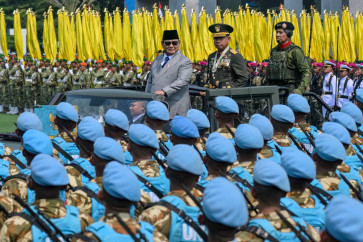
 Silvery glow: President Prabowo Subianto (left) and Democratic Party chairman Agus Harimurti Yudhoyono symbolically light an electric flame on Sept. 9, 2026 to open the party’s 25th anniversary celebration at the Indonesia Arena at the Gelora Bung Karno Sports Complex in Central Jakarta. (Antara/Tyo Pribadi)
S
usilo Bambang Yudhoyono (SBY)’s ten-year leadership (2004–2014) marked a phase of both consolidation and a renaissance for the Republic of Indonesia’s foreign policy on the global stage. Building upon post-reform domestic political stability and economic recovery, SBY shifted the pendulum of Indonesian diplomacy from an inward-looking orientation toward an active, structured, and confident international role, an outward-looking stance.
In the landscape of international relations studies, the strategic direction of diplomacy during the SBY era was guided by the principle of “navigating a turbulent ocean”. This metaphor reflects a profound geopolitical awareness that the international order is anarchic and fraught with uncertainty.
The imperative gains relevance when viewed through the lens of John Mearsheimer’s offensive realism. In The Tragedy of Great Power Politics (2001), Mearsheimer asserts that within an anarchic international system, great powers are naturally driven to maximize their power in pursuit of regional hegemony, a drive that inevitably triggers endless security competition. The rise of China and the strategic reorientation of the United States in the Asia-Pacific region held the potential to drag the region into a destructive clash of powers. These structural concerns align with the "Thucydides’ Trap" thesis popularized by Graham Allison in Destined for War (2017), a historical tendency for open conflict to erupt when an established hegemon (or ruling power) feels threatened by a rapidly rising power.
SBY rejected geopolitical fatalism. Indonesian diplomacy was directed toward mitigating this bipolar friction to ensure Southeast Asia was not reduced to a mere proxy battlefield. He formulated an “all-directions foreign policy” paradigm, guided by the operational credo of “a thousand friends, zero enemies”. This doctrine served as a middle-power instrument to flexibly position Indonesia at the epicenter of the global constellation, maintain a non-aligned stance, and prevent extreme polarization within the region.
Indonesia’s institutional response to the potential “Thucydides’ Trap” was realized through the doctrine of dynamic equilibrium. Rather than allowing the region to be dominated by a single polarity or a fragile traditional balance of power, Indonesia advocated for the inclusion of the United States and Russia in the 2011 East Asia Summit (EAS) in Bali. This move placed all major powers within an inclusive, rules-based multilateral architecture.
SBY’s leadership reaffirmed Indonesia’s natural position as a regional anchor within ASEAN. Indonesia oversaw the ratification of the 2007–2008 ASEAN Charter, transforming the association into a legal entity, and spearheaded the establishment of the ASEAN Political-Security Community (APSC) and the ASEAN Intergovernmental Commission on Human Rights (AICHR) to strengthen the region's centrality and strategic autonomy.

Indonesia’s capacity for peace diplomacy was put to the test when it defused military tensions along the Cambodia–Thailand border regarding the Preah Vihear Temple dispute in 2011. Acting as the ASEAN Chair, Indonesia spearheaded active mediation through shuttle diplomacy. This preventive maneuver succeeded in curbing the escalation of a regional armed conflict without compromising the fundamental principles of the “ASEAN Way.”