The Jakarta Post
Please Update your browser
Your browser is out of date, and may not be compatible with our website. A list of the most popular web browsers can be found below.
Just click on the icons to get to the download page.


Popular Reads
Top Results
No results found. Please check your search term and try again
Can't find what you're looking for?
View all search results
Popular Reads
Top Results
No results found. Please check your search term and try again
Can't find what you're looking for?
View all search resultsAnalysis: Agus’ balancing act: Criticizing power without leaving it
Change text size
Gift Premium Articles
to Anyone
Share the best of The Jakarta Post with friends, family, or colleagues. As a subscriber, you can gift 3 to 5 articles each month that anyone can read—no subscription needed!
 Set as preferred source
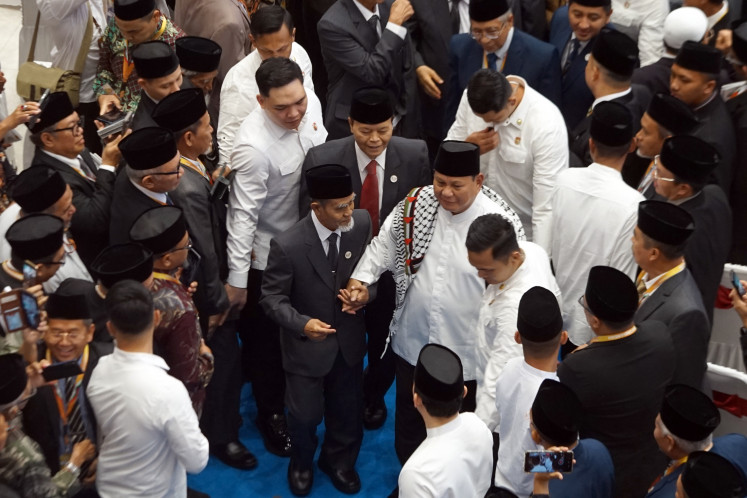
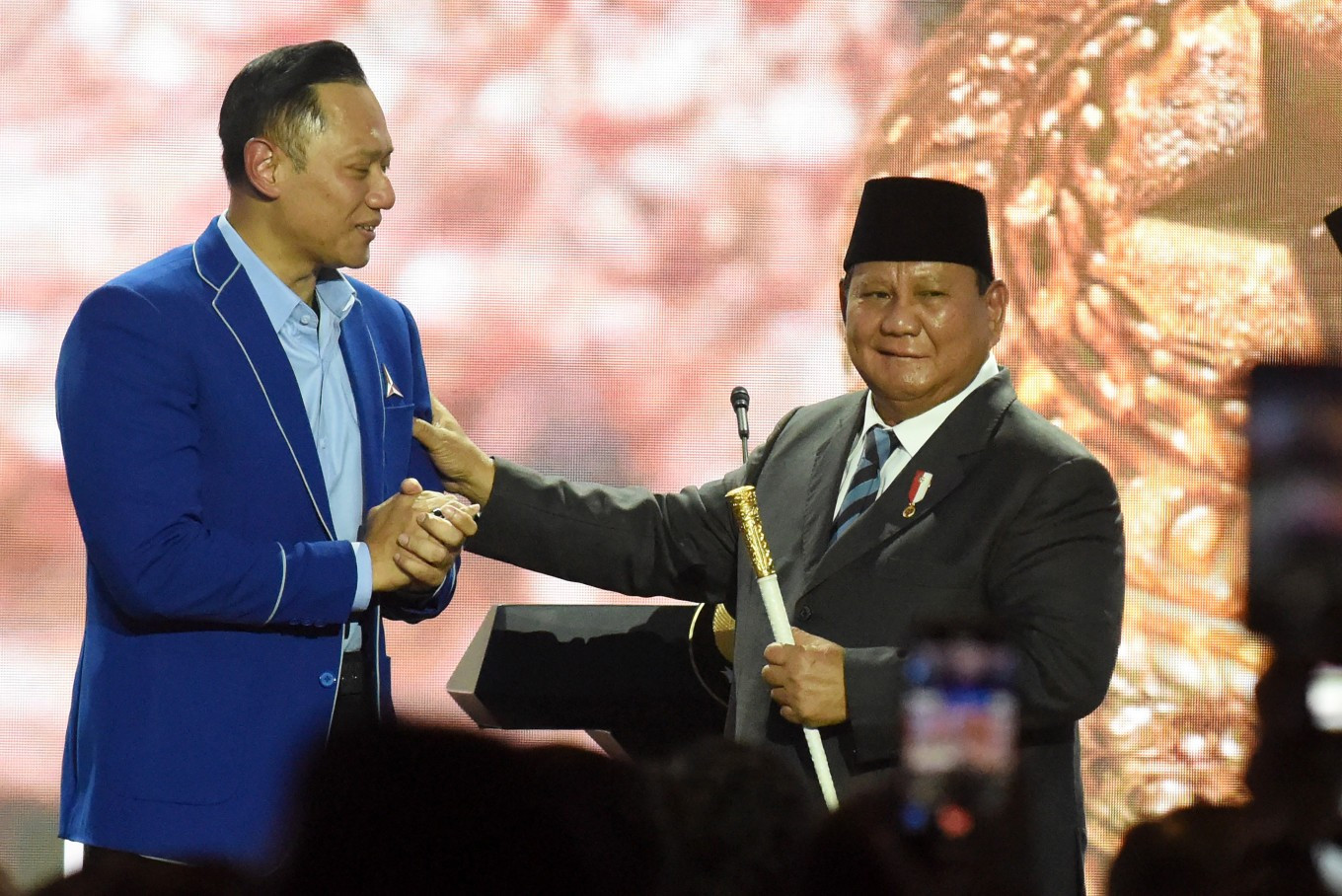 Democratic Party chairman Agus Harimurti Yudhoyono (left) hands a command stick to President Prabowo Subianto in Jakarta on Feb. 25, 2025, during the party’s sixth congress. ( Antara/Indrianto Eko Suwarso)
A
gus Harimurti Yudhoyono's recent political messaging can be interpreted as an attempt to achieve a delicate balancing act: positioning himself and the Democratic Party as a critical voice within government without crossing the line into outright opposition. It is a strategy born from both opportunity and necessity. For Agus, the political challenge is obvious. While he remains one of Indonesia's most recognizable younger politicians, he has not consistently appeared among the top-tier contenders in most discussions about the 2029 presidential election.
The dominant attention has largely been focused on figures with stronger executive credentials, deeper political machines or higher public popularity. If Agus hopes to become a serious presidential contender, maintaining the status quo is not enough. He needs greater visibility, a more distinct political identity and a narrative that separates him from the many parties supporting the government.
This helps explain the significance of his speech. Rather than offering unconditional praise for the administration, Agus appeared to emphasize themes of accountability, governance and the need for those in power to remain responsive to public concerns. The message was notable not because it represented a complete break from the government, but because it subtly challenged the perception that coalition parties must always defend the administration's every move.
The strategy serves multiple purposes. First, it allows the Democrats to reclaim part of their traditional identity as a centrist reformist party. Since joining the governing coalition, the party has enjoyed access to government but has also risked losing its distinctiveness. In a broad coalition dominated by larger political forces, smaller parties can easily become politically invisible. By adopting a more critical tone, the Democrats can remind voters that it possesses an independent voice.
Second, it helps 48-year old Agus personally. Indonesian presidential politics tends to reward leaders who appear decisive and independent rather than excessively dependent on existing power structures. If Agus is perceived merely as another coalition politician benefiting from office, his appeal may remain limited. If he can present himself as a leader willing to speak uncomfortable truths while still acting responsibly, his profile could improve significantly ahead of 2029.
The danger for Agus is that repeated efforts to distinguish himself could eventually be interpreted by coalition partners as positioning for a future campaign at their expense. If that perception grows, the Democratic Party could find itself marginalized in decision-making, deprived of influence or ultimately pushed toward the political sidelines. Even without formal expulsion from the coalition, a party can become isolated and lose much of the practical advantage that comes from being part of government.

Yet political history suggests that such an outcome may not necessarily be disastrous. The most relevant example comes from Agus’ own father, Susilo Bambang Yudhoyono (SBY). During the administration of President Megawati Soekarnoputri, SBY served as coordinating minister for political and security affairs. As tensions emerged between him and elements within the government, he increasingly appeared marginalized. His resignation and departure from the cabinet were widely interpreted as signs of political isolation.