The Jakarta Post
Please Update your browser
Your browser is out of date, and may not be compatible with our website. A list of the most popular web browsers can be found below.
Just click on the icons to get to the download page.


Popular Reads
Top Results
No results found. Please check your search term and try again
Can't find what you're looking for?
View all search results
Popular Reads
Top Results
No results found. Please check your search term and try again
Can't find what you're looking for?
View all search resultsBeyond naturalized glory
The historic FIFA ASEAN Cup triumph ended our 35-year trophy drought, but relying on naturalized stars exposes a youth pipeline that cannot afford to be left behind.
Change text size
Gift Premium Articles
to Anyone
Share the best of The Jakarta Post with friends, family, or colleagues. As a subscriber, you can gift 3 to 5 articles each month that anyone can read—no subscription needed!
 Set as preferred source
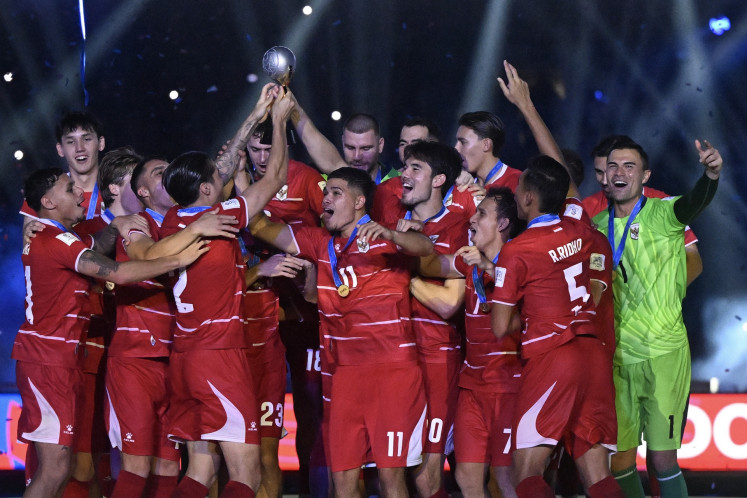
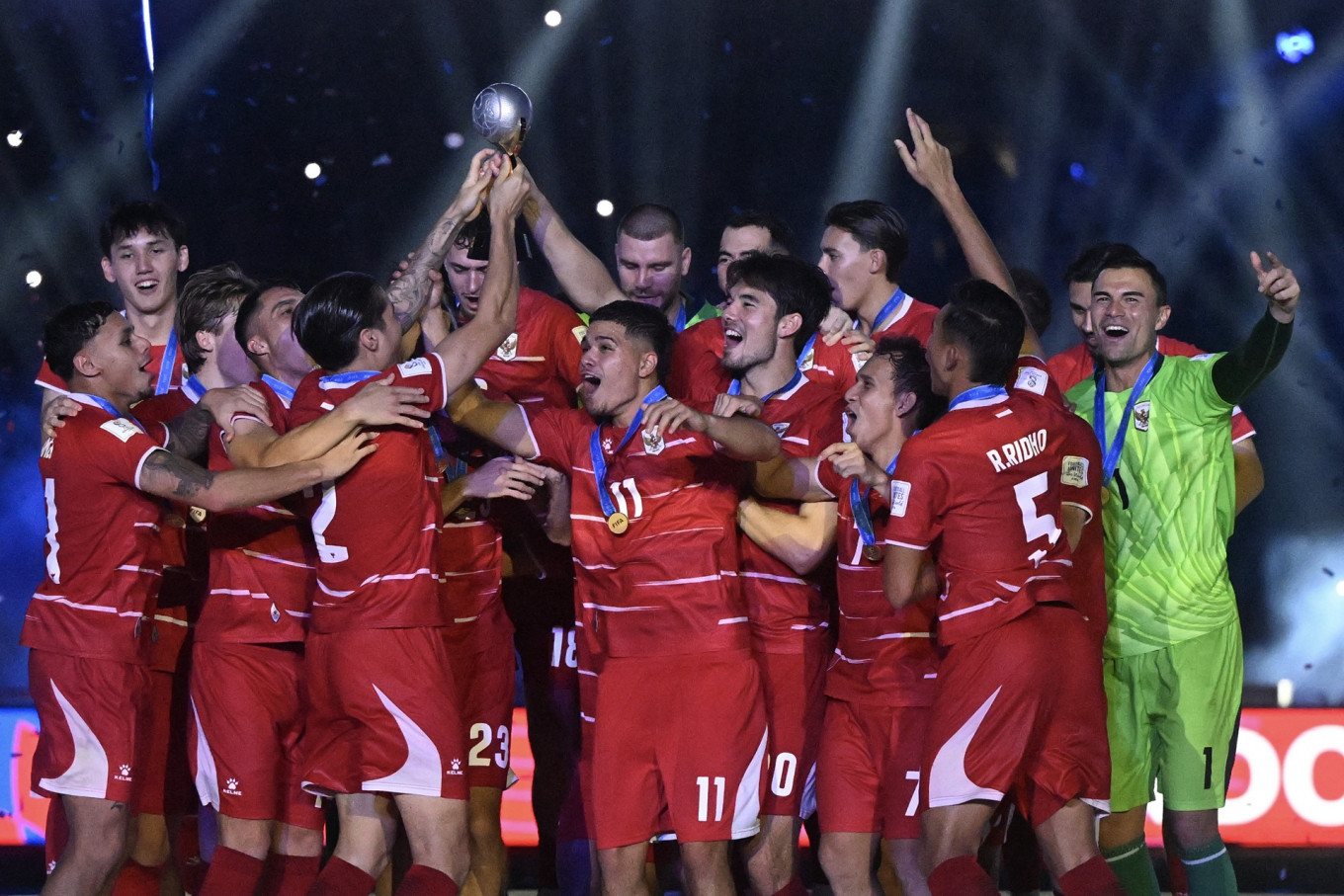 Indonesia's national men's soccer team players lift the FIFA ASEAN Cup 2026 trophy at the main Gelora Bung Karno (GBK) Stadium in Central Jakarta on Oct. 5, 2026. Indonesia won the inaugural FIFA-sanctioned competition after beating Thailand 4-2 on penalties with both teams tying 2-2 after extra times. (Antara/Rivan Awal Lingga)
I
ndonesia finally added some silverware to its soccer trophy cabinet, after capturing the inaugural FIFA ASEAN Cup on Monday, ending a 35-year title drought. The victory over Thailand, albeit decided on penalties, signals the resurgence of a regional heavyweight whose last major triumph dated back to the 1991 Southeast Asian Games.
As the nation celebrates this historic milestone, it brings into sharp focus the naturalization project launched roughly six years ago, a breakthrough policy that has paid significant dividends. Indonesia’s triumph almost certainly would not have materialized without overseas-born recruits, presenting a stark reality for a nation boasting millions of aspiring soccer players.
It is no exaggeration to state that the historic win at Gelora Bung Karno (GBK) Stadium hinged on the reliance on foreign-born players. Head coach John Herdman leaned heavily into an experienced, naturalized core across his starting 11, just as he did during the group stage, leaving only a handful of homegrown players on the bench.
Yet, even on home soil and fielding a squad largely plying its trade in European leagues, the Garuda labored to overcome a resilient Thai side. Thailand was reduced to 10 men in the final nine minutes of regulation time, yet still struck in extra time to lead 2-1 before the hosts leveled the score, eventually prevailing 4-2 in the shootout.
Regardless of critiques, a win is a win. Indonesia had spent decades desperate for a title to prove its mettle in a region where Thailand, and more recently Vietnam, routinely dashed its ambitions. Under Erick Thohir, the Indonesian Soccer Association (PSSI) has tapped heritage talent to transform the national squad into a formidable regional power. The pragmatic approach has delivered tangible progress, evidenced by Indonesia’s climb from 173rd in the FIFA rankings in December 2019 to 117th today, an inch closer to the target of breaking into the big 100 by end of this year.
The most compelling justification for this policy came during the 2026 World Cup qualifiers. While the team, under Patrick Kluivert, narrowly missed out on the final tournament, it restored national pride with a rare victory over Saudi Arabia and a hard-fought draw against Australia.

This surge in performance has ignited unprecedented domestic enthusiasm. A cheering crowd of 67,000 packed GBK Stadium for Monday's final, generating sold-out ticket gates, soaring broadcast figures and record merchandise sales. The broader public has largely embraced the pivot as well, as shown in a recent survey by Indikator Politik Indonesia which revealed that 71.5 percent of respondents endorsed the naturalization policy, with just 13.5 percent opposed.